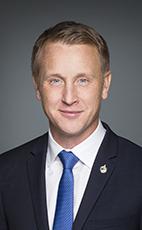
Chris Warkentin
Track Chris
- Get e-mail whenever he speaks in House debates
- Subscribe to feeds of recent activity (what you see to the right) or statements in the House
Your Say
Elsewhere
- His site
- On the Parliament site
- Twitter (and Twitter messages to him)
- Wikipedia
Crucial Fact
- His favourite word is first.
Conservative MP for Peace River (Alberta)
Won his last election, in 2011, with 75.80% of the vote.
Statements in the House
Natural Resources June 17th, 2013
Mr. Speaker, Canada is blessed to have the third-largest deposits of oil on the planet. Oil is a vital energy resource, providing one-third of global energy needs.
Canadian oil production is creating jobs and economic growth across Canada, and our government is currently fighting for Canadian jobs overseas by ensuring that Canada has access to markets.
To that end, I wonder if the Minister of Natural Resources can update the House on the lastest problems posed by the European fuel quality directive.
The Senate June 13th, 2013
Mr. Speaker, our government will not stop creating jobs for Canadians. We will not stop building a safer Canada. We will not stop promoting Canadian values around the world. We will not stop respecting law-abiding hunters and farmers. We will not stop standing up for Canada's north. We will not stop putting more money into the back pockets of hard-working Canadian families. But we will stop at stop signs.
First Nations Elections Act June 11th, 2013
Mr. Speaker, I appreciate the opportunity to clarify.
Obviously, the member has not read through the legislation because this provision within this legislation would allow for first nations to undertake a provision that they would have full control over. Under the circumstance that would be “a protracted leadership dispute [that] has significantly compromised [the] governance of [this] First Nation” then the minister could allow for the first nation to actually choose new leadership.
The minister would not make the choice. He would cede that responsibility to the first nation population. That is exactly what first nations folks are asking for. They are asking for the right to be empowered and the ability to make the choice for themselves as to whom they want to lead them forward. This is not a choice of the minister; it is a choice of the first nations people.
However, without this provision, all that is left is the requirement that we go back to the Indian Act, where it actually spells out a process for dispute resolution that is much more paternalistic. Therefore, it is important that we empower first nations to be the voice and to make the decision as it relates to their own future.
First Nations Elections Act June 11th, 2013
Mr. Speaker, we do envision an opportunity for independent and impartial appeals, and through the courts process that is exactly what is undertaken. That is what we as Canadians put our trust in, that those folks who serve in their capacity as judges and within the legal system can provide an impartial appeals process. We believe first nations should have the right to that as well.
First Nations Elections Act June 11th, 2013
Mr. Speaker, one of the things we have as a hallmark of our government, as it relates to first nations, is we do not believe that a one-size-fits-all solution works for first nations across the country. That is why we have built framework legislation that allows for a different reality in one community than possibly in other communities.
In this case, with regard to the Elections Act, we had strong recommendations from the Atlantic first nations and from Manitoba chiefs. They are asking for this legislation to move forward. They believe the provisions in this act would ensure they could move forward in a way that would better equip their communities. This is being asked for.
It is not a requirement that first nations move into this act; it is actually opt-in legislation. Therefore, those first nations that would desire to be under this act could move into it. Those that choose not to could continue under the current regime.
First Nations Elections Act June 11th, 2013
Mr. Speaker, it is a privilege for me to stand in this House today to speak to Bill S-6. I thank the hon. member for Lethbridge for sharing his time with me tonight. I am glad he is back in the House. I congratulate him for his contribution to the discussions tonight.
I serve as the chair of the aboriginal affairs and northern development committee, and over the last number of months we have been seized with a number of pieces of legislation that I believe are important to equip and empower first nations to move forward on a number of fronts.
Today, we have the opportunity in the House to continue a discussion on an important piece of legislation that will transform and modernize the elections of first nations, those first nations that choose to be empowered by this act. It is not an act that is being placed on first nations if they do not want it, but they have an opportunity to opt in if they want.
That is what is unique about our government. We are a government that recognizes that first nations are different. From one part of this country to another, first nations are as different from coast to coast to coast as communities are different from coast to coast to coast. It is important that we do not put a one-size-fits-all solution on folks from every part of this country and that we let first nations communities create their own environment to move forward in the way that best supports their priorities.
That is unlike the Indian Act. I think everybody in this House can agree that the Indian Act is an outdated piece of legislation that has lived out many parts of its usefulness. However, it obviously has a great amount of history and it would take some time to move us out of that.
I respect the fact that members are calling for an overhaul and a complete turning of the page. We can recognize as we look from one issue to the other with regard to the Indian Act that there are first nations that have different ideas as to how to move into the future. It is important that we give each community the ability to be empowered, so that they are able to articulate a vision for the future that would reflect the interest and the desires of first nations membership within their communities. That is different in every community.
The Indian Act does spell out issues surrounding elections in first nations communities. I just note that the last time this portion of the Act was updated was sometime in the 1950s.
A lot has changed between now and then. It is important to reflect on the thinking at that time. When they were revamping the Indian Act in the 1950s, it should be noted that the rules as they related to elections were really geared toward holding first nations governments accountable to the minister, rather than holding first nations leadership accountable to their electorate or to their members.
The bill goes a great distance in rectifying this. I think it is so important that we work together collaboratively to see this legislation move forward.
It has been articulated by the member for Saanich—Gulf Islands that we move forward with a complete overhaul of the Indian Act, but even in the discussions that led up to the change in this portion, just in the issue of elections, there are different visions and different ideas from one part of this country to the next. It is important that we bring forward legislation that provides options for first nations. That is exactly what this legislation does.
However, we do it in a pragmatic way, not in a way that may have a lofty goal without ever being implemented. We have a policy right now that will really create opportunities for those first nations that do want to move forward on this.
We have been undertaking a number of things that will give rights to first nations that they have been limited to receiving in the past as a result of the Indian Act.
Members will reflect on the fact that it was our government that in 2008 repealed section 67 of the Canadian Human Rights Act. It finally gave first nations people living on reserve the right to recognition under the human rights act. First nations communities had been waiting decades for that. Unfortunately, the Indian Act had separated them from the right that most Canadians enjoy and take for granted. That was one of the things we did.
Just recently, we extended matrimonial real property rights to first nations women to protect families and those people who were vulnerable in first nations communities.
We are continuing to bring the rights that most Canadians take for granted to those people who live on reserve.
The legislation continues the process of giving rights to first nations people, the same type of rights that other Canadians have come to expect and take for granted. Unfortunately, those rights have not been there for first nations and this bill would go a great distance in providing first nations with additional rights.
I should note that approximately 240 first nations across the country undertake their elections according to sections 74 through 79 of the Indian Act. This regime is not satisfactory for a number of reasons, the least of which is it imposes two year term limits on the time which chiefs and councils can serve in office.
Those of us in elected positions know that two years is really not enogh time for us to become equipped to serve in the capacity of our roles and to take a mandate and try to get it completed, then to continue that and have any type of stable governance in any community. A two-year time limit gives enough time for MPs to learn the basics of our job and then immediately be thrust back into an election campaign. That is not a sustainable structure for governance. Anybody in the House, when reflecting upon it, would say that a two-year term limit is really unreasonable for any elected official, and first nations people should have the right to extend it if their community so desires.
It has been recommended by the Atlantic Policy Congress as well as the Assembly of Manitoba Chiefs that the term limits be extended to four years. This is now articulated within the legislation. When we consider the recommendations that came from these two organizations, it makes a lot of sense.
A two-year term limit barely gives enough time for MPs to get trained in their jobs before they are running for re-election, but there are other practical reasons as well.
A two-year term limit is difficult for a new council, especially those people who have run for election for the first time. A new council would find it very difficult to build the necessary relationships to move their communities forward within two years.
One of the most important things that a local council can do is build relationships with neighbouring jurisdictions, with other municipalities or neighbouring government organizations. There is a limited opportunity as well to build relationships with financial organizations and with those people who might want to invest within these communities. This two-year extension is very important.
We believe very strongly in allowing first nations to build an environment within their communities where they will be able to foster an opportunity for the private sector to invest in their communities. Extending the term to a four year limit will allow these first nations communities to have a stable council, a stable government that will be able to negotiate and build an environment so private investment is undertaken within their communities. This would lead to opportunity, prosperity and hope for people who live in these communities, leading to better education, better health care and better outcomes generally.
Prohibiting Cluster Munitions Act June 11th, 2013
Mr. Speaker, I appreciate my colleague's thoughtful speech. It was actually a reflection on what exactly has happened. Obviously Canada was one of the first countries to sign on to the convention.
Canada has undertaken its responsibility the way that Canadians would expect: that it be responsible and be a proactive member in ensuring that these types of things are dealt with in the international community.
There are two things I would like to have the parliamentary secretary reflect on. First, I would like her to reflect on Canada's history when it comes to these particular munitions.
Second, I would also like the parliamentary secretary to reflect on what our allies are doing. Obviously we have heard members opposite wax eloquent on different aspects of the problems with these types of munitions. I am wondering how Canada's response resembles what has been done by other countries, such as the United Kingdom and Australia.
The Economy June 7th, 2013
Mr. Speaker, I wonder on what exact date the Leader of the Opposition travelled to Alberta to deliver his now infamous Dutch disease speech. I am wondering if he can confirm that he personally approved of that text and, I wonder, did his principal secretary Karl Bélanger pen any of those remarks. I wonder if the Parliamentary Secretary to the Minister of the Environment can confirm that our government will not set up a $21-billion taxpayer-funded super secret slush fund, which the NDP has so strongly advocated for.
Yale First Nation Final Agreement Act June 6th, 2013
Mr. Speaker, there have been consultations with respect to Bill C-62, an act to give effect to the Yale First Nation Final Agreement and to make consequential amendments to other acts.
Before I propose the motion, I want to thank the official opposition and all members of this House who have been working in co-operation to move expeditiously in advancing this legislation to implement the Yale final agreement.
I move:
That, notwithstanding any standing order or usual practices of this House, Bill C-62, An Act to give effect to the Yale First Nation Final Agreement and to make consequential amendments to other Acts be deemed concurred in at the report stage and deemed read a third time and passed.
Safe Drinking Water for First Nations Act June 6th, 2013
Mr. Speaker, I can tell the hon. member that the money was spent on water systems for first nation communities across this country.
We do know that the vast majority of that went into infrastructure. We know there is an infrastructure deficit across this country. Unfortunately, that was something our government inherited, something we take seriously. Therefore, we have implemented an aggressive strategy to build an infrastructure system to ensure there is clean drinking water.
When we build these systems we also have to have a regulatory regime to ensure that we address the people who are running these systems, the protocols in terms of drawing source water and a number of other aspects. I am not a water expert, but I understand there is a whole complex necessity for regulation to ensure clean drinking water. I think the Canadian taxpayer needs to be assured that the $3 billion that has been placed into infrastructure thus far would not be compromised by a lack of regulation.