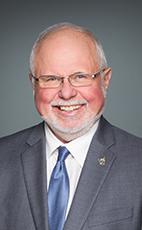
Mr. Speaker, I should point out right off the bat that you were one of my team members yesterday, and thanks to your efforts, our team won. Thank you, Mr. Speaker. It was a pleasure to serve with you on that team.
I had the honour of being elected in this House nine years ago this October. I was elected in 2010 with a minority government; again in 2011, five months after my first win, with a majority government; and then again in 2015. I have experienced being a member of a minority government, a majority government, and the opposition. I have had the honour of spending a lot of time in Centre Block. Over a nine-year career, I have been very fortunate.
Why does a person enter politics? Quite simply, it is to make a difference.
My political transformation from a wet-behind-the-ears, know-nothing teenager to a budding Conservative actually started in 1968. We lived in Winnipeg. I am of Czechoslovakian descent, and we were part of a small Czech community in Winnipeg. What happened in 1968 is the Soviets invaded Czechoslovakia. Our family took in refugees from Czechoslovakia. That gets a person thinking about the power of government and how government can be a force for evil, but if a person works hard enough, it can be a force for good.
Of course, being a Czech, we are made fun of a lot. I have been called a bouncing Czech, a cancelled Czech, a blank Czech. As long as I am not a phony Czech, I will be okay.
As the evolution of my political thought moved along, I bought a farm south of Riding Mountain National Park. I had a dream of becoming a farmer, living off the land, building a log house back in the woods, all that kind of stuff.
What went through my mind were the opportunities that this country offers. If people take risks, they can fail, but they can also succeed.
I am a Slavic person, as my mom was born in Poland. Slavic people like me have an inordinate fondness for property rights. We are visceral when it comes to owning our property. As I looked at the world around me, I could see that there were forces out there that were basically threatening my way of life and the way of life of all other property owners, and I do not just mean farmers; I mean people who have built something with their lives and how important that is to them. When government gets in the way of that, that is simply evil. People need a free society and the ability to take risks.
What comes with a free society? It is is personal responsibility. I get a little tired when people talk about crime statistics all the time. I will be quite blunt: It is as if it is my fault when somebody commits a crime.
Personal responsibility lies within the individual, so as I recite these characteristics, what political party would someone possibly join? It's the Conservatives, of course. These are the things that we stand for.
I represent a large rural area of 66,000 square kilometres. Dauphin—Swan River—Neepawa is one of the most beautiful places in Canada. My community is very diverse, with ranchers, farming, forestry, hunting, trapping, oil exploration and so on, yet with all that resource development, it remains an extraordinarily beautiful place.
Actually, conservation is one of the major activities of the communities in my constituency. People are harvesting trees in their day job, and then in the evening working with their fisheries habitat group to repair streams. Those are the kinds of people who are in my constituency, and I get very angry when people like that are attacked. Whether it is the animal rights movement, environmental extremists or people who want to take their firearms away, I get angry. We are not supposed to get angry in this job, but I simply could not help it. The injustice of what happened when those good people got attacked made me even more determined to defend that particular way of life.
I think we have a number of colleagues here who do exactly the same thing. I am very proud to be a colleague of members such as the member for Red Deer—Lacombe, the member for North Okanagan—Shuswap and the member for Bruce—Grey—Owen Sound.
I have been on the farm of the member for Bruce—Grey—Owen Sound. I would defy any environmentalist to go to his farm and see anything that he is doing wrong. He gently manages the land. He looks after it. He looks after the wildlife and cares about the world. The member for North Okanagan—Shuswap was the president of the B.C. Wildlife Federation and the member for Red Deer—Lacombe has a fisheries background just like mine, so Conservatives have absolutely nothing to apologize for in terms of our conservation ethics.
We are the people who actually get things done. Who negotiated the acid rain treaty? Brian Mulroney did. Who negotiated the ozone treaty? Brian Mulroney did. When I hear all this environmental stuff, all I know is that Conservatives can be very proud of our contributions to conservation.
I did not travel as far as my friend from Chatham-Kent—Leamington. I stayed at home and spent all my time on the fisheries and environment committees, and I very much enjoyed that. We had some very contentious bills to deal with such as Bill C-69, Bill C-68, CEAA 2012 and so on. I have to say, though, that I really enjoyed my time on the fisheries committee, because believe it or not, it worked across party lines. It is a very collegial group, and most of the reports were unanimous. I see the chair of the fisheries committee here, and I want to thank him for his efforts on behalf of Canada's fisheries.
Getting back to the constituency itself, what can I say about constituents? They place their faith in us. Nothing touches me more than when people I do not know comes up to me and says that they voted for me. Is that not something? We have all experienced that, because we cannot know everybody in our constituencies.
I want to thank my EDAs and the volunteers, of course. The late Jeff MacDonald was a mentor to me, as was Bob Lepischak. I thank all those people who worked so hard: the fundraisers, the EDA and so on.
What can I say about my family and my darling Caroline? I know she is watching—hello, darling. She was my best political adviser. As I said before, she is a spouse who praised me when it was required and made sure I knew what I was doing wrong when that was required as well.
Caroline texted me earlier. She was out today planting tomatoes in the garden. She is what we call a “bush chick”, which is a term that I use with the greatest respect. She lives in the woods and knows how to do things.
Tony and Marsha are our kids, and their spouses are Lainee and Graham. We have three absolutely beautiful grandchildren, Eden, Senon and Esmee. One of the reasons I will be heading out is to spend time with the three grandchildren on the farm. They love the farm. They love taking the guts out of a duck, cleaning a fish, driving a quad and doing all those things with papa.
I want to thank my brother and sister, Tim and Joyce, for their support over the years. I also thank the neighbours. Those who live in rural areas know how important neighbours are. When my wife Caroline is by herself on the farm, I know the neighbours are there for her. That is a very important fact.
I want to thank my mom and dad, Joe and Ida Sopuck. They have sadly passed on. They were both born in eastern Europe, dad in Czechoslovakia and mom in Poland.
I want to thank my mentors. They include Alan Scarth, an environmental lawyer from Winnipeg, who is a deeply philosophical man who helped me; Ted Poyser, who was chief of staff to Duff Roblin—and I am going to talk about Duff in a minute; Charlie Mayer, whom many members know, as he represented part of my area; and the sainted Harry Enns, who was the longest-serving MLA in Manitoba's history.
Harry gave me some really political advice. He said, “Robert, my boy, there are two things a politician never passes up: a chance to give a speech and a chance to go to the bathroom.” When one has a constituency as big as I do, one knows where all those spots are. I will leave it at that.
I thank my Ottawa staff Branden and Alex, who are in the office now, as well as Duncan, Brett, Jay, Dan, Olivier, Kyle, and the constituency staff Judy, Janell, Megan, Grace, Nellie and Valerie. I am sorry to go so fast, folks, but I do not have time to stop.
I really want to thank the House of Commons staff, the security staff and the bus drivers. They are salt-of-the-earth folks. As the member for Battle River—Crowfoot said, I was there in October when Parliament Hill was attacked, and we can never forget that these people will take a bullet for us. They deserve all of our respect.
I want to end by thanking my colleagues all around the House. I made friendships that will last for years. The value of the team is so important. I especially want to thank the Manitoba caucus, the member for Brandon—Souris, the member for Selkirk—Interlake—Eastman, the member for Portage—Lisgar and the member for Provencher for their help and support and indeed love over the years.
I too want to talk about what it was like to serve under Prime Minister Harper, who, as history will show, was one of the greatest prime ministers this country has ever seen.
It has been an honour and a privilege to serve with all members on all sides of the House as I end my political journey.