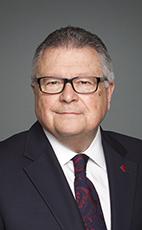
Ralph Goodale

House of Commons photo

Track Ralph

Your Say

Elsewhere

Crucial Fact

  • His favourite word is year.

Liberal MP for Wascana (Saskatchewan)

Won his last election, in 2011, with 40.80% of the vote.

Statements in the House

Questions on the Order Paper May 10th, 2013

With regard to government communications: (a) for each news release containing the phrase “Harper government” issued by the Economic Development Agency of Canada for Quebec Regions since February 6, 2006, what is the (i) headline or subject line, (ii) date, (iii) file or code number, (iv) subject matter; (b) for each news release mentioned in (a), was it distributed (i) on the website of the Economic Development Agency of Canada for Quebec Regions, (ii) on Marketwire, (iii) on Canada Newswire, (iv) on any other commercial wire or distribution service, specifying which service; and (c) for each news release distributed by a commercial wire or distribution service mentioned in (b)(ii) through (b)(iv), what was the cost of that service?

Statistics Canada May 9th, 2013

Mr. Speaker, the government is wasting $32,000 tax dollars every day to spy on the media and its own backbench. It wastes another $95,000 tax dollars on every government ad during hockey games. It vandalized the census and it now costs $25 million more to get less data. In 43% of Saskatchewan, it is a total failure. They have lost the town of Davin altogether and so Davin loses its municipal funding. Will the government compensate Davin for this Conservative ideological stupidity?

Employment May 9th, 2013

Mr. Speaker, the U.S., Japan, Australia, Sweden and other countries are all expecting economic growth better than Canada. Young Canadians especially are falling behind. There are 212,000 fewer of them who are working today than before the recession, 404,000 are looking for jobs, and this paranoid isolated government wastes $23 million, $32,000 every day, to spy on the media and its own backbench. For that spy money, the government could have triggered 7,600 summer jobs. Why did it not do that?

Taxation May 6th, 2013

Mr. Speaker, the Canadian economy has doubled in size over the past 30 years but median household income has grown only by 13%. Middle-class Canada is falling behind and Conservatives are making it harder by imposing more and more middle-class taxes, small business taxes, payroll taxes, new tariff taxes on everything from cancer wigs to the kitchen sink. We cannot blame the Chinese. They do not impose these taxes and they do not pay them. This is a made-in-Canada Conservative attack on the middle class and all those trying to get there. Why?

Taxation May 6th, 2013

Mr. Speaker, in budget 2013 the government increases taxes on middle-class Canadians by close to $2 billion every year. For example, on page 335, the Conservatives take $550 million more every year from the profits of small business owners. On page 289, there is a recurring payroll tax hike of another $600 million every year, an escalating, job-killing Conservative tax on every job in this country.

Why does Conservative tax policy attack the middle class and all those who are working so hard to join the middle class?

Taxation May 3rd, 2013

Mr. Speaker, in budget 2013, on page 384, the Conservative government imposes $333 million per year in new Conservative taxes on consumer goods. On page 335, we see $550 million per year in new Conservative taxes on small businesses. On page 289, there is another $600 million per year in payroll taxes. That is not to mention taxes on credit unions, safety deposit boxes and more.

There is close to $2 billion in new Conservative taxes on middle-class Canadians every year. Why?

Taxation May 3rd, 2013

Mr. Speaker, in their last four budgets Conservatives have increased taxes on middle-class Canadians by billions and billions of dollars.

Conservative tax increases on small businesses hurt the middle class. Conservative tax increases on payrolls hurt the middle class. Conservative tax increases on consumer goods hurt the middle class.

Specifically, why does budget 2013 increase Conservative taxes on middle-class Canadians by nearly $2 billion every year?

Economic Action Plan 2013 Act, No. 1 May 2nd, 2013

Mr. Speaker, with respect to the timing issue here, obviously it is unfortunate when debate in the House is curtailed by the use of time allocation or closure. That impinges upon the democratic right of members of Parliament to adequately consider matters that are before the House.

I look at the calendar on the table before you, Mr. Speaker, and it properly identifies today as May 2. The budget was presented on March 21. It has been well over a month since the budget was presented and yet the legislation to implement a portion of it has only been put before the House in the last couple of days. It seems a bit unusual for the government to move so expeditiously to bring time allocation to the discussion of the budget when it has had well over a month to put the legislation before the House.

I would like to ask the minister a very specific question. He has said the subject matter will go to a variety of committees; that may be useful. Would he go the further step and make sure that the House has the opportunity to vote on each one of the subject heads separately so that we are not confronted with one omnibus vote at the end of it all where we have to vote on soup to nuts all together at once, thus defeating the principle of proper democratic--

Petitions May 2nd, 2013

Mr. Speaker, I have a petition to file today on behalf of a number of people in Saskatchewan, particularly students at the University of Saskatchewan, who are expressing their concern about the treatment of a Canadian citizen, Bashir Makhtal, who is presently imprisoned in Ethiopia.

The petitioners are expressing concern about how the Canadian government can pay better attention to the circumstances of this individual.

Economic Action Plan 2013 Act, No. 1 May 1st, 2013

Mr. Speaker, at that time, Canada's debt ratio was in excess of 70%. In other words, the size of the federal debt was in fact 70% of Canada's entire GDP. The IMF was knocking on the door, just as they are doing today in a number of European countries. The IMF was knocking on Canada's door back in the 1990s, and it required significant action.

The changes in transfer payments made at that time were, in fact, temporary. By the time of the budget in 2002, the level of transfer payments to the provinces had been entirely restored, and they went on to all-time record levels with the changes made to equalization and the changes made to the health transfer in the budgets of 2004 and 2005. I am proud to say that I was the finance minister at that time who took those federal transfer payments to the highest level ever in history, up to that point in time.