
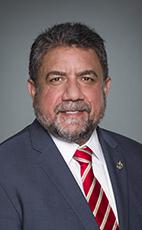
Sukh Dhaliwal

House of Commons photo

Elsewhere

Crucial Fact

  • His favourite word was conservative.

Last in Parliament March 2011, as Liberal MP for Newton—North Delta (B.C.)

Lost his last election, in 2011, with 31.50% of the vote.

Statements in the House

The Budget March 25th, 2011

I will begin by praising you, Mr. Speaker, and other retiring members of Parliament for your collective contributions to Canadian democracy. Democracy forms no part, however, of this now dying Conservative government.

The budget had nothing for families, very little for seniors, crumbs for students, tax cuts for mega corporations and, most importantly, no new ideas. It hides the real cost of prisons and jets. By not giving this information and these figures to Canadians, the government has shown arrogance and ethical breaches.

Canadians will decide a better way: a true north, strong and free, government on this side.

Questions Passed as Orders for Returns March 21st, 2011

With regard to programs begun after 2005 to “support Canada's softwood industry, including fighting the spread of the pine beetle in western Canadian forests and helping communities struggling from U.S. softwood duties”, as stated on page 19 of the 2006 Conservative Party of Canada's Federal Election Platform, for each program: (a) what is its name; (b) what funds were allocated to it; (c) what funds for the program were announced in government press releases; and (d) what funds will it have spent between 2005 and 2011?

(Return tabled)

Political Financing March 11th, 2011

Mr. Speaker, the government does not seem to get it. Two MPs, the former Conservative whip and the former House leader received back over $15,000 of taxpayer money through this fraud.

Yesterday, the Prime Minister said, “you win some, you lose some”. The Conservatives have clearly lost and it is time they returned this dirty money.

Will the Prime Minister order that these tax dollars be returned immediately?

Political Financing March 11th, 2011

Mr. Speaker, in British Columbia, 12 Conservative ridings were part of the in and out fraud. Six sitting MPs were part of a scheme to break the law. One of them is the President of the Treasury Board, the person in charge of spending taxpayer dollars.

How could the minister have gone along with this fraud? Did he not know this was wrong?

B.C. Premier Designate March 1st, 2011

Mr. Speaker, I rise today to personally congratulate my dear friend, Christy Clark, for becoming British Columbia's premier designate this past Saturday.

I also want to congratulate the other leadership candidates, Michael de Jong, George Abbott and my close friend Kevin Falcon, who all ran with integrity, pride, honour and vision.

Having known and worked with Christy for many years, I have great confidence in and admiration for her intelligence, tenacity and the new brand of politics that she hopes to bring to the province of British Columbia.

Christy, as a working mother, knows first-hand the challenges Canadian families face in this economy, and what can and must be done so that British Columbia can remain one of the top five provinces in the world to live. I know she will be a fantastic leader and I am proud to call her my personal and close friend.

I ask all members to join me in congratulating Christy.

Strengthening Aviation Security Act February 1st, 2011

Mr. Speaker, it is a privilege to speak to Bill C-42, Strengthening Aviation Security Act. I worked on this bill as a member of the Standing Committee on Transport, Infrastructure and Communities last fall.

Everyone recognizes that the world changed forever on September 11, 2001. Security procedures across the board have tightened from an unprecedented commitment to prevent such terrorism from ever happening again. Yet we must not sacrifice our freedom or our privacy in this battle. The previous Liberal government ensured that we maintained this balance as we must today.

One response in the United States was the secure flight program, which requires airlines to submit passenger information to the U.S. government prior to boarding. The information could include: name, date of birth and gender, passport data and flight information. It is then run against a watch list and passengers are approved or rejected for boarding or receive additional screening.

Secure flight has been in effect for all U.S. bound flights for some time now and the American government is now seeking to extend it to overflights, such as when a flight goes from Vancouver to Mexico by flying over the U.S. Bill C-42 would allow airlines to transmit the information required to comply with secure flight to the United States government.

I am deeply disappointed that the Conservative government was unable to secure an exemption for Canadian flights in its negotiations with the Americans. Why could the government not convince them that the Canadian security screening standards already ensure the safety of our flights? It is not as if we are a lawless nation that is unknown to our American cousins.

Nevertheless, there is a hard truth about this debate. The crux of the issue is that the American government has jurisdiction over its own airspace. If it requests this information, it is within its rights under international law.

However, that does not mean that we roll over. Our duty as Canadian parliamentarians is to ensure that Canadian interests are protected. In committee, we did just that and introduced key amendments to defend Canadian travellers.

First, we required that travellers be notified that their personal information will be transmitted to the U.S. government. Strangely, the only thing requiring passenger notification in the first draft of the bill was an American law. That simply was not good enough for Canadians.

Second, we required that this bill be reviewed in two years and every five years thereafter. Times change and priorities change. We should not lock in these rules without recourse. Perhaps a different government will be better able to give the Americans confidence in our own security screening procedures.

Third, we have restricted the transmission of passenger data to the United States alone. The Conservatives wanted to open the doors willy-nilly for any other country to receive Canadians' private data in the first draft of this bill. We will not give legislative consent to sharing of our personal information to third world despots.

Those amendments would ensure that the legislation is able to secure Canadians' privacy, at least within Canadian legislation.

The real challenge is not in our laws but in the practices of the American government. There are still significant concerns that can only be addressed to diplomacy.

Earlier, the hon. member for Western Arctic said that this bill would do nothing to protect the privacy of Canadian passengers. First, the passenger data transmitted will be subject to the United States patriot act. This has been confirmed by our Privacy Commissioner. This means that this information can be used and shared for other purposes than the aviation security, such as immigration and law enforcement authorities at home and abroad. That was a key concern for some of the witnesses who came before the committee.

The Privacy Commissioner also confirmed that non-residents would have very little protection or recourse with respect to their personal information. In other words, it is American rules and policies that remain a serious cause for concern. In particular, they must strengthen the procedures for the management of passengers and improve the redress program for passengers who wrongly end up on the no-fly list.

The Conservative government rode into power five years ago claiming that it would bring our relationship with the Americans--

Strengthening Aviation Security Act February 1st, 2011

Mr. Speaker, there are still some significant concerns about this bill that can only be addressed through diplomacy.

The passenger data transferred will be subject to the United States patriot act. This has been confirmed by the Privacy Commissioner. This means that this information can be used and shared for purposes other than aviation security, such as immigration law enforcement authorities at home and abroad.

Does the hon. member or his constituents have concerns about this issue?

Strengthening Aviation Security Act February 1st, 2011

Mr. Speaker, I heard the member for Edmonton—St. Albert mention the exemption for flights originating and ending in Canada. However, my constituents of Newton—North Delta and I are deeply disappointed that the current Conservative government was unable to secure an exemption for all Canadian flights in its negotiations with the Americans.

Through you, Mr. Speaker, why could the government not convince them that Canadian security clearance standards already ensure the safety of our flights?

Protecting Canadians by Ending Sentence Discounts for Multiple Murders Act February 1st, 2011

Madam Speaker, the bill is in fact very balanced. On one side it gives powers and resources to judges to make decisions on multiple murders and whether they should be giving sentences as consecutive or concurrent. By including consecutive sentences as part of our law through this bill it would provide a balance to the system.

Protecting Canadians by Ending Sentence Discounts for Multiple Murders Act February 1st, 2011

Madam Speaker, I am pleased to stand once again to speak to Bill C-48, which has now reached third reading and is close to realizing the vision of the member for Mississauga East—Cooksville whose private member's bill inspired its content.

As I have spoken about many times over my five years in this House, my colleague and I have been pushing for an end to automatic concurrent sentences for multiple murderers and rapists. I was proud to be the seconder to this important bill when it was brought forward in 2007.

Having spoken to many victims of crime and their families over the years, I became aware of how much of an insult and travesty the notion of volume discounts was within our justice system. The ability to serve penalties simultaneously is a slap in the face to those who have any sort of respect for human life. The murder of victim number two, three, four or five is just as significant, just as impactful and just as heinous as the murder of victim number one. The order in which the crimes were committed should have absolutely no bearing on the way in which a perpetrator is sentenced.

This House is no doubt aware of the stories of Ed Schellenberg and Chris Mohan, because I have taken every opportunity to share them with my fellow members. For my family, including my daughter, Keerat, who is in Ottawa today, and for the residents of Surrey and Delta, the tragic end to the lives of those two gentlemen was very personal and emotional because they were innocent bystanders caught in the crossfire of the most callous of criminals. Today I will once again share their story so their names are at the forefront of the mind of every one of my colleagues when they vote on this bill.

It was the fall of 2007 when plumber Ed Schellenberg was repairing a fireplace in a 15th floor apartment. At the same time, in a neighbouring suite to the one in which Mr. Schellenberg was working, Chris Mohan was on his way out to play hockey. The nefarious activities that were taking place on that 15th floor in another suite meant that both Mr. Schellenberg and Mr. Mohan became collateral damage for a group of criminals whose regard for anyone besides themselves was non-existent. Gang activity in support of the drug trade took the lives of two men who had absolutely nothing to do with the situation.

Canadians should not have to live in fear of conducting their daily lives in places where they have every right to be. The fact that these terrible murders took place in a residential building in the middle of a quiet neighbourhood makes this incident that much more frightening to contemplate.

Now, thanks to the tireless work of the Surrey RCMP and the integrated homicide investigation team, those individuals who were responsible for this brutality are now in custody and at various stages of the justice process. Our front-line defenders have done their job and have made residents of my riding of Newton—North Delta and those living across Surrey that much more safe and secure in their own communities.

However, now it is time for us as legislators to do our job because, as things currently stand, the courts are helpless because of current laws. The perpetrators of the Surrey Six slayings are counting their lucky stars that current laws allow for no additional punishment for the murders of Ed Schellenberg and Chris Mohan.

There was no deterrent to these criminals before they took lives and there is certainly no fear now that they are about to face the consequences of their actions. I say that it is about time that we, as representatives of the people, close this loophole.

There must be a difference for those who commit a single act of sexual assault or murder and those who go on a spree and impact many victims. Our laws must reflect the sanctity and respect for human life that is missing in these murderers. There can no longer be any delays due to parliamentary procedure or posturing of a government more concerned with politics than real change.

In 1999, a similar bill was passed in the House of Commons, but due to a general election being called, it died in the Senate. Since the member for Mississauga East—Cooksville reintroduced her private member's bill in 2007, the government has taken every opportunity to create manufactured obstacles to its passage.

I call on members of the government to stop the political games. No more proroguing Parliament, no more political filibustering and no more false accusations against members of my party, who are willing to work together to truly get tough and smart on crime. It does not matter that it was first a Liberal idea. All that matters is that we, as members of the House of Commons, are guided by the constituents we represent and the victims and families who have fallen through the cracks.

I know for a fact that over the years there have been many sentences imposed by judges who were pained to do so. They wanted to lay down stiffer sentences but were completely handcuffed by the parameters of the law. Bill C-48 is going to change all of that.

Before I conclude, I want to recognize the fantastic amendment made to the bill at the committee stage by the member for Notre-Dame-de-Grâce—Lachine, who has suggested that all decisions, whether with or without a consecutive sentence, should include a verbal or written explanation. It is always useful to know reasons for the important decisions and judges would not mind this requirement.

I encourage all of my colleagues from all parties to finally pass the bill and ensure that another victim is never again taken for granted by our laws.