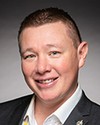
ʔəy̓ sweyəl. antha Zoë Craig-Sparrow. təliʔ cən ʔə ƛ̓ xʷməθkʷəy̓əm.
Good day. My name is Zoë Craig-Sparrow. I am from the hən̓q̓əmin̓əm̓-speaking Musqueam peoples. I was born and raised on our Reserve No. 2 in Vancouver, British Columbia. Thank you for having me speak today, here on the traditional territory of the Algonquin peoples.
I want to be very clear. I am in strong support of Bill S-2 exactly as amended by the Senate, and I urge that it be passed through this committee with the priority and urgency that it calls for.
You've heard a lot about the second generation cut-off. I am the cut-off. My mother has full 6(1) status, but my father was not status, so I was granted 6(2) status, half status. My father passed away when I was nine years old, and I grew up on the reserve with my mother, next door to my grandma, my aunt and my grandpa, Ed Sparrow, who raised me fishing on the Fraser River.
I met my now fiancé on Musqueam. He's not a status Indian, but he also grew up on the reserve. We're getting married in October and we plan to have kids shortly thereafter.
Our children will not have status. In the eyes of the government, they will not be first nations. They will not inherit the home that I own, right next to my mother's, and they will not be able to exercise their aboriginal right to fish, a right so important not only to my Sparrow family, as it was secured through the Sparrow decision, but also to the Musqueam people as a whole.
In contrast, if my parents were both status Indians, my children would have status. If my fiancé were a status Indian, they would have status. If I were a man who had children before 1985, they would have status. This is not just a violation of my rights to equality and to passing on my culture and identity; it means I cannot pass down the home that I worked hard to purchase. It means I cannot pass on the teachings of our family business, fishing, which was taught to me and my siblings by my mother and grandfather, who learned it from his father, who learned it from his, and so on. My babies won't even be allowed to be on the boat with me while I fish.
When we say this will lead to the legal extinction of first nations in three to four generations, we mean an extinction of entire nations and peoples. This is happening right now, with real implications for people and for families like mine. I'm the first generation of my family who, after the intergenerational trauma of residential school, can raise my children in a stable home in our community, free from violence and addiction. My mother broke the cycle, and I am the first to start fresh.
My grandpa fought so hard to survive residential school and see his “little family”, as he calls us, succeed. He's so proud of me, especially for being here today, but isn't that what reconciliation is—giving us a chance to rebuild our lives, culture and family, and the rights that were stolen from us?
I'm the first in my family to go to university, and I'm the first in my family whose children will not have status. I wouldn't have been able to go to university without the ISC funding.
I want to make a note about funding and costs, as I know that's a hang-up for a lot of people.
Will passing Bill S-2 as amended lead to more status Indians? Absolutely, it will. That is the point. It will ensure that we do not go legally extinct, and it will prevent assimilation and genocide. However, the number is far lower than some people fear. The Stats Canada estimate, as Pam shared, is about 320,000 newly entitled status Indians over the next 45 years. That's about 7,000 a year. This pales in comparison to the number of new citizens who are Canadian by birth, because Canadians have a birthright, and the hundreds and thousands of new Canadians we welcome every year.
We see all these people as a good thing. We are asking for legislation that would see 300,000 new Indians over 45 years and prevent our extinction. I don't understand how these costs can be seen as a bad thing.
While yes, these newly entitled status Indians may lead to increased government costs and funding, in the long run it's a cost-saving measure. I think about myself, for example; I am someone who would not have been able to access and graduate from post-secondary education without the funding and support of the federal government. Did this cost the government money initially? Yes, but it also allowed me to get good grades in my undergraduate degree, which set me up for scholarships for my master's and doctoral programs. It allowed me to get a job with health care benefits so that I didn't have to rely on government-funded, non-insured health benefits, and this health care will now extend to my children. It has set me up for a life in which, fortunately, I don't have to rely on social welfare funding. Without the investment in me and my future when I was a child, who knows where I would have ended up or how much more money my children and I would be costing the federal government?
Respectfully, it's about how you look at the situation. If all you want to see is an initial increase in the bottom line of the budget, that's all you're going to see, but if you look more closely, you'll see this as a low-barrier investment that protects the rule of law and equality in this country and prevents the extinction of first nations peoples. It seems like a win-win to me.
I'll conclude with this: The second generation cut-off is not a new issue. It has been studied, litigated, consulted on, reported on and condemned for more than 40 years by courts, parliamentary committees, UN treaty bodies and indigenous leaders and women. We do not need more consultation.
Even so, you cannot consult on gender and race discrimination, and you cannot consult on genocide. You cannot legally use consultations as a weapon to delay equality that my family and I need now, today. People's rights are being violated now. Every day that passes while we allow extinction documents to be a part of the legal backbone of our country is a day too many.
I implore you to follow the lead of the Senate and act swiftly and decisively in passing Bill S-2 as amended. You have a historic opportunity to stop this pattern of piecemeal amendments and delayed equality. Please don't make me fight my whole life, as Sharon McIvor has, just to see justice delayed time and time again.
hay ce:p qə. Thank you.