
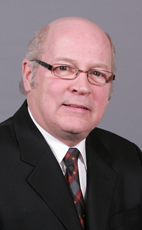
House of Commons photo

Crucial Fact

  • His favourite word was quebec.

Last in Parliament September 2007, as Bloc MP for Roberval—Lac-Saint-Jean (Québec)

Won his last election, in 2006, with 45% of the vote.

Statements in the House

Poverty October 21st, 1996

Mr. Speaker, last week the Prime Minister championed the cause of the homeless. He told everyone in Canada that he was aware of their problem, that he was very sensitive to the problem and that he saw people like these every day and talked to them.

My question is as follows: Will the Prime Minister admit that his government's record, which shows that it has concentrated far more on reducing the federal deficit than on dealing with the problems of those who live in poverty, is a clear indication that the Prime Minister is far more inclined to listen to those who are prepared to pay $1,000 for a Liberal Party fund-raising dinner than to the homeless and the poor of this country?

The Deficit October 10th, 1996

Mr. Speaker, members on the government side should not get so excited. The figures are there in the budgets. Everybody knows that transfer payments to the provinces have been cut. Ask the Minister of Finance, let the backbenchers ask the Minister of Finance and he will confirm this is true. It is all there in the budgets: Transfers, including those to Quebec, were cut substantially with the implementation of the Canada social transfer. So think about it, before you celebrate. Look at your budgets.

And now for our question. Since 95 per cent of the deficit reduction announced by the Minister of Finance came out of the employment insurance fund and transfers to the provinces, as he confirmed in his answer to the first question-the minister made no attempt to hide the fact-and since 95 per cent of this attempt to reduce the deficit is paid for by the provinces, by the unemployed, by workers and employers, what was the government's contribution, other than a meagre 5 per cent of this reduction, in other words, between 350 and 400 million dollars?

The Deficit October 10th, 1996

Mr. Speaker, I want to thank the Minister of Finance. This is the first time we have had a clear statement from the government that the surplus in the employment insurance fund-the premiums paid by workers and employers-has been taken by the government to finance its expenditures. At last we have the confirmation we tried so many times to obtain in the past, but to no avail.

Since the Minister of Finance seems so willing to give me the right answers, I would like to ask him whether he is prepared to admit that if he had not cut transfer payments to the provinces, today a province like Quebec would have no deficit at all, so that Quebec's deficit is what Ottawa has downloaded on Quebec?

The Deficit October 10th, 1996

Mr. Speaker, although the Minister of Finance has forecast a $7.3 billion drop in the deficit for 1996-97, if we take a good look at his figures, we see that the cuts in transfer payments to the provinces are responsible for at least 25 per cent of this reduction, and that the minister is using the surplus in the employment insurance fund, which, in itself, is responsible for 70 per cent of this deficit reduction.

My question to the Minister of Finance is this: Will he admit that 95 per cent of his deficit reduction is financed by the employment insurance fund and cuts in transfer payments to the provinces?

The Canadian Armed Forces October 9th, 1996

Mr. Speaker, the Prime Minister ought to take care to add to that statement: "And, if there are accusations hanging over someone's head, the Prime Minister ought perhaps to hold back on his congratulations until there is a verdict".

The House is faced with a problem at the present time, and this is it: the Prime Minister, who was aware that his minister had intervened and broken the code of ethics, admitted it only after it became impossible for him to avoid doing so, when he was forced to do so. In his letter to General Boyle, the Prime Minister was still praising the General's integrity and good service, while fully aware that there is an ongoing inquiry, which may lead to some conclusions. At any rate, there is at least some reasonable doubt.

What are we to think of such an attitude on the part of the Prime Minister? Are we to understand that, for him, the integrity of his government is intact, just as long as no one is actually caught red-handed.

The Canadian Armed Forces October 9th, 1996

Mr. Speaker, it is all very well for the Prime Minister to say that he did not really know whether what the Minister of Defence had done was a problem, when the underlying principle of his code of ethics is that ministers shall neither interfere, nor appear to interfere. The former Minister of Defence had written a letter. The Prime Minister cannot expect us to believe today that he was not really sure whether or not he had contravened the code of ethics. That is just too facile.

Furthermore, in response to General Boyle's letter of resignation, the Prime Minister wrote that he had served with courage, dignity and integrity.

How, knowing that the accusations made under oath by Mr. Gonzales were weighing heavily against General Boyle, could the Prime Minister be so sure and praise the integrity of the chief of defence staff without even knowing the outcome of the ongoing inquiry with respect to him?

The Canadian Armed Forces October 9th, 1996

Mr. Speaker, the crisis affecting the Armed Forces is slowly subsiding, with the departure of the former minister of defence, and of the former chief of defence staff who, in my opinion, took the only action possible under the circumstances. There is, however, another problem: the Prime Minister's inability to admit to the facts, because he wants to protect the integrity of his government.

Questioned in the House yesterday, the Prime Minister stated that he had been informed on the morning of October 2 that his Minister of Defence had seriously breached the Cabinet code of ethics. That same Wednesday, in the afternoon, the Prime Minister

stated, and I quote: "I have a lot of confidence in the Minister of National Defence", adding that he would keep him in that job.

How can the Prime Minister, after learning that very morning that his defence minister had gone against the code of ethics, repeat in this House, barely hours later, within mere hours, that he had confidence in his former minister and even tell us that he would be there for a long time? How can he explain this?

Canadian Armed Forces October 8th, 1996

Mr. Speaker, perhaps we should take a leaf from the army's book and record the exploits of the former defence minister on video?

Can the Prime Minister assure us, first of all, that the lengthy discussions in his own department yesterday, between his officials and General Boyle, were not for the purpose of making General Boyle's exit an easy one, and second, will he promise that no offer will be made to General Boyle before we know the conclusions of an interim report that will shed light on the falsification of documents in the Canadian armed forces?

Canadian Armed Forces October 8th, 1996

Mr. Speaker, last week the Prime Minister tried to convince us that the former defence minister had resigned over an action that had absolutely nothing to do with the Somalia inquiry. The minister was saved by an unfortunate letter.

Now, he is trying to convince us that the chief of defence staff has resigned, but that nobody had anything to do with it, when we know that officials from his own department were talking with the general for several hours yesterday afternoon. The Prime Minister can always take another run at it.

I would simply like to say this: Will the Prime Minister not admit that the fact is that he was too protective of his friend, the former defence minister, who in turn protected his friend the chief of defence staff, all in order to avoid admitting that he made a mistake in choosing the former defence minister, who made a mistake in choosing General Boyle?

Canadian Armed Forces October 8th, 1996

Mr. Speaker, we have just learned a few minutes ago that General Boyle, the chief of defence staff, has handed in his resignation.

We have known since yesterday that the discussions between the Office of the Prime Minister and his own department, the Privy Council, and General Boyle have been very lengthy and probably very difficult. However that may be, members will recall that, for over a month now, in response to our questions, the Prime Minister has been rising in this House and telling us time and again that he has confidence in his minister, in his former Minister of National Defence, and that he has confidence, every confidence, he said, in General Boyle.

How can the Prime Minister explain his sudden about-face today regarding the individual in whom he had such confidence a few days ago? What has changed?