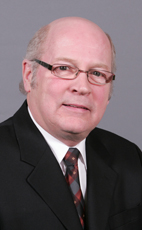
House of Commons photo

Crucial Fact

  • His favourite word was quebec.

Last in Parliament September 2007, as Bloc MP for Roberval—Lac-Saint-Jean (Québec)

Won his last election, in 2006, with 45% of the vote.

Statements in the House

Softwood Lumber October 6th, 2005

Mr. Speaker, the softwood lumber dispute is dragging on and the people of Chibougamau, Roberval and everywhere else in Quebec are waiting for the government to take action. A fifth decision by a NAFTA panel has confirmed to the United States, in no uncertain terms, that Canadian lumber is not subsidized.

Today the Prime Minister is in New York. If he wants to be taken seriously when he talks about softwood lumber, should he not send a clear signal to the Americans that he intends to support the companies by giving them loan guarantees so that they will be prepared to continue to fight this?

Foreign Affairs October 3rd, 2005

Mr. Speaker, this country is so vast and complex that the minister himself is unable to follow the Prime Minister's directions. That is the reality.

In international affairs, in spite of all we have been told about asymmetrical federalism, of the commitments made by the Prime Minister to Quebec and his remark about the door being wide open, that fact stands.

How can the Prime Minister explain that his speeches are used by his Minister of Foreign Affairs to convince the members of this House and federal parties that it is harmful to consult Quebec in areas under its jurisdiction? Actions and words do not jibe.

Foreign Affairs October 3rd, 2005

Mr. Speaker, just before the last election, in a speech on foreign affairs delivered on May 17, 2004, in Laval, the Prime Minister said about Quebec, “It must be able to speak out on the major issues that affect it! The door must be wide open to Quebec—no ifs, ands or buts. And it will be!”

How can the Prime Minister reconcile these remarks made before the last election to woe Quebec voters in Laval and the actions of his minister, who tried to convince other members of this House that it would be harmful to consult Quebec?

Point of Order September 29th, 2005

Mr. Speaker, I would like to say one thing, if you will allow me. I appreciate your suggestion to consult with the clerks. It so happens that I did that before we brought forward this amendment. It was found interesting and acceptable by the clerks.

I do not want to get anyone into trouble, but who do you think I should turn to now, since I have already consulted with the clerks?

Point of Order September 29th, 2005

Mr. Speaker, you know I always respect your rulings, this one included. I would, however, ask you to go a little further, please.

This is why: an amendment makes it possible to delete part of a motion and replace it with something else. There is no indication anywhere in our procedures that the addition must be of a given length. If the amendment had contained only the first two elements of the aid package, no one would, I believe, have considered it not in order.

With reference to length, based on the wisdom of your decision, those in future who have to reach decisions on what constitutes an acceptable and an unacceptable amendment will read that, in 2005, the Speaker of the day—I cannot give your name, Mr. Speaker, but it will be cited in all the treatises—had decreed that length could influence the quality of an amendment and make it unacceptable and inadmissible.

What I would like to see added to your ruling, Mr. Speaker, perhaps after some reflection—it cannot stay the way it is—is “as seems reasonable in the eyes of a Speaker”. I would also like to see you indicate the point at which an amendment ceases to be reasonable and becomes unacceptable. If this afternoon or tomorrow I present an amendment in my capacity as House leader on the same motion, indicating that I wish to replace the term “notamment” with the following, and then give the first three paragraphs, I will have to ask myself this: according to the Speaker's ruling, is three paragraphs too long, or not long enough? Can I add four or five? This is a very serious matter. I have in fact, six or seven elements to add to the resolution, and am told this is inadmissible. So it is solely about length.

I would therefore like you to give some indications in future when amendments are being made. If we add two paragraphs, that is fine, so are three, but four is just borderline, and five no good. We would need to know, Mr. Speaker. You would not like to see your name go down in procedural references as the speaker whose ruling added a grey area to the understanding of our rules. I would like to have that clarification.

Point of Order September 29th, 2005

Mr. Speaker, I appreciate my colleague's effort to render unacceptable the amendment proposed by the hon. member for Joliette. Unfortunately I cannot share his point of view. The amendment is exceptionally crystalline in its clarity.

On page 453 of House of Commons Procedure and Practice , we read:

An amendment must be relevant to the main motion.

Are the elements present relevant to the main motion? Absolutely. The main motion speaks of a plan to assist the textile industry. Each part of the amendment is a refinement of the assistance plan. This satisfies the criteria of an amendment on all points, since it is relevant to the main motion.

It must not stray from the main motion—

The proposal states that there will be an assistance plan, and each of the measures is part of that plan. This is consistent with the motion. Not only is the amendment relevant to the main motion, not only does it not stray from it, but it aims to further refine its meaning and intent. Nowhere does the text state that the amendment must further refine the meaning and intent, but in less than 50 or 10 words.

I challenge my honourable colleague to tell me which of the different parts of the amendment does not serve essentially to further refine the meaning and intent of the main motion. We are in fact talking about an assistance plan, and each part of the amendment is a refinement of what the assistance plan must be.

An amendment should take the form of a motion to:

leave out certain words in order to add other words;

insert or add other words to the main motion.

This is what the amendment does. I have trouble accepting what the deputy government House leader is saying. I do not understand his argument. The amendment is in fact relevant to the main motion, does not stray from it, further refines the meaning and intent, and utilizes the process of adding words or explanations to the main motion.

Nowhere in House of Commons Procedure and Practice is it stated that an amendment must not contain more than so many words. The only thing I can see that might be an element of my colleague's argument is the fact that the amendment is substantial. Well, it is substantial, quite simply, because it further refines the assistance plan.

The proposal satisfies on all points the definition of an amendment, however much that may displease my colleague. It is even a model amendment.

Hon. James Jerome September 26th, 2005

Mr. Speaker, it is always a very touching moment when we honour someone who has sat here, in this House, and who has devoted much of his life and professional career to the service of his fellow citizens.

Not only was Mr. Jerome a former member of this House but he also had an impressive legal career. He was seen by everyone as impartial when he sat in the chair that you now occupy, Mr. Speaker.

He was in fact remarkably impartial. This is a trait that everyone here respects in the Speaker of the House of Commons.

He was evidently a fair and impartial man. He was someone who had the courage, in 1973, when he was just the chair of a committee, to turn down an amendment that was proposed with government support but that was contrary to the laws and regulations in effect and would have limited the role of a parliamentary committee.

For this act alone, an act of courage if there ever was one, I think that Speaker Jerome will be remembered as a great Speaker and a fair-minded person. We will remember him not only as a jurist, judge, member of Parliament serving his fellow citizens, and Speaker of this House but also as an impartial human being, the father of a family and a husband who made a very positive mark.

On behalf of the Bloc Québécois, I would like to pay my respects to the members of his family, his friends, and all those who knew him and had the good fortune to work with him.

Broadcasting June 23rd, 2005

Mr. Speaker, I would not like to upset the good intentions of the minister, but on the other hand, I would like to save the francophone community. I would like to help francophones keep their radio stations. A quota of 2.5% is totally inadequate, indeed dangerous for the francophone community and Quebec culture.

The minister is a Quebecker. She has responsibilities. She has a maximum of 45 days to appeal the decision. She should do so; it is what is expected of her.

Broadcasting June 23rd, 2005

Mr. Speaker, in response to the CRTC decision on satellite radio, the Minister of Canadian Heritage has said she will wait for someone else to appeal during the 45 day appeal period. The minister can herself appeal the decision, which sets aside only 2.5% of stations for French language radio.

Why is the minister not acting? Why is she waiting for others in a matter of such importance for the francophone community?

Extension of Sitting Period June 23rd, 2005

Mr. Speaker, the questions my colleague has raised are interesting ones.

As far as the rights of homosexuals and of those whose religious convictions oppose gay marriage are concerned, I will say that one person's religion must not become another person's law. Everyone agrees on that. We have the deepest respect for those whose religious convictions cause them to oppose same sex marriage. Nevertheless, it has never been our intention in any way to oblige any religion or religious belief to perform religious marriages. This is about civil marriage. No religious denomination must be pressured into having to perform same sex marriages. This decision is up to them, it is their right, and I agree with that.

Moreover, a motion on this has already been presented and supported by us. We would be open at any time to the addition to the bill of provisions stating that no religious denomination shall be pressured or in any way obliged to celebrate or authorize marriages between two persons of the same sex.

This is a civil matter. We respect all religious denominations and their members and we want their rights to be respected. We just do not want their religion to become the law for others. It is as simple at that.

As far as our support for the closure motion is concerned, it is simple. It is our firm conviction that those who are watching us now, or have followed our actions throughout the year, are a bit impatient to see us pass the pieces of legislation we will be called upon to vote on. No one wants to see Parliament drag on needlessly until August at the cost of $35,000 an hour. I think people want to see us settle these matters once and for all.

That is why we believe that, as an exception, it is acceptable for us to be able to vote on the bills after a regular debate. This is unusual, I know, but the intention is not to take away anyone's right to speak, only to limit the time of the debates that we are going to be engaged in here. Extension until the end of June seems to us reasonable and sufficient. That is all.