
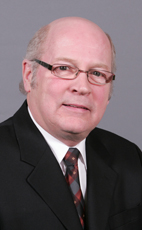
House of Commons photo

Crucial Fact

  • His favourite word was quebec.

Last in Parliament September 2007, as Bloc MP for Roberval—Lac-Saint-Jean (Québec)

Won his last election, in 2006, with 45% of the vote.

Statements in the House

The Budget October 20th, 2003

Mr. Speaker, this goes to show how preposterous this whole situation is, with one person drafting, and receiving recommendations, and another making decisions and providing direction.

What people want to know is whether the budgets for employment insurance, old age pensions, health, education and the Kyoto protocol will be affected by this government's next budget. That is what people want to know.

The Budget October 20th, 2003

Mr. Speaker, the Minister of Finance is holding prebudget consultations in preparation for the next government budget. In the circles of the hon. member for LaSalle—Émard, it is said openly that there will be major cuts in all government departments' budgets.

My question to the Minister of Finance is the following: Are his current prebudget consultations not mere window dressing, since the real decisions are being made outside, beyond Parliament's reach?

Taxation October 8th, 2003

Mr. Speaker, the Prime Minister has a gift for interpreting things a little differently than intended. What I said was that we thought centralist tendencies had gone as far as they could go with him, and now we find that the other one is worse. That is what we are learning.

I have this question for the Prime Minister. With the federal approach of sitting the municipalities down with the provinces to distribute the money, are we to expect that later on—for example in connection with education—they will be calling together the school boards and the provincial governments, while Ottawa puts more money on the table? Is that how they are going to do things in future?

Taxation October 8th, 2003

Mr. Speaker, the problem is that the resolution on which the government voted yesterday is being interpreted by the real decision maker, who is not here. He is elsewhere, and has announced his intention to bring together the municipalities and the provinces in order to discuss transfer of the tax.

I am asking the Prime Minister if there is not a danger of his successor being even more centralist than he has been and putting heavy pressure on the provinces by sitting them down directly with the municipalities and holding out money as the incentive?

Employment Insurance October 6th, 2003

Mr. Speaker, during the SARS crisis in Toronto, the Minister of Human Resources Development, who is from Toronto, decided within days to help the workers who were affected by the crisis, and good for them.

However, the victims of the softwood lumber crisis in Saguenay—Lac-Saint-Jean and all the regions of Quebec would like to receive the same treatment. They are depending on the government. What is the government waiting for?

Employment Insurance October 6th, 2003

Mr. Speaker, on Saturday, the member for Jonquière and I met with people from the Syndicat des employés d'Abitibi-Consol, a division of the Port-Alfred plant, who are victims of a temporary shutdown and are having a hard time coping with the employment insurance waiting period. These workers are among the victims of the softwood lumber crisis, since their company is directly affected by these woodlands operations.

My question is for the government. The government reacted swiftly for the Toronto workers who were victims of the SARS crisis. Why, then, is it refusing to do the same for the workers in my region who are victims of the softwood lumber crisis?

Former Privacy Commissioner October 2nd, 2003

Mr. Speaker, on behalf of those who are listening at home, and who realize that Mr. Radwanski has unacceptably wasted tax dollars, and on behalf of the members of this House, what we want to know today is this: if it was not the President of the Treasury Board, and not a cabinet minister, then who, in the Prime Minister's Office, made this decision? That is clear enough.

Former Privacy Commissioner October 2nd, 2003

Mr. Speaker, even though he is not allowed to answer, the President of the Privy Council is shaking his head to indicate that he was not the one who made this decision or gave such authorizations.

There must certainly be someone in the government who made a decision about extending these privileges. The first excess concerned housing and travel between Ottawa and Toronto.

It is not complicated: we are asking who, in the government, decided that George Radwanski would have special benefits?

Former Privacy Commissioner October 1st, 2003

Mr. Speaker, we must get this clear. Eddie Goldenberg was able to tell the Minister of Citizenship and Immigration, who was getting involved in the Montreal Grand Prix, “You—shut up”. If he was able to say that, he is probably able to say to the President of the Treasury Board, “You—do not get involved; this is none of your business”.

And can the President of the Treasury Board'failure to take action not be explained by the fact that Mr. Radwanski already had a defender, one very close to the Prime Minister?

Former Privacy Commissioner October 1st, 2003

Mr. Speaker, we would like to know why the President of the Treasury Board did nothing in the Radwanski case. Closer examination has shown that George Radwanski obtained special permission directly from the Prime Minister's Office to keep two principal residences, at great expense, although this practice is usually limited to one year.

Can the Prime Minister deny that, since the authorizations came directly from Eddie Goldenberg, his chief of staff, they carried a powerful signal that Mr. Radwanski could bend the rules with impunity?