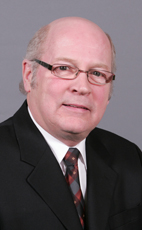
House of Commons photo

Crucial Fact

  • His favourite word was quebec.

Last in Parliament September 2007, as Bloc MP for Roberval—Lac-Saint-Jean (Québec)

Won his last election, in 2006, with 45% of the vote.

Statements in the House

Government Appointments June 10th, 2003

Mr. Speaker, the Prime Minister has just stated that Alfonso Gagliano has not been assigned to the Vatican because he has been assigned to Denmark for some time, and it appears he is going to continue his work there.

How can the Prime Minister tell us this in the House, when the Queen of Denmark's web site announces that there will be an official farewell dinner on June 17 for Alfonso Gagliano, the Canadian ambassador?

Softwood Lumber June 4th, 2003

Mr. Speaker, I appeal to the ministers and members from Quebec. When they meet people out on the ground, as we do, they must realize the distress that workers and companies are experiencing.

I call on one of them to speak on behalf of their colleagues, to stand up and tell us why they have been silent and why they have not insisted that the Minister of Industry put in place the measures that the regions need and that everyone knows are necessary. Let them stand and answer.

Softwood Lumber June 4th, 2003

Mr. Speaker, the Secretary of State responsible for Canada Economic Development for the Regions of Quebec does not need to look for solutions. They are right there in front of him. They respect NAFTA. They are called loan guarantees. That is what the industry needs, and despite his package of measures, hundreds of jobs are being lost in our regions.

Is there anyone on the government benches who is responsible enough to take the economic situation of our regions into account? They can keep their nice speeches; what we need are real measures.

Softwood Lumber June 2nd, 2003

Mr. Speaker, these regions and these people want to keep working in softwood lumber. They want to be able to earn a living in the lumber industry.

At the GDS mill, 250 jobs have been lost; at Gérard Crête, 300 jobs; at Tembec, 300 jobs; at Coop Laterrière, 450 jobs; at Cedrico, 250 jobs; and at Bowater, 350 jobs.

Do you think that these people want to be retrained for new careers? What they want is to keep the operations going with guaranteed loans. That is what they need.

Softwood Lumber June 2nd, 2003

The softwood lumber crisis continues to hit our regions very hard, and unfortunately the list is growing longer every day: 300 workers in Témiscamingue; 210 in the Beauce; 250 in the Gaspé; 300 in the Mauricie; 450 in Chibougamau; and 450 in Laterrière, in the Saguenay.

I ask the Liberal government whether the figures I have just listed—and which are only a part of the picture—are not enough to justify putting an emergency assistance plan into place to help these regions? What else does the government need?

Members of Parliament Retiring Allowances Act June 2nd, 2003

Mr. Speaker, on behalf of my party, it is my pleasure to announce that we will support the bill for the following reasons.

First, we have carefully reviewed each of the points submitted by the government House leader. For the most part, this is a technical bill. The chief actuary, who did the necessary checks in terms of the pension plan, observed and set out in a report that the legislation as drafted by parliamentarians could be open to interpretation. I think it is good practice and our most pressing duty to ensure that legislation is clear and does not leave any room for interpretation requiring additional legislation for clarification. There must not be any room for interpretation when we are talking about something as serious for everyone as pension plans.

Second, the disability allowance has been referred to. When a member is unable to continue working because of a disability, as in any other field, he or she is entitled to some financial compensation. To avoid past problems, when things had to be clarified, let us say that this legislation will allow everyone to understand the same thing, that all parliamentarians' salaries are calculated for compensation purposes, if needed. This is perfectly normal and appropriate.

As for rounding off ministers' salaries to the nearest $100, the legislation does allow rounding off of parliamentarians' salaries to simplify the calculation of benefits. It is not a question of whether computers can do the calculations or not, we can always calculate to the 22nd decimal. That is not the issue.

The problem is that the act allows for all parliamentarians' salaries to be rounded off to the nearest $100, and no one is going to go hungry over that. It is a detail, except that there was an oversight in the act with respect to ministers. When an act is passed and there is an oversight, it seems to me the right thing to do to amend it. There is not a single minister who, at the end of his or her four-year term, will have made more than $250 or $300 because of it, probably not even that much. So, it is not a question of money, it is a question of treating everyone equally and doing the right thing. If we cannot understand that, then something is wrong.

In the end, the only measure that will lead to additional costs is the remuneration for chairs and vice-chairs of special committees. I will simply say that everywhere, in all sectors of the economy, in businesses that are held up as examples of sound management and even in the Government of Ontario and the Government of Quebec, supplementary remuneration is paid to those who are given responsibilities.

Directors of of companies, which do not throw money down the drain, are given compensation for carrying out their duties. The chair receives a very generous compensation on top of the standard compensation, but that is not the case for chairs of special committees.

Parliamentarians do not receive astronomical salaries when they take on special duties; it is a compensation. People are paid for these additional responsibilities. It is the status and the new responsibilities that are compensated, not the work. I know people who work 90 hours a week, and they are not necessarily the highest paid people. These people do not get paid by the hour. I simply wanted to point out that the responsibility is recognized. I think that this is right and treats people fairly. Once again, we are not talking about huge amounts of money.

For these reasons, we will support this bill. This bill seems to us to be of a rather technical nature, one that is needed for sound management.

Softwood Lumber May 29th, 2003

Mr. Speaker, how can anyone explain that, suddenly, the government is changing its strategy when it has the upper hand and all that is needed is an assistance package for businesses and workers so they can make it through the process and still survive.

Why is the government changing its strategy when all that is required is phase 2 of its plan, which it has yet to deliver?

Softwood Lumber May 29th, 2003

Mr. Speaker, since the softwood lumber crisis began, the Minister for International Trade has been talking about the return to total free trade as the ultimate objective.

Given this, how does he explain the fact that he presented the Americans with a plan that, essentially, contains conditions similar to those adopted in 1996? What we want to know, after so many sacrifices, is why the government wants to return to square one?

Softwood Lumber May 27th, 2003

Mr. Speaker, everyone knows that the Americans can still use appeals to delay and can drag the dispute out for many more months. Meanwhile, businesses and families are suffering the effects of the softwood lumber crisis.

I am not asking the minister whether or not he has defended the industry vigorously. I am asking him this: What is he going to do to support businesses and families that are living in misery now, in the riding of Roberval that I represent, as they are all over Quebec?

Softwood Lumber May 27th, 2003

Mr. Speaker, the softwood lumber crisis is hitting hard. The regions that depend on the forest industry are suffering, and today in the riding of Roberval, the Chibougamau lumber yard announced layoffs of up to 450 people for two and a half months, and in Dolbeau-Mistassini, 50 jobs are gone at Bowater.

My question is for the Minister of Natural Resources. How can the Minister of Natural Resources have told us last October that he intended to introduce an assistance package to help businesses and workers, and then repeat the same thing yesterday, when still nothing has been done?