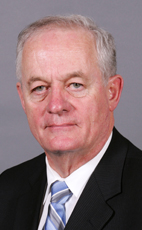
House of Commons photo

Crucial Fact

  • His favourite word was justice.

Last in Parliament September 2008, as Conservative MP for Calgary Northeast (Alberta)

Won his last election, in 2006, with 65% of the vote.

Statements in the House

Identity Theft November 19th, 2004

Mr. Speaker, identity theft is one of the fastest growing crimes in North America. The perpetrators of this crime include organized criminal groups and individuals who collect and use someone else's personal identification to commit fraud and expedite other criminal offences.

It is estimated that identity theft costs the Canadian economy $2.5 billion annually. However, for the victims whose identity has been compromised, the impact goes far beyond dollars and cents. Not only must they deal with the financial loss, damaged reputation and emotional distress, they must also go through the complicated process of clearing their names.

This crime is so serious that the Ontario Provincial Police organized its second conference last October which brought together international identity theft experts to discuss the issue.

Given the gravity and growth of this crime, it is shocking that the government has not moved to create a separate offence for the possession of multiple identity documents. It is time the government acted to help eradicate this activity that has become so pervasive in our society.

Royal Canadian Mounted Police November 17th, 2004

Mr. Speaker, with all the controversy surrounding payment for RCMP Superintendent Dennis Massey's regimental funeral, it sounds like a policy change is in order.

Could the Minister of Public Safety tell the House how many other families of fallen federal law enforcement officers have had to pay for their own regimental funerals?

Carrie's Guardian Angel Law November 16th, 2004

moved for leave to introduce Bill C-286, an act to amend the Criminal Code (child sexual predators).

Mr. Speaker, I am pleased to reintroduce this private member's bill entitled Carrie's guardian angel law. The intent of the bill is to get tough with pedophiles, many of whom serve days or months in jail for preying on children while the damage caused to the victims often lasts a lifetime. The bill refers to the victim as a person under the age of 16.

Carrie's guardian angel law carries a minimum sentence of life imprisonment in cases of sexual assault on a child that involves repeated assaults, multiple victims, repeat offences, more than one offender, an element of confinement or kidnapping or an offender who is in a position of trust with respect to the child.

Under the provisions of the bill an offender would be ineligible for a parole for 20 years.

It is time that those who harm our children are locked away for a long time.

(Motions deemed adopted, bill read the first time and printed)

Tlicho Land Claims and Self-Government Act November 1st, 2004

Madam Speaker, I am pleased to rise to speak to Bill C-14, the Tlicho land claims and self-government act

Before proceeding with my speech, I would like to take this opportunity to thank the people of Calgary Northeast for placing their trust in me by re-electing me to represent them here in the House of Commons. They have my pledge that I will continue to work hard to ensure their views and their concerns are well represented in Ottawa. I thank the people of Calgary Northeast for placing their trust in me.

Under the agreement between the Tlicho people, the Government of Canada and the Northwest Territories the Tlicho First Nation will gain control of 39,000 square kilometres of land between Great Slave Lake and Great Bear Lake. If we were to drive around the perimeter of it, it would take about an hour and a half. That is a sizable chunk of territory with a population of 3,500 people. It is certainly a lot of responsibility for that kind of territory.

No doubt there will be lots of activities coming up in the Northwest Territories. Certainly, within the framework where this particular chunk of land rests, that activity will include mining, fishing and who knows what else. Transportation will be key and it will certainly reflect on any kind of business activity that any other company or government will be engaged in in that territory.

I can see the need to actually make this self-government arrangement work to avoid continued jurisdictional entanglements in the future over what might happen there. Looking to the north, there is no doubt in my mind that the north holds so much promise and so much potential for not only those who live there but for the rest of the country. I would assume that the government on the other side would like to see that flow smoothly to allow people to do business in the north so that all may benefit from it.

This is perhaps one of the most significant agreements concluded by the Canadian government in recent years. Yet to my surprise it has received very little attention, especially when one considers that it has the potential to be both positive and negative to the long term interests of Canada.

I would like to talk about a couple of points, as I cannot talk on every issue that may have been addressed thus far. There are some that concern me as I look to what some of the provisions in this act actually wash out to be.

I am going to pick on the powers that have been granted to the Tlicho government to enact laws. I know this has been a subject of much debate when it comes to land claim settlements and even the activities that occur on various reserves throughout this nation. Even though the laws of Canada are said to apply to all jurisdictions on federal statutes, in fact, there is a big question mark as to whether they do or not.

I previously asked a question of one of the parliamentary secretaries about one of the reserves to the south.

I and my party would like to see this land claims settled but we want to see it done in a way that will be beneficial not only to those who occupy the land, but that it will contribute to the general well-being of the nation, and that those living on the land are subject to Canada's laws and have the same fair treatment as anyone else.

The parliamentary secretary made mention that reserves all enjoy the same treatment but I beg to differ with her. I have been on various reserves and, even though there has been no specific land claim arrangement, it has been instilled in their minds that they are an entity onto themselves, that the laws of Canada and the United States and the enforcement of those laws do not apply to them. For some unknown reason there has been so much political interference that the whole well-being of the people living on those reserves has been placed into question. In fact, some people have been placed in jeopardy.

The Liberals track record concerns me. It is not the fact that land claims are being completed. It is the fact that the Liberals' track record, when it comes to enforcing or applying laws evenly across the country, has been placed into question.

I want to point to one set of statements in reference to the powers given to the Tlicho government to enact laws. Two of those powers fall right into federal jurisdiction.

The first power is with regard to the control over the transport, sale, possession, manufacture or use of weapons or dangerous goods. We have laws in Canada that apply nationally. These laws regulate firearms and explosives. The Criminal Code is used if someone violates provisions within the code. Yet this is one area where the Tlicho government will be able to enact laws to possibly manufacture or use weapons or dangerous goods.

The second power is the control or prohibition of transport, sale, possession, manufacture or use of intoxicants. Authority has been granted to the Tlicho government to delve into these areas. It is not at all clear as to who will enforce what or, if there is an enforcement agency, where those who have been charged, convicted or whatever can appeal there case should they not be happy with what has gone on within their jurisdiction.

That again comes back to the point that the Tlicho government seems to have the ultimate say in all levels of authority within that new jurisdiction which the government wants to create. Where is the appeal process in this whole arrangement?

Finally, I would like to address the issue of access to information. Where do the rules of access to information apply, or do they? My impression from reading the bill is that it would be very difficult for me as a member of Parliament or someone else who has concern about what is happening in the proposed jurisdiction to access information that may deal specifically with that level of proposed government.

I want the House to know that I will not be supporting the legislation. I feel there must be additional debate and much more contribution issued when it comes to finalizing any self-government for the Tlicho people.

Tlicho Land Claims and Self-Government Act November 1st, 2004

Mr. Speaker, I certainly want to oblige the member. He wants someone to ask him a question. I will ask him a question or two.

First, I would like to make some comments about that member who so typically thinks, acts, walks and talks like a Liberal. One day I hope, and I guess I should not hold my breath, that the other side of the House will not wait any longer to hear what the experts say, when it comes to the Supreme Court and the charter, about enacting laws that are reflective of the broader consensus of residents in the country. I hope it does not have to run to the courts all the time and hear what they have to say. This in case is one of those prime examples.

I would ask the parliamentary secretary about the authority granted to the Tlicho government to enact laws that would be equivalent to our federal laws, specifically in two areas. My first question is on the control, prohibition, transport, sale, possession, manufacture and use of weapons or dangerous goods. The second question is on the control, prohibition, transport, sale, possession, manufacture or use of intoxicants.

The way I read this legislation, the Tlicho would have sole authority in those areas. They are under federal jurisdiction, yet that authority is being granted to the Tlicho government. They cannot have it both ways. In my way of thinking it puts the Tlicho government on a par, if not above, the federal jurisdiction of Canada.

Tlicho Land Claims and Self-Government Act November 1st, 2004

Mr. Speaker, the agreement certainly has its major shortcomings. In fact, the agreement brings back some memories of mine when I think about some of the activity on one of the local reserves in Canada that is shared partly with the U.S., Kanesatake.

I drove down to Kanesatake once. In fact my colleague from Wild Rose and I drove into that particular region down by Cornwall. As we drove across the bridge we saw a huge sign which read “The laws of Canada and the United States do not apply on this reserve”. I believe the sign is still there to this day.

The RCMP were unable to patrol the St. Lawrence River for fear of getting shot. The level of crime within the reserve was far beyond anything reasonable or acceptable. Smugglers lived in huge mansions on the shoreline of the St. Lawrence River, and those who did not involve themselves in criminal activity suffered at their hands. The band police could not enforce the law because they were subject to those with more power. Sometimes the chief and the council, even though they allegedly held the power, did not enforce the law evenly.

Therefore I have a concern over where this agreement might end up going. There does not seem to be a process set up that if somebody is not happy with the way they are treated by the laws that may be established, where do they go to appeal? If we look at the power granted to the Tlicho government to enact its own laws, if somebody is not happy where do they go?

Could my colleague shed any light on that particular point?

Tlicho Land Claims and Self-Government Act November 1st, 2004

Mr. Speaker, I really appreciate that we are in the middle of this debate on the Tlicho agreement because there is so much that needs to be addressed.

I too have a constitutional question for my colleague in reference to this agreement. It does in fact seem to be creating a separate, almost sovereign, kind of region in our nation. I have always believed that self-government, when it comes to our aboriginal or native populations, would always be within the Constitution of Canada. That is the only way that fairness and equality can be ensured, and we can adhere to the principles of the charter as it applies to aboriginal self-government.

The whole issue of aboriginal government and the powers that are granted to it, if in fact it operates within the framework that it can collect its own revenues and reduce its dependency upon the federal government, is in the form of accountability. The self-government framework actually creates an accountability chain within its structure and the people all benefit from that accountability structure.

Could my colleague address that particular point? Where does the accountability factor lie within this arrangement or is there any accountability?

Supply May 11th, 2004

Mr. Speaker, I have listened to the hon. member across for 20 minutes as he was basically spouting Liberal propaganda on health care issues. I think he has kind of defined the Liberal position there somewhere. Unlike my colleague from Prince George--Bulkley Valley, I am not appalled by what I hear because this is pretty much the common mantra coming from the Liberal side.

I would like to ask the member a technical question. I know it might be hard for him to grasp this, but I am going to ask him to comment on it. Would the hon. member encourage his party to conduct a social audit, under the existing Office of the Chief Actuary, dealing with medicare and health care?

Criminal Code May 7th, 2004

Mr. Speaker, again I feel privileged to speak to my private member's bill on this particular issue.

The bill, if passed, would ensure that those sentenced to life imprisonment would serve the remainder of their natural life behind bars. Too often, criminals convicted of heinous crimes are released onto our streets after serving only 10, 15 or 20 years, unless they are designated as dangerous offenders, and that really does not define the length of their sentences at all.

When I speak about 10 to 15 years served on a life sentence, we could look at first degree murderers, second degree murderers, maybe those who have committed hijackings or treason. Even acts of terrorism could come under parole eligibility after 25 years, if the courts and the government do not change the existing legislation.

Again I am going to refer to something that happened in my riding recently. This point was brought home to me again last Friday when I attended the parole hearing of Oskar Chan, who had murdered 18 year old Jonarhey Olivo back in 1994 in a drive-by shooting. The young fellow was just standing in front of the Marlborough Mall. Two rival gangs were at one another. He took a bullet in a drive-by shooting and was killed, and the only son of Regina Olivo was gone.

Chan was released on parole after serving his mandatory 10 years, and that was a life sentence for second degree murder. It was a very emotional time, I dare say, because even the mother of the youngster who was killed was not allowed to see the perpetrator, the accused, because he was kept behind a barrier. She was not allowed to look at him and look at his body language. Finally she did have an opportunity, after she gave her impact statement. It was a very emotional time. Ten years after the murder, Chan is now on the street, free to go about his business, while members of the Olivo family still suffer with that pain.

I do not think that is quite the way it should be. That is why, after a time, I brought this bill forward. It has been in the House before. I am not the only legislator who is calling for life to actually mean life in a life sentence. The Doer government in Manitoba, as my colleague from Dewdney--Alouette has mentioned, is asking Ottawa to get tougher on killers by making life sentences real life sentences. It is specifically pointing to the shootings of several police officers in the province of Manitoba. This was two years ago. It sees that there is a need to step down on that kind of offence, to indicate to those contemplating any kind of action, whether it is a deliberate action against a police officer as it was in Manitoba, or a retaliation shooting which would reflect first degree murder, that it is unacceptable. That deterrent is in the legislation.

A real life sentence would send a strong message to those in society who would commit such crimes, that they would spend the rest of their lives behind bars.

The bill is about deterrence and about protection. It is about protection from those who otherwise would be released onto our streets to commit another criminal act.

I trust that the members in the House on all sides will lend their support to this bill. In so doing, we will send a strong message to criminals that there are serious consequences, consequences that are not too often used in the justice system, for taking the life of another person, the worst of which is life imprisonment.

Petitions May 7th, 2004

Mr. Speaker, I have another petition dealing with the issue of two strikes legislation. The petitioners call upon Parliament to enact two strikes legislation, requiring everyone who is convicted for the second time of one or more sexual offences against a minor person to be sentenced to life imprisonment without eligibility of parole or early release.