Mr. Speaker, why do you not tell the Deputy Prime Minister that? I think he needs a lesson or two from the Chair.
The government has an ad hoc approach to—

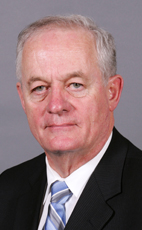 House of Commons photo
Won his last election, in 2006, with 65% of the vote.
National Defence November 15th, 1999
Mr. Speaker, why do you not tell the Deputy Prime Minister that? I think he needs a lesson or two from the Chair.
The government has an ad hoc approach to—
National Defence November 15th, 1999
Mr. Speaker, I can see why the Deputy Prime Minister has to read the answer off as to what the accomplishments of our troops are because he probably does not even know on a personal level.
National Defence November 15th, 1999
Mr. Speaker, the Prime Minister wants to withdraw our troops from Kosovo. He has confirmed what the official opposition has been saying for a long time, that our troops are overstretched. To add insult to injury, he has referred to our men and women in the military as Boy Scouts, while the foreign affairs minister talks about soft power.
When will the Prime Minister stop abusing and running down our military and start giving them the funding they need to do the job?
National Defence November 4th, 1999
Mr. Speaker, I have just returned from a military fact finding mission in Australia.
I first want to thank those private donors and the Reform Party which financially supported this endeavour to make it possible.
For 10 days I visited with Australian defence leaders and met with men and women of the Canadian forces in Darwin. Unlike Canada's military, which has suffered from political neglect for decades, the Australians have a replacement or upgrade program in place for all their major equipment.
Here in Canada air crews continue to struggle to keep the 36 year old Sea King helicopters in the air, while our government dithers.
If there is one overriding lesson that I would like to pass on to my colleagues on both sides of the House it is this: In Australia national defence is truly a national and non-partisan issue.
The tragic cancellation of the EH-101, where this Prime Minister made a cynical promise that continues to jeopardize the safety of military personnel, could not happen there—
Civil International Space Station Agreement Implementation Act November 2nd, 1999
Madam Speaker, that is a very good question from my colleague. No, the agreement or treaty that was struck in reference to the space station is not a constitutional matter.
My colleague across the way may say there is a Canadian law involved here. Maybe there is something in that reflection, but specifically on that treaty, no.
When it comes to the Nisga'a agreement we cannot impact more seriously on the constitution than what this agreement has done. It is worthy of much debate in the House.
Civil International Space Station Agreement Implementation Act November 2nd, 1999
Madam Speaker, I have no quarrel with the whole issue of what may happen and is happening with the space program and the space station. I do not think a person on this side of the House has any quarrel with the member in that regard.
He cannot seem to get it through his thick skull that the space station is not in question here but rather the Nisga'a agreement. That is why I am using that as a comparison. On one side we have a treaty that we find co-operation and benefit from. On the other side they shut down individual rights, which has a negative impact on society. The member across the way cannot get that through his head.
Civil International Space Station Agreement Implementation Act November 2nd, 1999
Madam Speaker, I would certainly like to thank my colleague for his support. The time is opportune for the Liberal government and certain members, I might add, to make mention of issues that are democratic. It is convenient and should be brought to the attention of the world because somebody all of a sudden is taking a right or a privilege away, and not to say that it should not be.
However, that applies on this side too because there are rights and privileges being taken away from others as a result of the Nisga'a agreement. We as the opposition have every responsibility to bring that to the attention of others in the country.
Civil International Space Station Agreement Implementation Act November 2nd, 1999
Madam Speaker, I do not disagree with the member for Wentworth—Burlington with respect to what the technology and the space station program will create. I agree wholeheartedly. I certainly laud the program. It is marvellous. I would like to see greater opportunities in Canada to develop our young people in the whole area of space technology which we lack in many respects. We have made some strides over the last few years but with no credit necessary to the government.
However, that was not the point I was making with my comparison of this treaty to the treaty that was just drafted on the Nisga'a agreement. I was also not following the party line.
We are concerned about what happens in the House, like any opposition member should be. We have a responsibility to ensure that debate does take place and that there is no other hidden agenda on any bill that may come forward. If the member for Wentworth—Burlington would dig into the short path, he would clearly see that there have been hidden agendas in other bills that have come before the House.
It is not the space station bill that I have any quarrel with in that regard. I think it is a marvellous opportunity for our country. However, when the government of the day decides that it is acting as God and decides to shut down debate on a bill that will have a greater impact on people in our country in a negative way than the space station will have in a positive way, then I have a problem with that. I and I know my colleagues will take every opportunity to voice that particular opinion.
Civil International Space Station Agreement Implementation Act November 2nd, 1999
Madam Speaker, certainly I intend to do that as I do come back to the issue during my debate. I think it is important to compare and compare I will do. I know, Madam Speaker, that you will not disagree with that particular point so I will try to keep my comparisons very relevant.
I understand that the treaty struck for the space station among these different countries was certainly an historic treaty. However, I do not recall just how much debate there was in the House over that particular issue or how much consultation there was here. The only thing I recall over this particular treaty, and it is a treaty, is that the space station agreement was brought here for rubber-stamping. It is all over, finished and done. All the government wants is the House's approval. That is no different than the Nisga'a agreement.
The Nisga'a agreement was done by the government in the same way. It was compiled with little consultation with those who really mattered. That is an important issue when we talk about an agreement that has such an impact on the lives of people in British Columbia and, for that matter, across the country. It is the taxpayer who is footing the bill. It is no different than on the space station issue where the taxpayer will also be footing the bill, although with the space station there is certainly going to be a different spinoff in the country than there will be with the Nisga'a agreement. It will be the balkanization of Canada.
Civil International Space Station Agreement Implementation Act November 2nd, 1999
Historic legislation is important. The Canadian space station is an historic occurrence. There is no question that the development, the co-operation and the resulting influence from the research that will be done up there will be historic. It is going to be a preparation for greater things to come in space, including a trip to Mars. Speaking with those in the area of research focused on that particular station, I know that is a very close agenda. Maybe with some exceptions, probably most of us here will be alive to see that happen.
However, there is another historic piece of legislation that was never debated in the House and that was the Nisga'a agreement. The government shut it down before we could get to the nitty-gritty, the nub of the matter. There are tens of thousands if not hundreds of thousands of people who are unhappy with that agreement.
We have an agreement here that everyone agrees with but we are still debating it. We can laud all the possibilities that the space station will bring to the country, if not to the world, but let us talk about the country because we are the ones who are contributing to it.
We are also contributing to the Nisga'a agreement as to what may come of it in the end. As members of the opposition party, we have a responsibility to deal with that very complicated issue and complicated bill. I do not know if most people realize this, but there are two books that deal only with the Nisga'a agreement. It is very significant in scope.
I do not remember who the speaker was, but he or she identified the Nisga'a treaty as the balkanization of Canada.