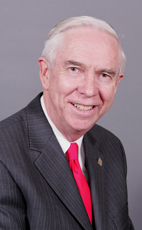
House of Commons photo

Crucial Fact

  • His favourite word was terms.

Last in Parliament September 2008, as Liberal MP for Miramichi (New Brunswick)

Lost his last election, in 2008, with 37% of the vote.

Statements in the House

Petitions February 22nd, 2005

Mr. Speaker, under Standing Order 36, I would like to present two petitions from my riding, both dealing with the definition of marriage.

The petitioners indicate that their strong belief is that marriage is a lifelong union of one man and one woman to the exclusion of all others.

Civil Marriage Act February 21st, 2005

Madam Speaker, the parliamentary secretary certainly has brought forth a very convincing argument from his point of view in terms of what changes should be brought about regarding marital relationships.

One of the major issues in this country is the fact that for probably 2,000 years, in our minds, in terms of being followers of the common law, marriage has certain connotations. In most people's thinking over past generations, marriage has been a relationship between a man and a woman. He brings to the House today a changed perception of what marriage is about and he could probably speak further on that.

I have a second point to make. In his discourse he indicated that even after this bill is passed, certain groups will be discriminated against because of their genetic relationships with one another. Is it his intent as parliamentary secretary to do away with relationships that previously prevented marriages of a man and a woman? Would those also be wiped clean? He indicated in his speech that geneticists have indicated this was not a problem with marriages of cousins and other relationships. If he could further expound on this for people in the House, we would certainly appreciate it.

Federal-Provincial Fiscal Arrangements Act February 14th, 2005

Mr. Speaker, I am very glad to take part in the debate today, dealing with equalization. As we know, equalization has been a long term program of our federal, provincial and territorial governments. It is enshrined in our Constitution. Last year it was up for debate. With the arrangements that were made between the Prime Minister, the Minister of Finance, federal officials and their provincial and territorial counterparts, today Bill C-24 arrives in the House at report stand and third reading stage.

We have had a number of meetings with provincial and territorial ministers. With those, our federal government is doing its best to work out programs in the interest of all Canadians. We have concluded a health care accord, and soon we will receive a bill in the House that will deal with health care arrangements.

The equalization arrangements are being debating today, after coming back from the Standing Committee on Finance. All parties involved in the meetings of the finance committee have given great support to the program and to Bill C-24.

We also have been negotiating with the provinces, dealing with child care and communities programs. I can assure the House that our federal officials, our ministers and Prime Minister work diligently and faithfully to try to conclude arrangements for the betterment of all Canadians.

I am a bit concerned, though, when I hear some people refer in the House and across the country to have and have not provinces. Really, there are no have not provinces. However, certain provinces within our federation have more capital, better assets and better programs and have the fiscal capacity to deal with their issues better than others. In terms of this arrangement and as of this date two provinces do not receive equalization payments while eight provinces and territories receive some response from these arrangements.

The fiscal imbalance to which some people refer is not due to the people living in those provinces, but more to the economy of this great nation of ours. Many areas of Canada buy products that are manufactured in certain provinces. They look to other provinces for their oil reserves. They look to the natural resources of all provinces and within that context, they attempt to make amicable arrangements by which the wealth of a nation can be shared.

It is important that our provinces and territories have room to negotiate and, above all, room to plan their activities over the next period of time. The bill gives an opportunity for provinces to plan their future activities and programs.

There is a guaranteed growth track within the bill and within its arrangements. The approach includes five key elements: a new minimum funding floor of $10 billion for equalization and a $1.9 billion for TFF for the year 2004-05; complete protection for provinces and territories against overall and individual declines in payments in that year; a level of $10.9 billion for equalization and $2 billion in TFF in 2005-06; a growth rate guaranteed at 3.5% until 2009; and an independent panel to advise on the allocation among provinces and territories.

Over the next 10 years and subject to review in 2009-10, the new framework will provide $33 billion more in equalization and TFF payments to provinces and territories. This is compared with the annual entitlements for both equalization and TFF, according to the estimates in the February 2004 budget and according to the official October report, of $12.5 billion in 2009-10, an increase of 42% over the next five years.

Again, starting in 2005 the Government of Canada will establish a legislated financial framework for equalization and TFF with fixed overall payment levels that provide predictable and growing funding. In 2005-06 funding levels will be set at $10.9 billion for equalization and $2 billion for TFF, the highest levels ever reached by these programs. Both amounts will grow at a rate of 3.5%.

In addition the Government of Canada will also launch a review by an independent panel of experts on how the legislated equalization and TFF levels should be allocated among provinces and territories in the next year. Provinces and territories have been invited to appoint two members to the panel.

This review, among other things, will evaluate current practices for measuring fiscal disparities among provinces and territories. It will examine alternative approaches, such as those based on aggregate macroeconomic indicators, for example, the GDP, disposable income, or expenditure needs. It will review the evolution of fiscal disparities among provinces and the cost of providing services in the territories, to help governments and citizens evaluate the overall level of support for equalization and TFF. It will advise whether the Government of Canada should establish a permanent independent body to advise it on the allocation of equalization and TFF within the framework of legislated levels.

The Government of Canada, meanwhile, will remain fully concerned about accountability and responsibility for all decisions and will continue to consult extensively with provinces and territories.

The mandate of the panel is an advisory one and the federal government will make decisions based on advice received from the panel and the provincial and territorial governments. This expert panel will report back by the end of 2005 in time to provide advice on equalization and TFF for 2006-07.

Above all there is a guarantee of a complete floor protection. The framework will provide a floor protection to every province and territory to ensure that entitlements for 2004-05 are no lower than the levels forecast in the 2004 budget.

The effect of these various programs that we are arranging, in fact the programs in terms of health care and equalization, will provide a cumulative increase of $74 billion over 10 years compared to the annual levels estimated in the February 2004 budget.

Finally, I would like to allude to my own province of New Brunswick, which is very happy with the arrangements. The premier has expressed his approval and the fact that he is able to continue to provide new programs for people in New Brunswick.

According to the data that we have before us, the province of New Brunswick will receive $1.181 million on a total of $9 billion in equalization in this fiscal year. It is about $1,572 per person. For New Brunswick it will mean about $152 million in additional payments and with it, New Brunswick over the next 10 years will receive more than $800 million in additional health transfers.

I am very happy with the bill. I hope it will proceed at high speed through the House and that we as Canadians, and especially as New Brunswickers, will receive the benefits of the new equalization program as we approach the next taxation year.

Agriculture October 12th, 2004

Madam Chair, I can only reaffirm what I said before. These programs operate in conjunction with the provinces. Negotiations are under way. My own province of New Brunswick, for example, would be much different than either of the two the member mentioned, but it is a matter of the provincial and federal people getting together to develop the program to assist their producers.

Agriculture October 12th, 2004

Madam Chair, my colleague of course was with us on that intervention to the United States last March. With it, we were looking forward to the opening of the border. There was talk about a comment period, a period when the Americans would be able to reply to the initiatives of the United States department of agriculture.

It is interesting to note that the United States consumers today are paying a higher price for their beef because of the fact that our beef is not entering their market.

We did have a lot of support in terms of what we heard in Washington, but sad to say, when we looked at some of those who put in comments, some of the leading senators, some of those seeking very high public office in the month ahead, we saw that they were against opening the borders to Canadian cattle.

It was shocking to see the senator for New York State and the two senators from Massachusetts wanting to make sure the border was closed. I hope that in the future they will change their minds, especially if they reach higher office, but it is a concern of mine and a concern of the agricultural community in Canada.

Agriculture October 12th, 2004

Madam Chair, I think if we look at the history of this we will find that things have happened in terms of where farmers could get the best price for their cull cows and over-age bulls.

Over the past years, during the late 1990s, often the best price for many farmers was in the State of Pennsylvania and on the west coast, often in the State of Washington. With that, in terms of our slaughter capacity being used in this country, farmers were getting the better price elsewhere.

If we were to take that initiative--and I believe there is money on the table in terms of slaughter capacity--our producers would have to guarantee these slaughterhouses that they would have access to their cattle in the future. We as a government and a nation certainly want to promote what the member is suggesting, but in the long run it is important that those slaughterhouses we might create in the short run would have cattle available in the long run.

Second, in terms of the banks, a few years back we saw where the banks offered a better rate of credit than the Farm Credit Corporation, which has been the backbone of our agricultural economy. Many banks loaned money to farmers at a rate lower than Farm Credit did. It appears that as a result of this, today the banks are reaping what they sowed. Our farm credit organization has worked with farmers very closely, but I am not sure how closely some of those banks the member for Acadie—Bathurst mentioned are ready to work with our farmers to make sure they survive this crisis.

Agriculture October 12th, 2004

Madam Chair, I thought I mentioned in my speech the fact that two different agricultural ministers have gone to Asia. Our ministers have been in constant contact with the secretary of agriculture in the United States. Personally, I have been to Washington with a group representing all parties to speak with the livestock industry, with the American consumers, with the American beef industry and with numerous congressmen. A number of us also represented Canada at the meeting of the WTO, where we discussed this problem with the Mexicans, with the Japanese and with other countries.

The member may use the word “constantly”, but I would say that there is a constant effort. The minister's job basically is in Canada and we have made two major trips to Asia to speak with the Asians, trying to assure them that we have a safe food supply, that our animals are being tested and that our beef is of high quality and meets their demands and concerns.

Agriculture October 12th, 2004

Madam Chair, we are having a very good debate tonight. It is certainly frustrating to so many people who are probably watching this, as farmers back home are looking at a very desperate situation.

It is difficult to believe that until May 2003 our farm community in the beef and dairy sector were doing quite well. Then lo and behold, one lowly animal was brought to slaughter. Of the probably 15 million cattle we have in this country, one cow went to market and it was found that that cow had BSE. With that, it entirely changed the outlook of our beef production in this country.

We know that in terms of changing the Crow business back in the early 1990s, the west especially developed a large feedlot industry. We know that until the period of May 2003 that most beef farmers producing quality A beef would probably get between $1.70 and $1.80 per pound.

I would like to point out that in our agricultural community, we have done very well in trying to identify an animal that would be brought to market, in terms of where that animal was, what it was fed, and how it arrived there, because back in the 1990s we brought in an identification system by which cattle were tagged. When a cow went to market, it was very easy for the packing plant to determine the history of that animal.

So in terms of the work that our Department of Agriculture and our producers have done over the last 10 years, we have done an excellent job in identifying beef production. But lo and behold, we found that the Americans decided to close their market. We have trouble trying to reason why the Americans would do that when in fact about 80% of our cattle that was leaving this country was going to the American market.

We also have to realize that in terms of BSE, along with another disease that was prevalent in parts of Europe called Johne's, it had reached proportions, especially in the United Kingdom, where a serious look had to be taken at the livestock industry. The British at that time, back in the 1990s, decided they had to have a major cull to destroy a lot of animals that had been fed certain foodstuffs.

The Americans, looking at their markets in terms of Asia, were afraid that they would have trouble selling American beef to the Japanese, Korean and other Asian markets. That may justify to them why they did that to us. Our own cattle industry, which was producing excellent beef, and our dairy industry, which was selling good genetics not only to the United States but to Mexico and to other countries, were all affected by the American ban that began back in May and June of 2003.

We had a previous debate on this subject in the House and we brought out some excellent points. With those points, our government has made certain changes in terms of our livestock industry. It has worked hard with producers and with provincial governments. In fact, our federal government has put nearly $2 billion into this problem already.

However, tonight as we address the issue we know full well that even though we have put a lot of money into it, there are still farmers like David Whelton out in Pokeshaw, New Brunswick, whom I know very well, who has trouble at his farm in trying to meet the demands that the banks and others are putting on his own livelihood. As we address this issue, we realize that across this country there are many people, like the constituent in Acadie--Bathurst, who are in grave circumstances as a result of the BSE problems.

I would suggest that the matter, in terms of opening the markets, especially the American market, has been a serious problem, one that our minister has spent a lot of time with. Both our previous minister and the present Minister of Agriculture and Agri-Food have worked with the Americans. They have talked to the American secretary of agriculture. They have also worked with Asia in trying to get markets in Korea and Japan and other places.

Today we know, as we look at this livestock industry, that more things have to be done. We know that there has to be increased slaughter capacity. In fact, if we do not increase our capacity and find markets for our beef, then we will find that a growing number of livestock back at the farm level will get older and older and will eventually have to be dealt with.

One of the members tonight talked about the price of beef and the fact that consumers are paying what he called an exorbitant price for beef while at the same time farmers generally do very well today to get $1.30 for hot rail grade A quality beef. We are told in terms of economics that two things are happening. First of all we are dealing with a situation where we do not have enough slaughter capacity but Canadian consumers are demanding more beef. As a result, in terms of the two forces pushing together, the Canadian consumer is paying too much for the meat he is buying for his daily table.

I would suggest that unless we develop a major culling program in this country to cut back on our inventory of animals over 30 months of age, many of them getting older, in fact older yesterday than they are today, we in fact will be facing disaster in terms of the livestock industry.

I know it is a very difficult thing to talk in terms of a cull. The British have done that very extensively. It would improve the genetics in our livestock herds and would offer our farmers an opportunity to develop our market, which would meet the supply that they are offering to the Canadian consumer.

We have had a good debate. I certainly hope I will get some questions on what I have said. We have had a number of programs and all of them have worked a little, but the situation has to be addressed in terms of the producer, the provincial governments and our own department, which has worked quite extensively to try to find a solution to this problem.

Address in Reply October 5th, 2004

Mr. Speaker, I would like to congratulate the member for an excellent reply to the Speech from the Throne. I welcome her to the House. Gatineau has an excellent representative here and her constituents can be very proud of the work that she has presented here today.

In our last budget we paid particular respect to the needs of cities by speaking of the GST portion that would be refunded to them. In the throne speech we have also indicated that municipalities and cities will get money back in terms of the gasoline tax. I know Gatineau will be affected by that.

Could the member please comment in terms of the attitude of the people in her riding toward the House and the government in offering greater assistance to our cities and smaller communities?

Member for Vancouver Kingsway May 11th, 2004

Mr. Speaker, I had the pleasure of working closely with my colleague, the hon. member for Vancouver Kingsway, when we were both serving on the executive of the national Liberal caucus.

My colleague was first elected in 1997 as the member of Parliament for Vancouver Kingsway. She has brought to Parliament her vast experience in community service and the spirit of diversity. As a recipient of the Order of Canada, she also made history by becoming the first Asian female member of our Parliament.

As a true model in her nation she inspired young people from all over Canada. As the chair of the northern and western Liberal caucus she strongly voiced the important issues and concerns of western Canada. She courageously and persistently sought the attention and support of the Prime Minister, ministers, and other members of Parliament in our national caucus on behalf of western Canada.

I would like to pay special tribute for her seven years here as a member of Parliament on issues dealing with immigration, economics, finance, health, human rights, and education. I invite all my colleagues to join me in wishing her happiness and peace in her future endeavours.