
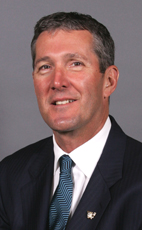
House of Commons photo

Crucial Fact

  • His favourite word was aboriginal.

Last in Parliament September 2008, as Conservative MP for Portage—Lisgar (Manitoba)

Won his last election, in 2006, with 70% of the vote.

Statements in the House

Privilege March 19th, 2002

Mr. Speaker, again my intention is to address the member's question of privilege. Despite his admonitions to the contrary I am attempting to deal with the specific accusations he has levelled against me, as frivolous as I believe them to be.

The statements by the minister of defence to the committee, which were contradicted subsequently by the chief of defence staff and by the deputy chief of defence staff, would be something that hon. members would think committee members would want to get to the bottom of. I raise this as an example of something that illustrates where the tyranny of the majority who want to get to the end of the process rather than the bottom of it was used.

I give this as an example to you, Mr. Speaker, because I think it is important. The Prime Minister's parliamentary secretary who has raised this question of privilege against me, said in advance of the committee's work that he would vote against all motions for more witnesses. That he would vote against all witnesses coming before the committee clearly betrays the government's desire to simply get to the end of the process as fast as it can, not to get to the bottom of it.

Now the Parliamentary Secretary to the Prime Minister is trying to use a question of privilege to discourage the opposition from criticizing the minister. I would like to tell the parliamentary secretary through you, Mr. Speaker, that he cannot silence me and he will not silence the members of the Canadian Alliance in this way.

He cannot end allegations of cover-up and manipulation of information on the part of the government by continuing that kind of behaviour. If he wants to end the criticism, he should begin for example by telling the member for Toronto--Danforth to stop threatening the witnesses who appear before the committee. He should urge the minister of defence to come clean and apologize. He should suggest to the Prime Minister that he get a new minister of defence. This bogus question of privilege will not end a thing.

As I said earlier, I respect the rules of the House and your authority, Mr. Speaker. I would not accuse any member of deliberately misleading the House unless I was prepared to formally raise it as a question of privilege with a motion so that the House might make a decision.

I did so in the case of the minister of defence in accordance with our rules and practices. Accordingly you, Mr. Speaker, permitted me to move my motion. I noted that the government members tried to spin your ruling and claim that you did not find a prima facie question of privilege.

At the Standing Committee on Procedure and House Affairs on Thursday, February 28, Joseph Maingot, the author of Parliamentary Privilege in Canada , was asked that specific question. He responded by saying that finding a prima facie question of privilege was the only basis on which the Speaker could allow a motion to be put. Apart from unanimous consent that is the procedure.

Just because the Speaker did not use those words does not mean there was no prima facie question of privilege. To the disappointment of certain members, a prima facie question of privilege was found. A motion was moved. The motion was adopted. The matter was then sent to the Standing Committee on Procedure and House Affairs for consideration.

In my presentation in the House and at committee, I had no choice but to use words such as “deliberately misleading” in reference to the minister's behaviour because that was my specific charge. The rules require that I make a specific charge when I raise a question of privilege.

I reviewed the presentation of the Parliamentary Secretary to the Prime Minister and I see no specific charge against me. The member claims that material put in the public domain reflects on the dignity of the House. It is fair to say that it reflects on the reputation of the minister of defence. That is the consequence of being charged with such a serious offence as the minister of defence has been charged with.

It is ironic that what I assert is that the minister was deceptive in his behaviour to the House, but I have not asserted his incompetence. If the minister in his own defence claims he is neither devious nor is he incompetent, he is incompetent to understand his own briefings, he is incompetent to forward relevant information to the Prime Minister. It is ironic that he would contradict in his own testimony, the testimony of the chief of defence staff with whom he has to work so closely and that the committee would then dismiss that issue as if it meant nothing when of course it does.

The committee's behaviour and the conduct of the member for Leeds--Grenville as a member of that committee demonstrate again better than I can the irony of this situation. In their attempt to pass this process on and to move it quickly forward, what they have done is they have raised more questions about the competence of the minister of defence than the opposition could ever have raised.

In closing, I followed the procedures of the House with respect to my charge against the minister. I respected the rules. My remarks were parliamentary. What I said was said at the appropriate time in the appropriate way.

With respect to the remarks I made outside the House referred to by the Parliamentary Secretary to the Prime Minister in his presentation, it should be noted that what I said outside the House was consistent with what I said inside the House and it was consistent with what I said in committee. If the circumstances allowed me to use certain words uttered inside the House, uttered inside committee, then those same circumstances allow for the same words to be uttered outside the House.

The charge against me is weak. It is a poor and desperate attempt to diffuse the real affront facing parliament today. The real affront facing parliament is the behaviour of the government and its flippant and arrogant attitude toward the processes of the House and the principle of responsible government.

As an opposition member of parliament I will continue to expose wrongdoing when I see wrongdoing, corruption when corruption is found. I shall continue to defend the dignity of the House. I will call to task any minister who deliberately misleads the House.

As Lester Pearson once said, the opposition functions as the detergent of democracy. It has been my experience that the dirtier things are, the more important it is to have good detergent.

Privilege March 19th, 2002

Mr. Speaker, on February 28 the Parliamentary Secretary to the Prime Minister raised a question of privilege claiming that the dignity of the House was in question and suggested that it had something to do with statements I made outside the House.

I have the utmost respect for the House, its members and the authority of the Speaker. I have the utmost respect even for the member for Leeds--Grenville but I take offence to these kinds of accusations.

The member's charge of contempt involves my charge of contempt against his colleague, the Minister of National Defence. His case appears to be more a prima facie case of tit for tat than it is one of contempt.

I raised my question of privilege against the Minister of National Defence because I believed that parliament deserved, and its members required, truthful and precise information. The fact that it was a minister of the crown involved made it that much more serious because the principle of ministerial responsibility provides the foundation of our constitutional system for the control of power. Providing parliament with accurate information and being responsible for that information is a key responsibility of a minister.

The parliamentary secretary would have us believe that he is protecting the dignity of the House. The way I see it and the way Canadians will see it is that the Prime Minister through his parliamentary secretary is trying to protect the Minister of National Defence and the reputation of his government. If he were interested in the dignity of the House he would not be trying to censor the opposition from exposing his government's disrespectful and dismissive view of the House and its members. As John Diefenbaker once said:

If parliament is to be preserved as a living institution, His Majesty's Loyal Opposition must fearlessly perform its functions. The reading of history proves that freedom always dies when criticism ends.

My accuser is noticeably upset with my charge of contempt against his colleague, the Minister of National Defence. He desperately wants the criticism of the way his government is handling this issue to end but it will not end. If anything, the way in which the government has responded to this criticism will encourage it.

My responsibility and the responsibility of members on this side of the House is to protect Canadians from the tyranny of the majority. Such tyranny must be guarded against. We saw ample evidence of that this morning in the committee examining the ambassadorial appointment of former public works minister Alfonso Gagliano.

The government has aborted the committee's inquiry into the defence minister's conflicting statements about prisoners in Afghanistan in order to prevent further embarrassment for the minister. Liberal MPs vehemently opposed requests for more evidence after going through a preliminary round of 11 witnesses. The Liberals on the committee used their majority to defeat motions, to call witnesses, to gather more facts, to get more information, to recall the minister, and to resolve questions raised by contradictions between his testimony and that of the Canadian military chief of staff.

Privilege March 19th, 2002

Mr. Speaker, I rise in support of the motion brought by the hon. member for Mercier. I will add some comments I hope will help you in your deliberations.

Our diplomatic corps is vital to the effective execution of Canadian foreign policy. It is clear that our diplomatic corps should represent Canadian values and interests abroad. Canadian ambassadors are the standard bearers for our country and Canadian values. Given the importance of the role it would seem important to select ambassadors according to a rigorous screening process. However such is not the case for political appointees.

New ambassadors recruited from within the foreign service typically possess a minimum of 20 years experience. They must go through a competitive and exhaustive process to ensure their merits are examined in detail and taken into account before they are made into ambassadors.

The current nominee has no diplomatic experience. Today's committee meeting was to be our sole means of reviewing his merit or lack thereof.

It is central to our responsibilities as members of the committee to examine behaviour. Ethical behaviour is vital for an ambassador. That goes without saying. One must adhere to the values Canada wishes to project abroad if one is to represent those values.

I think most Canadians consider fairness, honesty and merit to be ethics we should follow and associate ourselves with at all times. There have been numerous accusations against the nominee we were to question today that call into serious doubt his adherence to those ethics. Today again was our sole opportunity to examine his ethics.

Oxford defines ethics as the moral principles governing or influencing conduct. If we are unable to consider and examine the conduct of an applicant how can we possibly examine the ethics of the person?

The responsibilities charged to us under the standing order tell us we should examine the qualifications and competence of appointees. Today we were not permitted to raise questions about numerous well publicized allegations concerning the former public works minister. I will not repeat the allegations here but they are numerous.

I can understand the chair, to a degree at least, trying to make sure factual information is presented prior to a question being asked. However when the chair decides to rule out all references and questions relating to past political activity it is going too far.

Mr. Speaker, what that does and what you will do if you do not rule in favour of the motion is say it is all right to charge committees with responsibility for examining the competence of individuals but render them unable to examine the way the individuals have fulfilled their responsibilities. In other words, we would be totally unable to make references to past behaviour in the examination of witnesses. If we cannot make references to past behaviour how can we possibly establish whether a person before us is credible or not?

My father used to tell me not to listen to what a man says but to look at what he has done. That is the way to evaluate a person's ethics, capabilities and competence. How can we possibly do that in committees which are not allowed to raise questions about a person's past conduct?

Mr. Speaker, I understand you will need to rule based on certain precedents. On numerous occasions the committee has examined applicants for foreign ambassadorial postings. If you examine the minutes of those meetings you might well find that questions about the past activities of such applicants as Sergio Marchi and others abound. Questions about their behaviour, decisions and conduct as ministers of the crown are in the minutes of the committee meetings.

There is a well established precedent of the committee being charged with the responsibility of examining and evaluating the capability of applicants. Perhaps not all applicants have been burdened with the same allegations of misconduct as this one. Nonetheless, applicants have had to be examined by committees of their former colleagues which were able to raise questions about their past decisions and activities as political people.

Departing from that precedent would render the committee unable to ask questions about the past actions of applicants. When the Prime Minister chose to appoint colleagues to foreign ambassadorial positions ahead of others who were much more deserving, as he has continued to do, the committee would be unable to properly examine them.

Why have the committee? It would be a rubber stamp. It would exist only to give the appearance of credibility to something incredible. It would give the perception of validity to something totally invalid. It would give the appearance of legitimacy to something entirely illegitimate. The activity this morning was an insult to the intelligence of the Canadian people.

Mr. Speaker, I urge you to find in favour of the suggestion of my hon. colleague from Mercier.

Species at Risk Act February 26th, 2002

Mr. Speaker, I am pleased to add some comments to the debate. I appreciate the comments by my hon. colleague, which were deeply heartfelt, as are the comments that all members make in the House about this issue. I think protecting species at risk is a broad based concern shared by all Canadians.

In terms of this particular amendment to the bill and others that have been presented, our concerns are based on the desire to see legislation that works. We are concerned with results and to achieve those results one has to consider the socioeconomic aspects of the bill.

To suggest that we will achieve the desired goals we have for the legislation without being fair in terms of the socioeconomic impact this will have on our partners in the use of the environment, the resource companies, the individual producer and the agricultural producers, which is a major concern for my riding, is to suggest something that is unachievable.

The reality is that landowners and farmers deal with these issues on a daily basis. They are the frontline people. They run their businesses in an environment in which they are in partnership with nature. They recognize not only the risk that nature presents to the, but the risk it presents to the species with whom they share the land. In my experience it has been people like those in my constituency, farm families and rural inhabitants, who have been the frontline troops in the battle to preserve our species at risk and their natural habitat.

Many of the projects that have taken place in my riding, such as soil conservation projects, grasslands preservation projects, wetlands conservation projects and the like, have been successful only because of the participation of people in that region who believed these projects were fair, reasonable and that they would work. They involved themselves in a sharing manner in making these projects work. The bill fails to do that and because of that it is flawed.

My dad used to say that some people were so smart they were stupid. What I am referring to is the basic fact that all the scientific data in the world will not change the fact that if people on the land, people who depend on the land, perceive this bill as something that punishes them or is unfair to them, all the brains in the world and all the beautiful laws we write here will not succeed in getting the result we want.

I cannot help but contrast the problems in this bill with the problems facing our Minister of National Defence right now. I am glad he is here with us. In his case he was briefed on an issue but has asserted that he did not quite understand that briefing. He said that he came to a fuller realization of the briefing as the week went on. What that speaks to is a failure to communicate and a failure to understand. That is paralleled by this bill.

I know many groups made submissions to the committee in the preparatory stages of the bill. They were asked to make submissions and did so in good faith. The World Wildlife Fund, the mining industry, the pulp and paper industry, even the Sierra Club all agreed that socioeconomic impacts needed to be considered and considered seriously if the bill were to succeed. The problem we have is that the briefing did not take place and the reality is that the information did not seem to stick. It is the same kind of thing--

Foreign Affairs February 26th, 2002

Mr. Speaker, they are not even following the lead of each other. The minister should talk to the Prime Minister. The minister himself said on Thursday, February 14, that he was waiting for evidence of Hussein's weapons of mass destruction program. Now he has it. A CSIS report released yesterday confirms Hussein is “determined to develop nuclear weapons capability at the earliest opportunity”.

Canadian intelligence agents have already advised the government of that fact. The minister is running out of excuses. He has a coalition. He has evidence. Now he has a decision to make. Will he support our allies or will he make more excuses? Which will it be?

Foreign Affairs February 26th, 2002

Mr. Speaker, the Minister of Foreign Affairs has placed two preconditions on Canadian support for military action against the Iraqi regime of Saddam Hussein.

The first condition is that there must be a coalition. Yesterday British Prime Minister Tony Blair made that coalition a reality by announcing that the United Kingdom would play a full part in actions to stop Iraq from developing weapons of mass destruction.

Will the government now support Canada's allies in countering the very real global threat of the Iraqi weapons program?

National Defence February 25th, 2002

More government spin, Mr. Speaker.

Here is what Canadian forces people are saying. Major General Ed Fitch has said that the army is on starvation rations. Brigadier General Ivan Fenton has said that the army is very overstretched due to benign neglect. The commander of our army, General Mike Jeffery, said on Friday that the army is living on borrowed time.

We ask a lot of our Canadian troops. When will the government start to show some respect for them? Serving Canadian military officers rarely speak out against the decisions of their political masters. Why are they speaking out now?

National Defence February 25th, 2002

Mr. Speaker, the Prime Minister recently insulted those of us who have been calling for a strengthening of investment in defence as “a bunch of guys who are lobbyists who are representing those who sell armaments”.

The Prime Minister's comments are an insult. They are an insult to the majority of Canadians who want us to be able to stand up for ourselves in the world. They are an insult to the men and women of the Canadian forces both past and present.

Commander Mike Jeffery has said that this government is “driving our personnel into the ground”.

Will the minister dismiss this distinguished Canadian's comments as those of just a lobbyist, or is the general right?

Citizenship and Immigration February 22nd, 2002

Mr. Speaker, I appreciate that answer.

Yesterday the Minister of Citizenship and Immigration contended that Liberal IRB appointments are made on the basis of merit and competence, yet we know that department has been a dumping ground for Liberals.

Yves Bourbonnais, who is at the centre of this corruption investigation and a Liberal appointment, was a disbarred lawyer convicted of committing fraud against the government.

Can the Deputy Prime Minister tell us, is that the sort of confidence Canadians can expect from the government's appointments?

Citizenship and Immigration February 22nd, 2002

Mr. Speaker, Canadians need to know that the Immigration and Refugee Board is not allowing more terrorists like Ahmed Ressam to operate in this country. Yesterday the immigration minister arrogantly refused to answer questions about this serious matter calling them stupid. Since the minister responsible is obviously not, can the Deputy Prime Minister offer Canadians some assurances that their security will not be put at risk by IRB corruption?