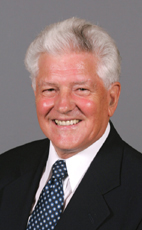
House of Commons photo

Crucial Fact

  • His favourite word was particular.

Last in Parliament November 2005, as Conservative MP for Kelowna (B.C.)

Won his last election, in 2004, with 48% of the vote.

Statements in the House

Prebudget Consultations November 7th, 2001

Mr. Speaker, that was a most learned discourse. It is absolutely unbelievable but I think the hon. member forgot in which House he was speaking. I think he thought he was speaking in the provincial house. I think he finally recognized that he was in Ottawa and so he got turned around a little bit.

The hon. member knows or should know that a tremendous amount of trade takes place between Canada and the United States. In fact 85% of our export market goes across the border and about 45% of that transfers across the border over three bridges in Ontario.

The member waxed very eloquently about the condition of the roads but there is a lot more to it than that. Not long ago I saw a presentation with a computer model showing how traffic could be re-routed through some of the border crossings.

I wonder whether the hon. member would have the courage to talk to the Minister of Finance to make some provision in the budget that would actually create an opportunity for a re-routing of this transportation and to be sure that in fact this could happen. That would eventually result in a more efficient transportation system and actually reduce the amount of money required to do this.

Is there a move on the part of the member to help the finance minister figure out a way that would work better? That is my first question.

The second question has to do with the position of cities in our economy today.

Export Development Act October 30th, 2001

Mr. Speaker, I would be very happy to respond to the hon. member. That is not at all what I referred to. There is sensitive information, and the hon. member knows that I know that.

I completely agree that if there is information that is pertinent to a particular contract, it must be kept confidential. However I do not believe all information is of that nature, and he knows that too.

The important issue here is that there is a lot of information that can and should be made public. The financial institutions, such as the banking institutions that are governed by the superintendent of financial institutions, must give certain information to the superintendent. What we are talking about is that the corporation we are talking about today does not have to do that. It should be as clear and transparent as those institutions have to be to the superintendent, no more and no less.

We are not talking about the abuse of information. I am not going on a fishing expedition and I do not think the hon. member is. That is not the issue nor is it the point I was trying to make.

The point I am trying to make is that if it is legitimate information it should be made public and it should be available to all those who want it.

Export Development Act October 30th, 2001

Mr. Speaker, I would like to address my remarks to three particular points in the bill. I would like to attack it from the principles of patronage appointments and of crown corporations and private enterprise, and also on the business of transparency, in particular with regard to the judge, advocacy and jury all at the same time with the bill. It would do those things.

It is actually amazing what the bill would do and how it came to be. The first thing I want to stress is the business of this crown corporation actually being created to be in direct competition with private enterprise. Some people would ask how I came to this kind of conclusion. The conclusion comes to me on the basis of what the United Kingdom did when it considered joining the EU. At that time it became very evident that it needed to maintain a clear balance between crown corporations, which are really the instrument of government, to develop their particular policies, purposes and objectives, and to do so in a commercially viable way. At least that is the purported intent.

While I do not quarrel with a situation where a private enterprise could not get into that enterprise, I do quarrel with it here. So did the EU and so did the United Kingdom. In fact, in 1991, ten years ago, the United Kingdom privatized a short term branch of its equivalent export agency. It was called the Export Credits Guarantee Department. The agency was privatized to ensure that there were no implied trade subsidies in the EU from one country to another. The United Kingdom government now, as written in 1997, provides a political risk reinsurance to the private company that took over the ECGD.

I think it is very significant that the United Kingdom saw the potential conflict that was there, not only in its own government but also in the governments of other countries, and the complication that it would create among various countries doing business with one another. It wanted to have a fair and level playing field among them.

Why is that significant? The EDC really runs its operation on two accounts. It has a commercial account and it has a Canada account. The commercial account really gets most of its money from financing export operations and the insurance in guaranteeing certain loans to exporters. The Canada account, on the other hand, is designed to advance the particular policies, objectives and purposes of the Canadian government. I am really addressing my remarks here to the first part of that, because that is its major operation. It is here that it finds itself in direct conflict with private enterprise.

Philosophically and on principle I am utterly and completely opposed to government doing things that the private sector can do as well or better. I would suggest that not only is that the case for the private enterprise, but it is actually in the interests of all Canadians that it be the case.

I will move on to my second point which has to do with the patronage appointments that are possible here. I will read, for the benefit of those who are listening to us this afternoon, the provisions for this activity as provided for in Bill C-31. It is really an amendment to section 7. Section 7.1 states:

The Board may establish any other committee and that committee may exercise any powers and perform any duties of the Board delegated to it by the Board.

If we wanted carte blanche, there it is. We would first of all have this board and this board would have a number of members on it appointed by the government. They feel they would like to do something. There may be some friends that they would like to have doing some work, so they form a committee and appoint people who are their friends and who can do certain kinds of things. The number of committees is unlimited. They may form any committee to do whatever they want and then they can delegate whatever powers they have to any one of those particular committees.

One would think that reason would prevail and that in fact there would not be an abuse of this power, but we have seen it, not only in this government but in other governments where this kind of freedom exists and politics rather than the interests of people enter into the decision making process. At that point it is clearly obvious that a political advantage accrues to those who supported the party in power. That is what I am concerned about.

Not only would the bill make it possible, the bill almost says please do it and make sure that there are enough vacancies here so that we can appoint anybody we want to have appointed to these committees. I take strong exception to that. I do not believe that kind of thing should happen.

Can a private corporation do something similar to this? Yes, it can, but it has the added difference that it does this on the basis of being efficient and working in the interests of the shareholders and the people it is trying to serve.

That motivation may be the same for the government, but it may not be. The political situation may be one of fostering its own bed rather than developing what is there in the best interests.

I know, Mr. Speaker, that is not you. You care about people. I know that. I know you very well. Even though you are in an opposing party, you are the kind of guy who I think would not do this sort of thing. However, Mr. Speaker, they are not all like you.

I will move on to my third point which has to do with the judge, advocacy and jury of this committee. I cannot believe the kind of thing that has happened here. However, not only do I have to believe it, I have to put it in the context of what the auditor general said about this corporation.

I want to refer specifically to paragraph 22 in the May 2001 auditor general's report on the Export Development Corporation and in particular the environmental review framework. In paragraph 22 he states:

Unlike federal departments and agencies--

Here I notice that he is separating out from federal departments and agencies that crown corporation in particular, the Export Development Corporation.

--the Export Development Corporation is not subject to the Canadian Environmental Assessment Act or to the Access to Information Act. Unlike private sector financial institutions, it is not subject to regulation by the Office of the Superintendent of Financial Institutions, does not pay income tax, is not required to pay dividends, and can borrow at favourable rates on the credit of the Government of Canada.

That is very significant. This group could determine a number of things. With regard to the environment, it may determine whether a particular project “is likely to have adverse environmental effects” and then later on it will define what an adverse environmental effect is to be. Is that not interesting? A project comes up and the board decides on what are adverse environmental conditions. The other one is whether the particular project actually does meet those requirements. If we wanted to create a situation where we could change the rules of the game halfway through the game, we would have a perfect way in which to do this. All the board would have to do is change the definition and change its particular interpretation or application of that definition for a particular project.

I cannot think of a greater morass, almost a miasma, a poisonous vapour arising from this kind of situation, than a group that comes to this board and says it will not cause environmental damage, with the board members saying they are not sure if it fits the definition or not, and then they could move it around to suit the situation as they wanted.

That should never be allowed. There should be an independent group like the environmental group that stands for all government agencies and departments, financial institutions, private institutions and for us as individuals. It should apply in exactly the same way to this agency even though it is a crown corporation.

I have to vote against this provision unless it is changed.

The Economy October 25th, 2001

Mr. Speaker, the Canadian Chamber of Commerce is asking the federal government to implement two important resolutions presented to it by the Kelowna Chamber of Commerce.

The first resolution asks the federal government to make permanent its spousal employment pilot for highly skilled workers. Allowing spouses and partners to seek employment in Canada attracts the best high tech workers from around the world and brings their considerable talents to the flourishing technology sector in the Okanagan.

The second resolution calls for the federal government to provide tax incentives to businesses and individuals who buy ultra low emission vehicles. Kelowna is the home of Dynasty, a maker of electric cars and a leader in environmentally sound technology.

I encourage the federal government to work with the Canadian Chamber of Commerce to make these resolutions a reality and to support the dynamic economy of the Okanagan.

Question No. 42 October 24th, 2001

With regard to grants, contributions and/or loan guarantees made either by a Crown Corporation, a department and/or an agency of the government to Bombardier Inc., for each fiscal year since 1996, can the government specify: (a) how many such grants, contributions and/or loan guarantees were made; (b) the source and value of each grant, contribution and/or loan guarantee; (c) the date they were issued; (d) the reason or reasons such assistance was provided; and (e) the present status of the grant, contribution and/or loan guarantee (whether repaid, partially paid, or unpaid, including the value of the repayment)?

Return tabled.

The Economy October 24th, 2001

Mr. Speaker, my question is for the Minister of Finance. The Minister of Finance knows that we are in an economic downturn. He also knows that the people who suffer the most because of this are those who are at the lower income level.

Will the finance minister, in his budget, declare that the increase in the Canada pension plan will not take place in January 2002?

Supply October 23rd, 2001

Mr. Speaker, I have a supplementary question for the member which has to do with the stringency with which he would like to pursue the issue of terrorism in Canada and Canada becoming the venue or the springboard for these unsavoury people to launch themselves into another country.

I wonder if the hon. member could talk about that in some detail. He spent a lot of time talking about other things. In his response to my earlier question he said that we had all those safeguards now.

Does the hon. member know that some 27,000 of these people have gotten lost somewhere and we do not know where they are? Does he also know that people in Fort McMurray were discovered to have not one but a list of criminal offences against them. Does he know that these people were able to find refuge in Canada when they should not have had refuge in Canada and should not have been considered to be refugees? They should not have qualified but nothing was done.

Does the hon. member know why this is happening? Is it because the government is not doing what it can do or is it because the legislation is wrong? If that is the case, why is C-36 not before the House to do some of the things we are talking about?

Our motion specifically deals with a new way of looking at protecting our country and making it safe from terrorists coming into this country in the first place.

Supply October 23rd, 2001

Mr. Speaker, I found the comments of the hon. member rather interesting. It seems to me that the hon. member forgot to read the motion currently being debated.

He waxed long and eloquently upon the benefits of immigrants coming to the country, which I certainly would endorse. Many people, I dare say most of us, have ancestors who were immigrants to Canada. We are very proud and thankful that we are able to live and make a living here. Many people have contributed many things to the country. The hon. member absolutely is correct about that, but that is not what we are debating today.

We are debating the possibility, in fact the desirability, of creating a defence mechanism whereby government officials would be empowered to arrest suspected criminals or terrorists at the border. Spontaneous refugee claimants appearing at the border without documentation would be detained until we could find out whether they were legitimate refugees. Finally, there would be a list of safe countries from which we would not accept refugees. That is what we are debating.

This is not a question of whether we should or should not have immigrants come to the country. Of course we want immigrants. We want to be compassionate toward refugees who are suffering and who are in danger of being persecuted for whatever reasons, whether they be religious or political. We want to be compassionate and encourage immigrants but the issue is what the best possible mechanism would be to make sure that people who are suspected of being terrorists or who are known to be terrorists are kept out.

We all want safe communities. We want to feel free from having our possessions stolen. We do not want our friends or associates murdered. We want peace. We want quiet. We want non-violence. The motion is designed to create a mechanism to take the identified terrorists aside and tell them they cannot come to Canada, that Canada will not be a place for them to launch their terrorists activities or for them to go to other countries.

That is the issue. I wish the hon. member would comment on that issue rather than on the immigration issue at large.

Anti-terrorism Act October 16th, 2001

Mr. Speaker, I thank my colleague for splitting his time. It makes it possible for me to speak earlier in the day rather than later.

I think the government is taking the right step by moving in the direction of introducing Bill C-36. However, as my colleague asked so clearly, why did it take so long? I also recognize that the bill was probably put together very quickly on very short notice. Apparently people seemed to think there was no need to do anything like this.

Now we have legislation that is omnibus in nature and covers a variety of other acts that are to be amended by this bill. Perhaps some of the safeguards that need to be included in the bill have not been thought of or have not been adequately dealt with. I will focus on a couple of them.

I refer to a particular phrase that the hon. minister stated in her address to the House earlier this day. It had to do with dealing with the root causes of hatred. Perhaps the issue here is not so much hatred as it is fear.

What happens in terrorist operations is that terrorists use fear as their weapon. It is one thing to destroy property or to destroy human lives, but hatred is a motivator, as I think we all know and have experienced. It gets the adrenaline flowing.

In the game of hockey adrenaline can really run high. People do not really hate the opposition, but by golly they sure get boiled up every once in a while and sometimes perhaps there is an element of that. When a player can strike fear into and intimidate the opposite team member, the team member will avoid the other player. Damage does not have to be done because the fear is debilitating.

What is happening in our country right now is that we are not acting as perhaps we ought to do. The threat of terrorists is to intimidate to the point where it incapacitates the individual. That is a much more subtle effect than simply destroying someone, because it affects everyone.

It is one thing to take down two towers in the centre of New York City. It had a terrible effect. We feel very sympathetic to the families involved. However it is affecting all of us. It is affecting our celebrations.

On Saturday I was at a wedding ceremony where candles had been ordered to be part of the table setting. They were delayed and got there an hour before the reception was to take place. Why? They had been ordered six months ago. They had been held up because of the September 11 events in New York City.

Every one of us is affected. It does not bother some a great deal, but others are fearful. There are people, for example, today who refuse to get on an airline because of the fear of what will happen to them and whether it is safe to travel. That is the fear I am talking about. That is the effect it has on our economy. I suggest we really look at the effectiveness of terrorist acts at striking fear into the hearts of individuals, rendering them almost incapacitated.

I will move on to another point. The definition of a terrorist act causes me some concern. I do not think I have time to read everything, but I will refer to the overall section referring to an act that is committed:

--in whole or in part with the intention of intimidating the public, or a segment of the public, with regard to its security, including its economic security, or compelling a person, a government, or a domestic or an international organization to do or to refrain from doing any act, whether the person, government or organization is inside or outside Canada...and that is intended...to cause death...and that is intended to cause serious interference with or serious disruption of an essential service, facility or system, whether public or private, other than as a result of lawful advocacy, protest, dissent or stoppage of work that does not involve an activity that is intended to result in the conduct or harm referred to in any of the clauses.

The hon. minister took great pains this morning to emphasize this, so I would like to ask the members as well as the committee members who will meet to discuss the bill to consider the example of what happened in Vancouver when the transit system was incapacitated by a strike for more than six months. It was not the express intention of the union or the group of people that brought about the strike to cause severe difficulty, but the strike did so and it was not unknown that it did.

If the intention is the issue but the result is immaterial, I think that to separate them is perhaps misleading. Not only must we intend to do something bad, but if we do something bad whether we intended to or not the act itself becomes a bad one. It is not that this is not what should be done in the act. The caveat here, what ought to be so strong, is that it does not mislead the public and allow certain freedoms to be exercised at the expense of others.

On the balance side of this position is the intrusion, if you will, by the power of the state through its police officers and other peace officers to, on the suspicion or belief that a terrorist act is about to be committed, charge and detain someone without particular evidence in place, to simply put someone aside because it is believed that person will be doing something such as intimidating people or destroying property. In some cases it would be correct and I think the police should have that power, but there ought to be clear safeguards as to what kinds of things would support that belief that someone might engage in such activities.

There are some things in the bill that ought to be fixed. I do not want the minister to go away from this thinking we are totally opposed to the bill. We are not and I certainly am not, but we ought to be very careful about civil liberties and at the same time not open the door to certain other opportunities that might cause us other difficulties.

With the time I have left, I would like to make one more point with regard to the operation of CIDA. This morning a column in the National Post written by Diane Francis makes a very interesting case. She asks the question: Should CIDA, a taxpayer funded organization, support organizations like Minga, which is operating in Colombia?

It is not quite clear. I certainly do not know the details of what is going on there, but the implication of this column is that it is not clear whether Minga is aiding and abetting the operation or the function of three groups: the National Liberation Army, the Revolutionary Armed Force of Colombia or the United Self-Defence Forces of Colombia.

If Minga is in fact doing that, then it actually is in collaboration with organizations that have been put on the list of terrorist organizations by the United States of America. If she is right we ought to take a very careful and serious look at it. I know the bill suggests that we should not fund any terrorist organizations and I am sure the Government of Canada would never think of doing that, but it could be that unless there is a clear and careful audit of how moneys like those from CIDA, for example, are spent and applied such moneys might find their way into organizations such as these.

I really would ask this question and I would ask the minister to ask the Minister of Finance and the minister in charge of CIDA to look at where the money is going, how it is being applied and whether it in fact finds its way indirectly to terrorist organizations.

With that, I would like to suggest that the committee look very carefully at this legislation and that we in parliament support the principle of the legislation, surely, but let us look at the details in such a way as to look after our civil liberties and deal with the real issues.

Courts Administration Service Act October 3rd, 2001

Madam Speaker, the whole business of setting things up in such a way is to make sure that the judges who are appointed for each of the specific courts make the decisions that they ought to be making. When this does not happen, when the solicitor general loses the particular responsibility through the formation of a committee, that is not doing what was originally intended for the solicitor general. It is an illustration of what happens here.

I will support this piece of legislation because its intent is okay. I also want to caution that unless it is administered in such a way that the intent is realized, it will not meet the objective that was set for it in the first place.