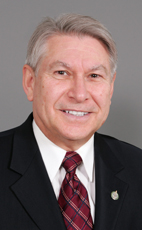
House of Commons photo

Crucial Fact

  • His favourite word was terms.

Last in Parliament September 2008, as Liberal MP for Thunder Bay—Rainy River (Ontario)

Lost his last election, in 2011, with 22% of the vote.

Statements in the House

April 16th, 2007

Mr. Speaker, first, there is no mention anywhere in the budget of specific regional support for any of the programs across the country. The north and all regions must be reassured. I ask the parliamentary secretary to convey that.

The second point is the budget clearly does not address the distribution of the gas tax to the roads and local service boards of Ontario. There are $6 million yet waiting for a mechanism to distribute these funds.

Third, why would the budget not follow the recommendations of the provincial and national municipal organizations such as the Association of Municipalities of Ontario and FCM to make this funding, these supports for municipalities permanent?

April 16th, 2007

Mr. Speaker, consultations were held throughout northern Ontario on FedNor in particular and the budget in general.

There was no mention in the budget about this issue and people in Thunder Bay are very worried, not only in my riding but throughout the north. They did not see any mention in the budget of what is of concern to them. They do not need any more worries. They want reassurance.

As we have been holding these hearings, the people have been telling us, in very plan language, that now is the time for government to recognize the needs of the regions. When they do not hear mention of the regional programs, whether it is FedNor or ACOA or the others, then all this talk in government of diversification means that there is a role for government to play. In the regions, a little can go a long way. Government must recognize that FedNor is already under-resourced. Indeed, it needs more money.

Last year's cuts of $4.6 million must be replaced and indeed upgraded. There is certainly enough demand, as I believe the parliamentary secretary is well aware, when we talk about the components through which FedNor administers the COMRIF program in the province of Ontario.

Just the other day the minister responsible for FedNor sent me a letter that talked of that $298 million over the next five years. That $298 million over five years may seem like a lot, but in the province of Ontario that money is for eligible counties, regions and municipalities under 250,000 people. We are talking about almost 375 jurisdictions of the 446 that exist in Ontario.

What happened over the past three intakes for infrastructure was that the engineering and professional fees were not included as part of that allocation. It becomes very costly for small communities and there is no guarantee that they will get in under any of those programs. There is no list. If one is successful the first time, one can apply a second or third time.

These municipalities do not get any advice as to the validity of their cases. They can apply three times and be out of pocket. Essentially it becomes a lottery to them. These become very heavy hits for small communities. What we need is a process to tell them where they are. It should have been in the budget. If they are not going to be successful in the first round, then at least they should know that they are on the list somewhere.

Also in the province of Ontario there are roads boards, which are composed of volunteers. In the past three intakes, only one has been successful in its COMRIF application. Their question on the budget is that if they are not going to be eligible, why does infrastructure include them? Why make them go through all these hoops, particularly when it is so difficult for them to come up with this money in the first place?

The budget also should have addressed the distribution of the gas tax to these roads boards in Ontario. As the parliamentary secretary is well aware--

Foreign Affairs March 27th, 2007

Mr. Speaker, the Mexican authorities and the media continue to identify Cheryl Everall and Kimberley Kim as suspects in the murder of two Canadian citizens in Mexico.

In a letter to me, the Minister of Public Safety stated, “Foreign Affairs Canada is responsible for representing Canadian interests abroad”.

Why has the Minister of Foreign Affairs failed to request information from Mexican authorities regarding the status of this investigation and to find out if these women have been added to any watch lists? Why will he not help clear the names of these innocent women?

Action for Neighbourhood Change March 26th, 2007

Mr. Speaker, for the past two years, Action for Neighbourhood Change has been supporting the efforts of residents in five Canadian neighbourhoods to improve the quality of life in their community.

The program has been led by the United Way, in partnership with the Caledon Institute, the Tamarack Institute and the National Film Board. The Liberal government recognized the value of this initiative and provided financial support through three federal departments.

Action for Neighbourhood Change has been exploring how citizens can take the lead in revitalizing their neighbourhoods and what kind of investment and support is needed to succeed.

The Simpson-Ogden area in Thunder Bay is one of the participating neighbourhoods and the positive results are clear: a beautification campaign is ongoing; a strong sense of community pride has emerged; and residents have begun projects to inspect substandard housing, to develop anti-crime programs, to expand arts and environmental programs for teens and to enhance after school programs.

This program is too important to let it fade away. I call on the minority government to revisit its budget and help address this vital need for northwestern Ontario.

Employment Insurance Act March 23rd, 2007

Mr. Speaker, thank you for the warning.

We have already heard many of the benefits of the employment insurance system. It is a valued social program. All of us in the House agree that it has proven its helpfulness and usefulness. When we consider the positive impact that it has had for children and parents, we know it has addressed the aspect of a financial burden in stressful times. However, inequities remain in the act, which is why it needs a full review and I am pleased to bring these to the attention of the House today.

In 2000, the country was divided into economic regions for the purpose of determining benefits.

Thunder Bay, which is part of my riding of Thunder Bay—Rainy River, which is defined as a metropolitan area, became its own economic region, identified as number 37. Anything outside of Thunder Bay falls in the economic code of number 38. The difference between these two economic regions is immense.

For example, Mary lives in the city of Thunder Bay and Jennifer lives in Gillies, which is about 10 minutes outside of Thunder Bay. Both ladies work at company ABC. If company ABC has a work shortage and lays off a dozen of its employees, including Mary and Jennifer, both would apply for EI benefits.

Mary's application would fall under economic region number 37 for the city of Thunder Bay. She is required to have a minimum of 665 hours of work to qualify for the benefits.

Jennifer's application falls under economic region number 38 for northern Ontario. She is required to have a minimum of 525 hours of work to qualify for the benefits.

Under economic region number 37, Mary is eligible for a minimum of 15 weeks and a maximum of 38 weeks of benefits.

Under economic region number 38, Jennifer is eligible for a minimum of 26 weeks and a maximum of 45 weeks of benefits.

Those two individuals live just 10 minutes apart but Jennifer can get up to seven weeks more benefits than Mary for doing the same job at the same business.

Further, Jennifer's required hours are 525 compared to 665 for Mary. That is a 140 hour difference. This is a serious inequity that needs to be addressed.

Let us go quickly to severance pay.

Hundreds of forestry workers have been laid off at plants across my riding. Many of these individuals have worked for over 20 years at the same company. They have now lost their jobs due to global challenges, high fibre costs, high energy costs and, after so many years of dedicated service, these employees are entitled to severance pay to help them make a new start.

The employment insurance program views severance pay as a privilege, not an entitlement of their years of service as a dedicated employee. All severance must be allocated before employment insurance kicks in. I am aware of many constituents who have waited nearly a full year before being able to receive employment insurance benefits.

I strongly disagree with this punishing view of severance. Severance should be fully applicable to downsized employees to use as they will without penalty. If the penalty were not applied to severance, individuals would be better able to use that allotment to improve their lives, to pay for retraining, to start up a new business venture or to partner in an existing business. In reality, this penalty serves as a disincentive for these employees.

I recently received an e-mail from Shaun, an employee of Bowater for 27 years before he was permanently laid off. He views that $50 billion fund that he has been paying into for those 27 years as something vital to take care of him and his five children.

However, when we really examine the nature of a support network, it must be fair. It must induce respect and dignity, and that is why with this private member's bill before us is an opportunity to review and improve it.

Indeed, I would have to say to the members opposite, rather than carte blanche opposing this, let us have a truly meaningful, open and thorough review. I believe in this way we can make a positive difference.

All of us as elected representatives receive overtures. In fact, all of these cases that will come to us have that element of sorrow because people's lives have been disrupted. They have to decide what they will do. This is where a caring and compassionate country eases that burden, takes the pressure off and guides these people through the difficult times.

Indeed, a caring society and one that is indeed not only having a budget year but is having a budget in the EI fund is where I believe must be more sharing, more generous indeed, so that these people can carry through.

I do not think that there is anybody in the House who has not spoken to people experiencing those kinds of difficulties. When one sees it, then one realizes that in a fortunate country our measurement is how we treat those who are not having the same fortune.

Agriculture and Agri-Food March 23rd, 2007

Mr. Speaker, I asked a very respectful question. It would have been nice to actually get a direct answer.

A few weeks ago in the House, the Secretary of State for Agriculture advised the hon. member for Malpeque that there was plenty of money for drought-stricken farmers.

On Monday, there was no mention of this in the budget, not for southwestern Saskatchewan, not for Peace River, not for Rainy River and not for Thunder Bay. Why not?

When will the Minister of Agriculture deliver on the specific funding promised by his secretary?

The Budget March 23rd, 2007

Mr. Speaker, after reading all 477 pages of the budget, I have concluded that its lack of mention of regional economic development means a continuance of the disregard by the government for rural Canada. The Prime Minister has been quoted often on his disdain for the work of the four rural development agencies.

My question is for the Minister of Finance. Does its absence in the budget mean that this is the beginning of the end for regional development in Canada?

Business of Supply March 1st, 2007

Mr. Speaker, I hope the concern is shared by everyone in the House, that this is an export of Canadian technology. When we know it could be done in Canada, it hurts us even more. I agree with the questioner. Her case is very valid and I would certainly support her.

Business of Supply March 1st, 2007

Mr. Speaker, if that was a question, then I am certain I do not accept the premise.

When we talk about what government can do, which is the rational I have tried to use in to make my argument, if there is public money for infrastructure funding, particularly in public transportation, we have an opportunity to encourage and embellish Canadian technology, job training and the labour market. Indeed, by developing a public transportation buy Canada policy, it would allow everybody in the House to benefit. This would be something that we could export to the world. It would create manufacturing jobs not only in my riding of Thunder Bay—Rainy River, but for people throughout the country in other regions.

Business of Supply March 1st, 2007

When I do something wrong, I appreciate the chastisement. Thank you, Mr. Speaker.

I will take a moment to expand further on the effects of the youth employment service cut for my riding.

Launched in 1997, the youth employment program has been instrumental in developing Canada's workforce of the future by providing young Canadians access to programs and services that help them gain the skills, knowledge, career information and work experience they need to find and maintain employment. In the Thunder Bay—Rainy River riding, the program has provided assistance to over 250 youths each year.

In just a few months, youths across the riding will start looking for a summer job. Little do they know the extra challenge they will now face in this search. By cutting the summer work experience program in half, the government has eliminated funding for over 125 student jobs across my riding. Many of the businesses that participate in the funding program cannot afford to a hire summer student without this assistance. Because of this heartless funding cut, students will have an even tougher time finding a job this summer.

However, the bad news does not stop there. What if our youth are unable to find summer jobs? Will they be forced to take out additional student loans to pay for post-secondary education or, worse, will they need to postpone their education plans in order to save enough to cover the costs?