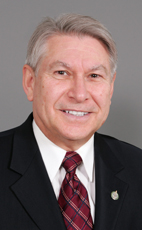
House of Commons photo

Crucial Fact

  • His favourite word was terms.

Last in Parliament September 2008, as Liberal MP for Thunder Bay—Rainy River (Ontario)

Lost his last election, in 2011, with 22% of the vote.

Statements in the House

Cycle for Spirit September 20th, 2006

Mr. Speaker, on April 24, three young Canadians set off on bikes from Victoria, B.C. to raise money for children's charities. Steve Fidler of Vancouver, Adrian Pusiak of Toronto and Jeremy Cummings of St. John's are all employees of The Keg Steakhouse who finished their cross country “Cycle for Spirit” on August 4.

They started this journey with a fundraising goal of $150,000 and finished their trek with a total of over $184,000. One hundred per cent of funds raised will go to children's charities through The Keg Spirit Foundation, which has donated more than $2 million to children's charities since its inception in 2001.

I had the pleasure of meeting these amazing young men as they came through Thunder Bay, and I congratulate them and their Keg co-workers across the country for supporting the many children's charities that will benefit from this adventure.

June 13th, 2006

Mr. Speaker, for months reasonable people have been urging the government to listen and to represent Canadians in regard to what is a long list of shortcomings.

In summary, anti-circumvention will kill new companies and stop innovative government programs. There will be no money for Canadian lumber companies for the next 10 months. We are still paying $40 million a month in illegal tariffs as we speak. The gutting of the dispute mechanism for NAFTA will end the free trade agreement, and we have seen enough examples of new products coming on. There is no interest on the $4 billion that we are expecting to be returned and no one knows when that will come. One billion dollars will be given to the Americans to work against us, to pay their legal bills and for President Bush to use to campaign.

And this just in: the Ontario government now objects to the deal because of the illegality--

June 13th, 2006

Mr. Speaker, what are northern Ontario's concerns about the softwood lumber deal? Why would this deal be called a sellout or a capitulation? There are many concerns, and clearly most have not received satisfactory answers, in spite of repeated reasonable questioning. Lumber groups and associations, private companies, exporters, manufacturers and labour have identified several tragic flaws.

First, the deal allows the Americans to keep 20% of the tariffs that were collected illegally. Recent reports suggest that the White House will receive $480 million, to be used at the discretion of President Bush. There are no controls on the use of these funds, so the fear is that they will be used in the Republican campaign or as third party funding in the next Canadian election. Five hundred million dollars will go to U.S. lumber interests to pay their legal bills from the past years or for future challenges to Canadian exporters. No interest will be paid for the funds that have been illegally held for such a long period of time.

Second, as for free trade, it eliminates the dispute panel, which means that all of Canada's hard-won victories in proving our case are thrown out. Already other American industries are challenging Canadian products such as corn, knowing that it will not cost them anything to stop us.

Third, this deal was rejected many times previously because it simply gave away too much. However, the dire straits of the industry may make any deal seem attractive in order to at least temporarily stop the bleeding. This situation easily could have been offset by the Liberal forestry plan of $1.5 billion, which was put in the funding envelope immediately prior to the November 2005 election call. Certain victory in the courts would have compelled the Americans to return all of the money, with interest.

Why have 80 Canadian companies now filed suit against the United States? Why have the major forest companies and many associations filed their protests? Why are both the Canadian and American governments being sued for selling out?

The main reason for all of the above is the special conditions that give free access only if current conditions stay the same. If there are changes, Canadian industries will suffer more penalties. We are still paying $40 million a month. So much for the good faith.

Just because there is a deal does not mean it is good. Northwestern Ontario will suffer heavily. It is predicted that 20% of Canadian sawmills will close. This is unacceptable.

Provincial and federal governments will not be permitted to change forest policies in any manner that could be interpreted as assisting the forest industries because of the terminology of the anti-circumvention measure, nor can any new assistance be provided. Should regional energy pricing come to the northwest, the Americans can overrule it.

The deal has been called an outright political surrender, but it is not too late, even now. I stand here today to let the Prime Minister know that northwestern Ontario will not be subjected to President Bush's hidden agenda.

For four years, Canada has been winning this battle. We do not have to give everything away just to end the war. The government must stand up for Canada.

Committees of the House June 12th, 2006

Mr. Speaker, when the farm groups come to us or when we go to them as individuals, they are imploring--I will not say they are begging. There is such a deep concern. I will try not to overemphasize that or embellish it in any way but each and every dairy farmer talks about this issue. They work so hard as it is. I do not know where they get the time to do the lobbying but they are worried about the future of providing a quality industry. They are in it because they believe in Canada and they believe that providing a first class safe product is what is the best thing for Canadians.

When we meet them we realize they are great families that keep this country solid. I cannot help but be impressed each and every time by the depth of their sincerity and the need for us to respond in an immediate and positive way. That is what compelled me and, I am certain, everyone else on the committee, except for the government, to support them.

Committees of the House June 12th, 2006

I was there and I saw it happen. I do have the motion in front of me.

I just want him to know that in point of principle, which is what we do with these decisions, that is what happened. Very clearly, the government voted against supply management and in no uncertain terms.

Committees of the House June 12th, 2006

Mr. Speaker, I believe the hon. member for Abbotsford has just confessed that the party he represents voted against supply management at the agriculture committee. I will confirm that is what happened at committee.

The point of principle was whether they were or were not in favour. When the motion was presented, clearly--

Committees of the House June 12th, 2006

Mr. Speaker, this debate is truly interesting because it does represent not only the dairy industry as the point in question but it comes down to not only producers and consumers questioning whether butter tarts should have butter in them, whether cheese should not be described as a cheese-like product, and whether milk should not be described as near-milk or ice cream as almost ice cream.

Indeed, in my riding the Thunder Bay Federation of Agriculture has presented several petitions and cases noticing the 2.65% cutback in milk quotas and only a .015% increase in the price of milk. They are still expected to somehow cope not only with these negotiations at an international level at a city far away from all of us but right there on the farmstead.

At the agricultural committee several other parties and the government were there and heard this case. It comes down to how we actually manifest milk protein concentrates and what the impact is on a daily basis. Well it comes to a loss of approximately $2 million a month for our dairy industry. As this continues, clearly that cannot be sustained.

Members of the House would be well advised to know that when these people come to us, they are not coming as some kind of ill-informed protestors. There is hard research. These are people who care deeply about the future of our country who provide good food and good product to Canadians. When we find out that every time MPCs replace 2.6 tonnes of skim milk powder, we can see the immediate impact in a very physical kind of way. Are we finding now that MPC imports are constituting some kind of breaking point for supply management? The question is, do we go on pretending that it is not something to be concerned about or do we respond?

I believe that the motion before us is our opportunity, as a trigger, to emphasize to the farming community that we are responding very directly in a caring way and that this message is something that we take very seriously. There is a point that will come eventually, as these imports continue unabated, that the milk price structure in Canada may collapse and that is a fact.

When people who have been doing research on this and follow it, if not daily, hourly, tell us that, I am certain that they have concerns. Therefore, it is our duty as elected representatives to respond. In the agriculture committee, when we heard these presentations the committee decided in a vote to bring it to the House because it had now reached that level of concern.

A question was asked earlier about the other components of the industry. It was concluded in committee to support the dairy farmers. This would lend credence to their case in their discussions and negotiations with other aspects of the industry, including the consumers. In this way they would know the state of the industry at this time.

When we look at what is happening, we cannot at any time weaken our government's position. Unfortunately for the government, the Conservatives voted against supply management and against the dairy farmers in committee. That is the message that I have been receiving from farmers, so when I hear appeals from all four parties here in the House that this issue be addressed in a non-partisan manner, I am quite willing to join that and really want to do it.

I hear flimsy things blaming the previous government for all the ills. After six months people are asking where are all the miracle cures that we were proposing for the past number of years because they are not happening? This is not a simple issue. It is complex and difficult.

Last year the previous government set record payments for agriculture in the farming community. Farmers know what was done for them last year. When the present government says that, it loses all credibility. It is amazing what happens. We cannot pull the wool over the farmers' eyes. They feel it daily and they understand immediately the impacts of these decisions.

When we pushed again in the agriculture committee to get the money for the grains and oilseeds people earlier this spring, the minister actually claimed last year's money from the previous minister was the rescue money. Farmers know exactly what is going on; these people will not be taken in.

We have to understand that when things like the Wheat Board come up simultaneously with the concerns of the dairy farmers, they are asking what is really going on here. If the government claims to be in support of supply management, why is it not adamantly standing up for them? When it claims to be in favour of the Canadian Wheat Board, why is there a private member's bill that would destroy it?

We get calls from all over the country. I find it quite amazing the number of provinces that have called me, being from Thunder Bay--Rainy River in the heart of Canada. It is an interesting receiving point for these things, but primarily it is because of my role as a member of the agriculture committee. I am impressed by the high level of awareness and understanding in the rural communities on this issue and all of its complexities.

The farmers know, as we speak here, who is really going to be supporting them. Therefore, when members ask us to say, no, let us not really trouble our American neighbours as they flood our milk industry, dairy farmers are perplexed. To a large extent they are waiting to see what will happen, but I know that they are quietly angry and feeling deceived that the members they had theoretically supported at the ballot box are now abandoning them.

I have to face these people straight on in my riding. They come to see me in my office or I go to see them at the farm gate or in their agricultural society meetings or in the western part of the riding with the Rainy River Federation of Agriculture. They know exactly what the price of milk is per minute. They know the impacts of all these legislative things and what they can do. They know how many tonnes are coming in and they know how it affects them each and every day as they try to produce a quality product for Canadians.

Each and every one of us here has to deal with this and has to answer to the farming community. In the agriculture committee I asked a question of those people who were speaking for us in Geneva and at all these other trade talks in different places. I asked them if they truly, not just from an international trade standpoint, believed that supporting the Canadian farm industry was the main reason that they were going to bat, that they were going to negotiate, and that they were going to speak for all those farmers with passion, determination and a commitment.

This was not just academic. We wanted them to take the economy of the Canadian dairy and farming industries to heart. We wanted them to believe in the industries and to represent their interests in supply management with a fervour and a passion.

Hockeyville June 6th, 2006

Mr. Speaker, the town of Atikokan is carrying the hopes and dreams of northwestern Ontario's hockey lovers on its shoulders as the community skates its way to the Hockeyville contest finals.

Atikokan is a town with a huge heart and tremendous esprit de corps. Despite facing difficult community challenges, they continue to rise above those trials by working together. Residents of Atikokan display the true definition of community spirit and are justly worthy of the title of “Canada's Hockeyville”.

When the Hockeyville team visited Atikokan, it witnessed a demonstration of pride that was overwhelming. The whole town showed up for the parade and, indeed, every lamp post, every corner lot, every business and home was flying the flag of Hockeyville. It was an emotional weekend, and Atikokan is enjoying the energetic support of every community in northwestern Ontario, an area larger than France.

The people of Atikokan believe in themselves. They believe in the greatness of the sport of hockey. I am honoured to be representing a community soon to be known as “Hockeyville”.

Petitions June 2nd, 2006

Mr. Speaker, my second petition is with regard to the concern of Canadians on raising personal income taxes on the very lowest categories. I hope that the government will take that under advisement in a very serious manner.

Petitions June 2nd, 2006

Mr. Speaker, I have two petitions to present.

The first petition is on child care and early learning, signed by several hundred people with regard to their concern to reinstate the program.