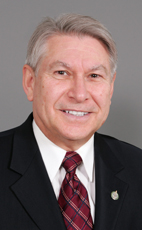
House of Commons photo

Crucial Fact

  • His favourite word was terms.

Last in Parliament September 2008, as Liberal MP for Thunder Bay—Rainy River (Ontario)

Lost his last election, in 2011, with 22% of the vote.

Statements in the House

International Bridges and Tunnels Act May 1st, 2006

Mr. Speaker, in response to the question posed by the hon. member from Quebec, the $600 million border infrastructure fund, which is already in the bank, should go a long way toward helping communities, such as the ones we are talking about, with regard to their infrastructure.

He also asked about jurisdictions. Ontario has the International Bridge and Terminal Company and Baudette and Rainy River Municipal Bridge Company. St. Mary’s River Bridge Company owns the bridge at Sault Ste. Marie. The Blue Water Bridge Authority owns the bridge in Sarnia. The City of Windsor has the Detroit-Windsor Tunnel. The bridge between Buffalo and Fort Erie is owned by the Buffalo and Erie Public Bridge Authority. Three bridges are owned by the Niagara Falls Bridge Commission. We have the Federal Bridge Corporation and the Thousand Islands Bridge Authority. There are several more.

International Bridges and Tunnels Act May 1st, 2006

Mr. Speaker, I have had the pleasure of working with the member for Trinity--Spadina on these issues over many years. I believe she has asked me a nine part question. I will endeavour to do my best to provide an answer in the time allotted to me.

The province of Ontario suffered greatly through the Conservative era and it has only been in the past few years that the new provincial government is trying to undo that. As well, the federal commitment to infrastructure for communities was the first attempt by any national government to take a very active and pecuniary support role in addressing municipal revenue shortcomings in a direct way.

In the past year, I believe for the first time in history, the province of Ontario actually came to an agreement with the federal government on a national highway program. That was also very significant because the previous government would not do that.

With that in mind, we know that organizations such as the Federation of Canadian Municipalities and the Association of Municipalities of Ontario are very concerned about the ending of these infrastructure funds. In my presentation today, I tried very clearly to show that infrastructure funding must continue to communities in general, but that any supportive funding for border security, accessibility, tunnels, bridges, and all these kinds of things must be an independent and freshly directed source of funding so that it does not dilute the other funding that is available to communities.

When we talk about this commitment, currently the municipal leaders all across the country are in great fear of tomorrow's budget. They do not want to start all over again in trying to convince a national government of the need to support municipal or community infrastructure. The member's question was very well put in that way and I know she understands the issue very well. Throughout my riding and throughout many people's ridings, indeed throughout all parties, people are quite concerned about tomorrow's budget, that it may undo many years of good work by intelligent municipal leadership across the country.

International Bridges and Tunnels Act May 1st, 2006

Mr. Speaker, I believe the hon. member for Red Deer is uniquely qualified to talk about gas.

Returning to my riding, it became poignantly clear that Canadians were hearing much of the disparaging and demeaning attacks on the previous government. Canadians know of the tremendous record of achievement in the G-7 and all of the other things, but I am going to use my time to talk about the actual act before us.

By way of background, my riding is composed of 27 communities, 16 municipalities and 11 first nations. It is a seven and a half hour drive covering two time zones. In the issue at hand, we are talking about a bridge between International Falls, Minnesota and Fort Frances, Ontario. We want to make this act work, not only for Fort Frances, from which this bridge connects to an area larger than many countries in the world in addition to the other two border crossings at Pigeon River and Rainy River. If we use this time wisely, I believe we can come up with some legislation that is effective and productive for all those concerned.

Right now many of us are deeply concerned about the passport issue and security itself and how it relates to these border crossings and tunnels. For my area in particular, commercial traffic and the vitality of the forest industry are of prime concern.

As we know, the tourist trade in Canada has been diminishing. We have to do everything possible to make it easier for tourists to be attracted to Ontario in particular, Canada in general and northwestern Ontario specifically, which depends very highly on the Midwest of the United States.

The concerns of the communities in the Rainy River district are very much justified as to who controls and owns this bridge. Recently private holdings have put this bridge up for proposal and offered it for sale, after many decades of being in private hands. This bill gives one of the first opportunities to investigate public ownership in this case specifically. We have the support of the municipalities on both sides of the border and the councils of which have passed resolutions encouraging the governments of Minnesota, Ontario, Canada and the United States to adopt some form of public ownership. This is the first opportunity, and the bill is timely in allowing us to come forward with this.

When we think about what we can do on a national basis, this is a step by step process in which we can reclaim jurisdictional, operational and physical control of these facilities. Many may ask why the government would want to incur another expense or more ownership and maintenance issues, but this should be viewed as an opportunity. I will get into that in a few moments.

MPs and interest groups representing the council and business interests of Fort Frances have attempted to have meetings with the minister. As of yet, they have not taken place. I hope that a plea in the House for some personal attention to this matter will fall upon the right ears.

The bill should accommodate such situations about which we have talked. Funding for borders in terms of purchasing and restoring Canadian control would be a wise move. Tomorrow's budget should accommodate this and any future opportunities. I believe this is a chance for us to regain some of the composure in our national security issues.

Having done a considerable amount of research of the bridge crossings of Canada, it is interesting to see the many variations of theme, how many different combinations of ownership exist from public, private, provincial, independent or national. When we look at one bridge in isolation, it will take some meshing over a long period of time. I am well aware of that and I trust that the public service is also aware of it. When we ask for one-time funding or to make a special case, I understand the difficulty of this because of the precedents that it will set.

However, we should all take some consolation in knowing that this is a way to make things better. A national strategy or a national policy on access to our best neighbours, trading partners and friends should clear up uncertainty and turn it into an opportunity. As a case in point, the tolls at Fort Frances are among the highest in the country. Although there are packet rates for people who work or have frequent business across both sides of the border, it still can be viewed as a deterrent. Any chance to lower those would be an encouragement of trade and tourism. Those are the types of issues we would look at if the government would take this step.

As I alluded to earlier, Northwestern Ontario is extremely concerned about the rollover on the passport issue. Unanimously, people are very upset about the acquiescence to President Bush on this. Many individuals and organizations such as the Northwestern Ontario Tourist Association, led by Jerry Fisher, the Northwestern Ontario Association of Chambers of Commerce and the Northwestern Ontario Municipal Association were making significant progress in gaining allies in the United States, particularly American legislators who also understood the detrimental impact of destroying two-way traffic.

The town of Fort Francis came up with a great idea to have a conference of border communities. Leadership from coast to coast could get together and impress upon their respective governments the need to deal with this issue. The potential for extra parliamentary support could have turned this issue around. Rolling over to President Bush was a much too rapid and vapid turnaround.

The concerns of infrastructure in general and the draining off of infrastructure support through other funding has also been discussed in this debate. I hope that will not be the case, and I wanted to go on record on that. I believe this would be something the bill could accommodate, separate from existing community infrastructure and planned border infrastructure funding. We want to ensure that the funding is focused, not defused, and that it gets the attention it deserves. The community movement in the Rainy River district has said that it has witnessed this over years. It sees this as an opportunity in terms of economic development.

I believe the bill can accommodate such proposals, which I believe the minister will soon acknowledge. I am not saying he has not yet, but these are probably on his desk and he is looking at them. I would think we should view these as opportunities, as chances for regions of the country to benefit. This area extends from the Manitoba border to Lake Superior. We are talking about the entire northern section of Minnesota. Not many people can say their riding covers one whole state. I am pleased to say I do.

When we look at these access points, in particular the opportunity for the town of Fort Frances and the entire region, which goes up to James Bay and Hudson's Bay, we can look at something that will do a tremendous amount of good. I am asking the government to consider this in the bill and I will be making presentations to committee as it comes forward.

Federal Accountability Act April 27th, 2006

Mr. Speaker, two days ago, April 25, the chief of the Assembly of First Nations corresponded with every member of Parliament addressing this very specific question. I am sure the member opposite did not intend that he would represent first nations communities.

The letter is very clear in terms of the issue at hand. If it is accountability I do not believe that anyone in the Assembly of First Nations has any issue with that whatsoever. However for someone to insinuate that any one group, in terms of self-government or any of these processes, is deliberately doing something incorrect, I think the person probably owes an apology to the Assembly of First Nations.

We can only go by our communications in a nation to nation discussion. I believe that many of the points put forward by Chief Fontaine are reasonable and achievable in terms of a really rational approach to accountability.

Let us try to stop the accusation being made continually by the parliamentary secretary about what Chief Fontaine is hiding. I do not think that is the kind of talk we want to hear in Parliament.

Basically, we want to improve the bill. I have 11 first nation communities in my riding of Thunder Bay--Rainy River. They have lots of issues with different parts of accountability and accounting: duplication of some of the requirements, reporting that they feel is not really necessary, and those types of things. However in general they know that they are audited. That is very clear. Once one has been in the field and met with first nations at the community level, then one understands that they are very sincere about wanting to be accountable and in a democratic way.

Federal Accountability Act April 27th, 2006

Mr. Speaker, in talking about the accountability act I will go back through a bit of the history. During my term, which started in 2004, we called numerous witnesses. We realized that the previous legislation that had been proposed but which was never brought to the Commons, was flawed and had some serious problems. We had 17 months essentially of having people make representations as witnesses from the United States and all over Canada, people who essentially had been victimized as whistleblowers.

We had a tremendous amount of concurrence in terms of the understanding of the legislation that in a minority government forum all parties would have input. Indeed, several of the committee members are in the House today. Through that process, indeed, on the last day of Parliament in June 2005, the legislation actually concluded in Parliament and went forward.

Since we already have the legislation, which has gone through the process of having called witnesses and having spent a lot of time calling these people, why would this legislation not simply be passed and, if it needs strengthening in some form or another, then we could simply do it through other processes? We know a lot of work has already been done and that during the committee process there were certainly more members of opposition parties at that time than the government which, in effect, gave them a majority on that committee.

It seems strange that the parliamentary secretary would resort to attacking other kinds of things as opposed to simply answering the question. I did not think I had asked anything untoward. It was pretty clear in terms of this and it was a reasonable question to ask.

The second component glaringly and obviously missing from the legislation is third party financing. Most of the people with whom I have spoken can agree with the financing rules and with the general intent of the accountability act. I do not know anybody on our side who is trying to slow this down whatsoever. In fact, we are probably ready to send it to committee as soon as possible so let us do that.

In this case the question then looms: Could other nations have an influence on Canadian elections? It is very clear that there is a gap in the proposed legislation. If we want it to work and we are concerned about making it work then let us send it to committee where these kinds of things can be addressed and there are no tragic gaps that are in there now.

Yes, the legislation is necessary and timely but, in this case, I believe that with the good work of committee we can actually make it even better.

Federal Accountability Act April 27th, 2006

Mr. Speaker, my question to the hon. member from Vancouver was very straightforward. The committee on whistleblower legislation met for 17 months. The legislation was passed and anything to infer that there was some kind of process, it was a joint process of all committee--

Federal Accountability Act April 27th, 2006

Mr. Speaker, through the past terms of Parliament, the Standing Committee on Government Operations and Estimates took approximately 17 months of meetings, reviews, calling of witnesses, and drafting and passing legislation for the whistleblower act. That legislation was awaiting royal assent, but obviously that will not happen.

This part of the proposed act would cause a total recommencement of this entire process, which occurred at considerable expense to the government by calling witnesses from essentially all over the world.

Generally, in a minority government situation, it was clearly the prerogative of the other parties to defeat that legislation, even in committee, or insert those amendments that they felt were necessary because it certainly would have carried.

I am asking the member if her party has a particular perspective on the recommencement of this legislation and if her representative actually felt that it was good legislation because it did pass unanimously through the committee stage and on to first, second and third reading?

Petitions April 27th, 2006

Mr. Speaker, I rise today to present a petition of 295 names in support of the child care agreement signed between the Province of Ontario and the Government of Canada.

In my riding, the municipalities received a very supportive gesture from the Province of Ontario in that the province, assuming in good faith that this agreement would go forward, uploaded the services that had been paid for by municipal tax bases through the social services administration boards. This means that with the plan to end the agreement after this year, the Province of Ontario has been compelled to spread out the funding awarded to them over the next four years. After that period of time, the municipal tax bases will be again burdened with this aspect of child care in each municipality.

The petition calls upon Parliament to restore the agreement and asks that the government continue in good faith with the agreement that was signed not only with Ontario but with other provinces and territories. I put this in very plain terms. This will severely impact municipalities by raising property taxation and it also would not create the intended spaces.

Federal Accountability Act April 25th, 2006

Mr. Speaker, there is much in the act that we can all agree with, of course, and much that is laudable, but it seems to me that one glaring exception is the lack of reference to third party advertising, thereby allowing people, possibly even people from other countries, to influence Canadian elections. I would ask the hon. member for Davenport if he has any comment on that glaring exception. It is missing big time.

Resumption of debate on Address in Reply April 11th, 2006

Mr. Speaker, I thank the hon. member for giving me a chance to represent the previous Liberal government, which inherited an astonishing deficit and debt. Over that 12 year period, we think of the remarkable progress that was made and that last year, we had enough money to fund a child care program that was national in scope.

I do not know the answer to your particular question. When we think about what this forum is, I appreciate that you were listening to the concerns that I had. I would be more than pleased to respond to any particular questions that you have about my concerns, which I will reiterate and which I am sure that the member, as a Manitoban, also shares. They are issues relating to the CAIS program and disaster relief for agriculture. I talked about softwood lumber. Child care has to be one of your prime concerns. When we talk about municipalities, your municipality is a direct beneficiary of the Liberal government's support for communities such as Winnipeg. Major programs in infrastructure were allocated over the past couple of years. You would think you would be patting us on the back for all that support, because your riding is also a direct beneficiary of that, if I am correct in my geography.

When you add all those things up, I will just thank you for the past 12 years of support.