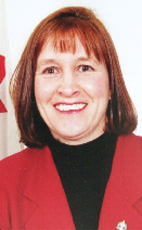
House of Commons photo

Crucial Fact

  • Her favourite word was money.

Last in Parliament May 2004, as Canadian Alliance MP for South Surrey—White Rock—Langley (B.C.)

Won her last election, in 2000, with 60% of the vote.

Statements in the House

Immigration March 21st, 1997

Mr. Speaker, on Tuesday, the minister of immigration acknowledged that she had instructed Canadian immigration officers in Quebec to refuse entry to any immigrant who had not been approved by the Quebec government.

Today, it was announced that while Quebec receives 39 per cent of all the money that immigrant investors bring to Canada, only15 per cent of these immigrants choose to reside in Quebec.

Is the minister prepared to instruct immigration officers in the other provinces to refuse entry to immigrant investors accepted by the Quebec government because they choose to invest in Quebec but decide to reside in and use the services of other provinces?

Privilege March 21st, 1997

Mr. Speaker, it would be very tempting to do what the House leader of the government suggested.

To clarify the matter, because we felt the Department of Citizenship and Immigration did not have the right to deny us access, we did follow up by phoning the press gallery. We were told that the department did not have the right to deny me access to that building.

The point of my concern is that we had departmental officials trying to prevent members of Parliament from getting information at the same time as the media was getting information on the details of government regulations. My objection is to the treatment I was given as a member of Parliament by the staff in the office of the Minister of Citizenship and Immigration.

Privilege March 21st, 1997

Mr. Speaker, I will. The meeting was called by the Department of Citizenship and Immigration in the press building across the street on Wellington. It was a briefing of the details of the changes to the immigrant investors program. When we asked if we could attend, the department told us that we would not be allowed to attend and that I would be given the same briefing by the same departmental officials after question period, which would be more than two hours after the detailed briefing had been given to the media. The time of the briefing was nine o'clock this morning.

Privilege March 21st, 1997

Mr. Speaker, I rise on a question of privilege with regard to actions taken by officials of the Department of Citizenship and Immigration who, in my opinion, have acted in contempt of Parliament.

This morning I was told that I would not be allowed into a preview of a press conference with department officials giving details of proposed changes to legislation or regulations given by the minister. Mr. Speaker, I would like to refer you to Joseph Maingot's Parliamentary Privilege in Canada , page 14 where it states that the Senate and the House of Commons have the power or right to punish actions, which, while not appearing to be breaches of any specific privilege, are offences against their authority or dignity. Such actions, though often called breaches of privilege should more properly be considered contempts.

I rise because I feel that the actions of the department of immigration have been in contempt of Parliament.

As you know, Mr. Speaker, it is the practice of this place to include opposition members when detailed briefings are given on changes to regulations. I feel that the attempt by the department to deny me access until after the media had received the information is to deny me my privilege to information.

It is time that we as members of Parliament object to departmental officials placing the needs and desires of the media ahead of members of Parliament and the House.

I would like you to consider seriously that this is a contempt of Parliament and of my privileges as a member of Parliament. The media was given information that was going to be denied to me until two hours after the fact.

Canadian Census March 19th, 1997

Madam Speaker, it is my pleasure to rise to speak on Motion No. 277 of the hon. member for Beaver River. It is a topic which is very dear to my heart.

I raised this issue on September 29, 1995 in question period and again on October 2, 1995 in question period because it was brought to my attention that the option of claiming to be a Canadian would not be on the new census.

Having been one of the Canadians who had a long census form to fill out, I found it very interesting, particularly Question No. 19 and its confused language, nationality, geographic origin and colour. Trying to answer Question No. 19 became extremely difficult.

One of the options under Question No. 19 was other. Because Canadian was not listed anywhere in that question, I had the uncomfortable situation of having to place Canadian under other. I refused to identify myself as a colour, as belonging to some geographic region or as someone who speaks a certain language. For a government not to allow Canadians to identify themselves as being Canadian is not progressive.

I am faced daily with people who are assumed to be immigrants and newcomers to Canada. Some of these immigrants have lived in Canada for 20 or 30 years. Because we as a government insist on breaking people down based on the origins of the family trees of individuals who are Canadians in all sense of the word-they pay taxes, use and pay for the facilities, the hospitals and the schools, have citizenship and vote in elections-they are not able to call themselves Canadians on our census form.

I do not want to leave the impression that I do not believe it is important to accumulate statistics. It is very important. It is acceptable for persons to be asked in a straightforward manner their racial background and left to determine what they want to put down, whether it is Irish, Scottish, Jamaican, Korean or whatever. They should not be asked if they are white or black, from the Philippines or from the Punjab. That is the wrong way to ask for a person's racial background or nationality. It is for statistical reasons only.

Canadians must be allowed to proudly claim that they are Canadian. I do not care whether a person is a brand new Canadian who got his or her citizenship the day before the census form arrived, or are Canadian born, or are a Canadian who has been here for 30 or 40 years. People who have come to this country or who were born here and are proud of being Canadian should be encouraged to state that on a census form.

It was with trepidation that I filled Canadian under other. It is a disgrace to have to put Canadian under the category of other. I also took the opportunity to fill in my lineage which was quite an interesting experience since I am a typical Canadian. My parentage is Scottish, Irish, Pennsylvania Dutch, German, Swedish and a few other other things to boot. That is what being a Canadian is all about. I felt I was not able, through the census form, to indicate honestly what I felt: I am proud to be Canadian. I am proud to be a third or fourth generation Canadian. I was saddened that my children could not put down that they are Canadians.

My hon. colleague's motion asks to return to the use of the word Canadian in questions like question No. 19. I do not buy the answers I received to my questions in question period. I quote the Minister of Industry: "On the issue of race, in the past people have

made calculations based on language rather than a specific question on racial origin. This time we think the provision of fuller information will give us a much better understanding of the make-up of Canadian society that should be beneficial for a wide range of purposes".

I would like to know what is the "range of purposes". I would like to know what the government is planning. It feels it has to segregate little communities. Depending on how it feels it must segregate them from each other. I really think this is a very divisive way of dealing with new Canadians.

My hon. colleague from Beaver River is looking to the unity of the country when she suggests that the federal government should be concerned about those things that bring Canadians together, about recognizing Canadianism. The identification of being Canadian is one of those things that will unify the country rather than divide it.

Any government program that is designed to give special consideration to any individual over another is wrong, particularly if it is based on gender, race, religion, geography or colour. Any government legislation that does not treat all Canadians equally is wrong. I fully support my colleague from Beaver River. I appreciate her efforts in trying to return some pride in being Canadian and in trying to return the ability to exercise the right to put Canadian down not as other, not as an afterthought, but very proudly to claim oneself to be a Canadian. I look forward to the next census I have to fill in where I can mark Canadian rather than other.

War Criminals March 19th, 1997

Mr. Speaker, I understand there are over 1,000 names of suspected Nazi war criminals living in Canada. I also understand that the Canadian Jewish Congress has provided over 220 names to the RCMP and it has not responded. The department of immigration also has a list of over 200 suspected modern day war criminals.

What action will the government take beyond the 12 it is taking through civil proceedings to ensure that more war criminals are deported? One Nazi war criminal in the past 50 years has been

deported. What will the government to do ensure that not only Nazi war criminals but modern day war criminals-

War Criminals March 19th, 1997

Mr. Speaker, today the Canadian Jewish Congress has accused the RCMP of not taking action or even taking seriously information that was given to it on Nazi war criminals living in Canada.

Over the past 50 years successive Liberal and Tory governments have ignored the existence of Nazi criminals living in Canada. Why?

Immigration March 18th, 1997

Mr. Speaker, this individual was also refused entry into Ontario because this person was not going to reside in Ontario but in Quebec.

This is just another example of the government's policy of exclusion that treats people differently across the country. This is still a united country and it would be nice if the government acted as if it were.

Is the minister prepared to instruct Canadian immigration officers that approval for permanent residency in Canada is valid from coast to coast to coast?

Immigration March 18th, 1997

Mr. Speaker, recently a young immigrant arrived in Montreal with her approved Canadian residency papers but was refused entry into Canada by the Canadian immigration officer because Quebec had not granted her the right to live in Quebec.

While the Canada-Quebec accord permits Quebec to select economic immigrants to that province, it also acknowledges that every person with permanent resident status is granted mobility rights, equal protection and equal benefit without discrimination.

What right did the minister's department officials have to deny entry to an immigrant who arrived in Quebec with documents which stated that this individual has been approved for residency in Canada?

Citizenship And Immigration March 5th, 1997

Mr. Speaker, this discussion has been going on for a number of years. While this pre-election goodie is nothing more than an effort by the government to buy its re-election with taxpayers' money it still does not treat the provinces equally.

For example, Quebec receives $3,294 per immigrant from the government for settlement. Even with a $20 million increase in federal spending British Columbia will only receive $1,035 per immigrant.

If the minister is not prepared to fund all the provinces equally, is she at least prepared to give B.C., Ontario and Alberta the same guarantees found in the Canada-Quebec accord?