
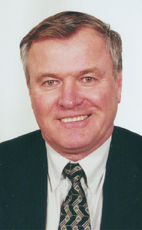
House of Commons photo

Crucial Fact

  • His favourite word was farmers.

Last in Parliament May 2004, as Canadian Alliance MP for Selkirk—Interlake (Manitoba)

Won his last election, in 2000, with 44% of the vote.

Statements in the House

Grain Transportation November 7th, 2002

Mr. Speaker, is this situation not just hunky-dory? We have farmers who are locked up and grain workers who are locked out.

Farmers cannot afford to have the Prince Rupert port closed down. Producers view this lack of action as just one more example of the government's inattention and disregard for western Canadian farmers.

When will this member of the government step in and use final offer arbitration as a means of solving this dispute?

Grain Transportation November 7th, 2002

Mr. Speaker, the walkout of grain handlers at the port of Vancouver has been going on for over two months. Now picket lines at Prince Rupert have completely shut down the movement of grain out of the west coast. Due to the drought, this is one of the worst years that farmers in western Canada have ever had. Now the government will not even ensure that their meagre grain crops can be shipped to customers.

Why will the government not help powerless farmers caught in the middle of this dispute?

Petitions November 7th, 2002

Mr. Speaker, the petition I am presenting today is in addition to the tens of thousands of signatures that have already come in regarding child pornography. The people in my riding of Selkirk--Interlake are tremendously concerned about protecting our children and request that the use of pornography by pedophiles and other pornographers be stopped.

The petitioners call upon Parliament to take immediate action on this.

Supply November 6th, 2002

Mr. Speaker, the PC Party has the position that farmers would vote on this, which is different from what the Canadian Alliance would do. Is it the position of the PC Party that the 50.1% of farmers who want a monopoly can impose on the other 49% of farmers, i.e. 45,000 farmers, that they cannot do what is in their own best interests economically?

Supply November 6th, 2002

Mr. Speaker, the Canadian Wheat Board would be operating in an open market system because it would be a voluntary cooperative, accessing grain through contracts and selling at the same as anybody else in a free enterprise system.

The Canadian Alliance policy since 1989 very clearly has been to have a voluntary marketing system in all agriculture commodities, including wheat and barley. Farmers never did vote to have a monopoly. That was imposed upon them by politicians.

The member from the NDP talks about philosophies and policies. The NDP is strong on human rights. Why is a farmer denied the human right to sell the fruits of his own labour after doing all the investment? Do the human rights of an individual farmer to do the best for himself not override a group of farmers who want to impose something on him that is negative to his economic well-being?

Supply November 6th, 2002

Madam Speaker, in summing up the minister's speech, I would say that the Canadian Wheat Board's board of directors is there to administer the monopoly that is imposed by law, under the Canadian Wheat Board, by the House, namely the Liberal government. All that the board of directors is allowed to do under law is administer the act that it is given.

Can the minister tell me of any other economic enterprise in this country where the government and one group of that economic enterprise can tell another portion of producers in that economic enterprise how to do their business? Is this a free enterprise economy? Or is it a command economy by a monopoly imposed by a Liberal government?

Supply November 6th, 2002

Madam Speaker, oats were removed from the Canadian Wheat Board monopoly in the early 1990s. Since that time Canada has become the largest exporter of oats for human consumption in the world. I am proud to say that one of the plants is in Portage la Prairie in my home province.

Does the member agree that if we leave it up to marketers and individual farmers to market innovatively, that greater wealth for this country can be produced?

Agriculture November 5th, 2002

Mr. Speaker, clearly that is not the case. We can have support programs for our farmers if want.

My next question is also for the agriculture minister, seeing as he is speaking for the trade minister.

Our supply management sector is very concerned that the government will trade off supply management. In the 1995 agreement the government committed 100% to reducing those tariffs that protect supply management. Is the government going to stand here today and tell supply management that it is not going to reduce tariffs?

Agriculture November 5th, 2002

Mr. Speaker, let them continue clapping, because the agriculture minister rejects the position of the Cairns group, which is calling for reductions of subsidies and tariffs.

The government cannot be on both sides of this issue. Would the trade minister tell the House what Canada's official position is on agricultural trade?

Agriculture November 5th, 2002

Mr. Speaker, the Prime Minister publicly claims to support the end of all agriculture subsidies and tariffs in order to level the playing field for our farm families.

At the same time, the agriculture minister--