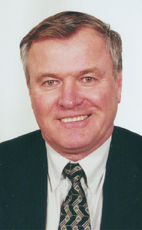
House of Commons photo

Crucial Fact

  • His favourite word was farmers.

Last in Parliament May 2004, as Canadian Alliance MP for Selkirk—Interlake (Manitoba)

Won his last election, in 2000, with 44% of the vote.

Statements in the House

Agriculture October 28th, 1999

Mr. Speaker, if the government would listen to Reform today, farmers would have the support they need.

Thousands of farmers have lost their farms and thousands more are hanging by a thread. These farmers are suffering through no fault of their own, but the Prime Minister still does not care or help would be there today.

If floods wiped out half the businesses in Shawinigan and if foreign subsidies were killing the other half, would there be help for Shawinigan today?

Agriculture October 28th, 1999

Mr. Speaker, the government is in denial about the severity of the farm crisis. As usual, the Prime Minister's response is don't worry, be happy. Imagine, Mr. Speaker, if all your expenses went up but your income went down 107%. That is what happened to Saskatchewan farmers and it is happening to Manitoba farmers.

We are not just talking about the average business that is in trouble. We are talking about Canada's national food supply. Why will the Prime Minister not help our farmers through this winter?

Agriculture October 27th, 1999

Mr. Speaker, the agriculture minister has met with farmers and they have not received the help they need. I am asking for the Prime Minister to meet with farmers this time. They are trying to work out a constructive plan to help them through the winter.

Why does the Prime Minister have so little compassion for the plight of these farmers that he is unwilling to hear their concerns firsthand?

Agriculture October 27th, 1999

Mr. Speaker, the government's agriculture policies have left thousands of farmers facing the winter with little or no hope. The Prime Minister has to take responsibility.

Tomorrow a delegation of prairie agriculture ministers, farmers and premiers are coming to Ottawa to discuss solutions to this problem. The Prime Minister said this morning that he is refusing to meet with farmers and is opting to meet only with politicians.

Why is the Prime Minister refusing to face the very people who are suffering as a result of his policies?

Nisga'A Final Agreement Act October 26th, 1999

Mr. Speaker, on behalf of the people of Selkirk—Interlake I would also like to say that this issue is so major for every Canadian that I do not agree with deciding it in undue haste.

If debate is limited, how can Canadians understand what is going on with this issue which involves the Nisga'a people? I believe it does have broader implications for the rest of the country.

I support negotiating treaties with aboriginal first nations people. In my riding there are lands being purchased to add to reserves, which is not causing any problem other than minor questions over some tax issues.

In the case of the Nisga'a treaty, it seems like the Nisga'a people have had their say, which is good, but I do not understand why the other aboriginal people who live in the vicinity of the Nass Valley have not had their say. I do not understand why we are rushing through this debate and why Canadians are being asked to sit quietly in the dark while the Liberal government, which was not elected on this issue, purports to be able to speak for all Canadians.

Treaties, in essence, can only be entered into on a nation to nation basis. In view of that, it is incumbent that we have a full debate here and that the Canadian people fully understand the issue.

Does the hon. member not agree that a full understanding by all Canadians and a full agreement by all Canadians would ensure a peaceful future, not only for the people of the Nass Valley but for their neighbours and in fact all Canadians across the country?

Supply October 25th, 1999

Mr. Speaker, I can help out a bit. The former provincial government of Manitoba, the provincial PCs, gave out $50 an acre for the flooded natural disaster acreage. It was doing something. The NDP Government of Saskatchewan has done nothing in the way of extra money. We are waiting to see it come forward with money.

I have a quick question for the member. The banks have been fairly lenient with farmers in trying to help them out a little. Farm credit has been tough. I have also had calls that the Canadian Wheat Board is pressuring farmers over the cash advances they received in previous years. I see no leniency there.

Should the Canadian Wheat Board be more lenient on the cash advances than what it appears to be doing?

Supply October 25th, 1999

Mr. Speaker, my question for the Liberal government member refers back to supply management. Who was it that negotiated up to 1993 article 11 and supply management, changing it from a quota system of imports to a tariff system designed to be reduced incrementally, eventually eliminating supply management?

Was that the Conservatives and Liberals, or was it the Reform Party that did that?

Supply October 25th, 1999

Mr. Speaker, I too resent the suggestion that it is only farmers in little pockets of the country that are in financial trouble.

Farmers who grow wheat in Ontario are allowed to export a portion of their product outside the Ontario wheat marketing board. Would it not be beneficial for western Canadian farmers to export their wheat outside of the Canadian wheat marketing board in addition to voluntarily marketing through the wheat board if they so wish?

Supply October 25th, 1999

Mr. Speaker, today we are to be debating the farm income crisis and not slamming each other around, party against party. We are all supposed to be doing what we can for the farmers.

I got one little hint of a positive comment from the member. He was talking of diversification in agriculture. Certainly that is one of the areas in which farm incomes can be raised.

When it comes to the Canadian Wheat Board, the member must be reminded that the wheat board only operates under the confines of federal legislation that restricts farmers from selling wheat and barley on export except through the board.

If in the case of prairie pasta producers, farmers were able to increase their incomes selling durum wheat by value adding it into a pasta type product, would the member support having a voluntary wheat board? It would allow growers of various crops to value add to their crops in conjunction and in co-operation with fellow farmers of the same attitude. Would he support a voluntary wheat board to promote this diversification in western agriculture?

Supply October 25th, 1999

Mr. Speaker, I certainly thank the member for Charleswood St. James—Assiniboia for identifying for his government a potential $112 million saving to farmers on grain transportation. Today's debate is exactly about how to get more money into the hands of farmers, particularly those who are especially suffering in the area of export commodities.

In addition to making grain transportation more of a commercial contract based system, would the member consider advocating to his government the reduction of the four cent federal excise tax on fuel and lowering user fees, especially in the case of the Canadian Grain Commission, or not increasing those fees to cover its deficit?

Finally, to help farm incomes greatly he could advocate a voluntary Canadian Wheat Board so that farmers who want to form a co-op, which in essence is what the Canadian Wheat Board is, specific to their products, in this case durum wheat, could add further value and the value added money would stay with farmers producing durum wheat?

Would he comment on those ideas and indicate whether he would support them?