
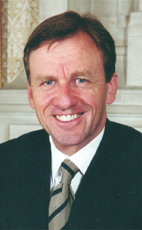
House of Commons photo

Crucial Fact

  • His favourite word was justice.

Last in Parliament May 2004, as Liberal MP for Etobicoke Centre (Ontario)

Won his last election, in 2000, with 56% of the vote.

Statements in the House

Hepatitis C April 2nd, 1998

Mr. Speaker, I do not think it is helpful to allow a myth to grow about the provinces' position. It is very clear that the provinces support this offer.

I spoke this morning with Minister Rochon of Quebec. He reaffirmed that he is behind this offer. He put the same thing in writing in a letter to all health ministers.

This morning Premier Clark said what we all feel. We all feel uncomfortable about this difficult decision. The premier also made it clear he acknowledges there is an agreement. His minister's office confirmed it supports it.

Let us keep the facts clear. All provincial governments joined with the federal government in supporting this position.

Hepatitis C April 2nd, 1998

Mr. Speaker, again let me set the record straight.

The government of the province of Quebec has reaffirmed as recently as an hour ago in a letter I received from Jean Rochon, the minister of health, that it fully and unconditionally supports this settlement offer that has been made by 13 governments. Allow me to quote:

I feel that our program is justified and that we made a fair decision.

Minister Rochon said again that he was in favour.

Governments stand together, every government of all the provinces and the territories. This morning Mr. Clark said—

Hepatitis C April 2nd, 1998

Mr. Speaker, just to set the record straight, first of all the AIDS package did not cover everyone. In fact, it was left to us in this most recent announcement last week to include those who were infected by partners or parents. We completed what was started 10 years ago.

Second, the AIDS package as I see it from this distance of 10 years was based on exactly the same principle as the proposal we made for the hepatitis C settlement. Namely, at that time the government implicitly acknowledged fault or negligence in not having put systems in place to look for HIV contaminants in the blood. Same principle then, same principle now.

Hepatitis C April 1st, 1998

Mr. Speaker, I have emphasized throughout this matter that the decision made by governments was a very difficult one. We had to apply a principle in distinguishing periods during this chronology, during this tragedy.

I have made it clear that whether those governments were NDP, Conservative or Liberal, we all thought that one principle should apply. If we are going to have a health care system publicly funded in which people are compensated regardless of fault, simply because there was risk and there was harm, then we cannot go on. That principle is terribly important and it is that principle that we have applied together in this very difficult circumstance.

Hepatitis C April 1st, 1998

Mr. Speaker, the hon. member speaks of victims being abandoned as though the medicare system in Canada did not exist and is not available for their benefit. Thank God we live in a country in which all those people who contracted hepatitis C are able to rely on the excellent public health system we have put in place.

As for those victims in the period 1986-1990, I have well explained the rationale that all governments in this country adopted in approaching this problem.

Hepatitis C April 1st, 1998

Mr. Speaker, in various places throughout the world various tests were proposed. Those who understand the history of this chronology recognize that it was in 1986 when Canada should have, indeed practically could have, put a test in place. That was the year when things changed internationally and the year accepted as the turning point.

That is why it was chosen as a turning point by ministers of health not just from this government but from provincial and territorial governments that all looked at these facts and came to the same conclusion.

Hepatitis C April 1st, 1998

Mr. Speaker, the hon. member should take care with his examples. There is not another country in the world that has the public health care system of the quality—

Hepatitis C April 1st, 1998

Mr. Speaker, the hon. member as a physician should know that across this country every day in clinics, in hospitals and in offices medical procedures are undertaken that involve risk.

Is the hon. member suggesting that anyone who is harmed, regardless of fault, as a result of the health care system should be compensated? That is the principle at issue here. Thirteen governments have made their decision and I say it is the right one.

Hepatitis C April 1st, 1998

Mr. Speaker, what the hon. member should know is that this decision was a government decision. It was a decision made by 13 governments.

It is a very unusual situation in Canada when our bipartisan intergovernmental bases come to one conclusion, and it is the responsible one.

Hepatitis C April 1st, 1998

Mr. Speaker, the member should know that the governments of Canada are putting together $1.1 billion in compensation for 22,000 people infected between 1986 and 1990.

The member should also know that those who are responsible for the health care system both federally and provincially spent months considering this very difficult decision.

The conclusion to which we came was that we would not put the public health care system at risk by putting in place a system that compensates everyone for every harm regardless.