
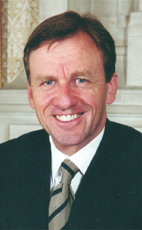
House of Commons photo

Crucial Fact

  • His favourite word was justice.

Last in Parliament May 2004, as Liberal MP for Etobicoke Centre (Ontario)

Won his last election, in 2000, with 56% of the vote.

Statements in the House

Rights Of Victims April 7th, 1997

Mr. Speaker, it is regrettable that after so short a period of time in national politics that the hon. member would have become so cynical. It is also very sad that the hon. member is prepared to ignore the facts on such a wholesale basis.

The hon. member speaks about victims. In June of 1994 when we had Bill C-68 before the House and the victims of crime, children, husbands and wives, mothers and fathers who have been shot to death by firearms, came to this building and asked the Reform Party to join with the government in doing something for victims, to those victims this party turned a deaf ear.

When the government proposed changes to the Young Offenders Act and introduced for the first time victim impact statements in youth court, it was that party that voted against it.

Finally, when the government proposed in Bill C-41 on sentencing to provide true restitution for victims so they could get back what they have lost, it was that party that voted against it. It is the government that stands up for victims in this country.

Organized Crime April 7th, 1997

Mr. Speaker, I have spent a lot of time, since my meeting with Mr. Bégin, meeting with those involved in the matter, that is the mayors of the Montreal and Quebec City regions and the chiefs of police. I have also spoken to the mayors and chiefs of police of other places, because this issue concerns Canadians everywhere. Gangs and organized crime may be found in other cities as well.

I promise today to produce next week this government's proposals and measures, which will be effective as well as valid and constitutional.

Organized Crime April 7th, 1997

Mr. Speaker, first, as I said, I asked Mr. Bégin a number of days ago to clarify his position. The proposals put forward by my Quebec counterpart are vague and general. I have some legal questions.

I feel it is very important in all this to avoid passing legislation that will be struck down or nullified by the courts in six months.

This sort of approach would only give Quebecers and Canadians false hope. We must pass effective legislation that is also valid and constitutional. So, as I said, we intend to announce next week the measures we will propose, and I am very happy to hear the member from the Bloc Quebecois say that he is prepared to work quickly with us.

Organized Crime April 7th, 1997

Mr. Speaker, I am delighted to hear the hon. member agrees there is some urgency involved here in the House of Commons.

However, as far as my dealings with Mr. Bégin, the Quebec Minister of Justice, are concerned, it is true that last week, I was disappointed by Mr. Bégin's response to my request. I merely asked him to clarify his position on an anti-gang bill. I asked some legal questions. I asked legal opinions, opinions of his Department's lawyers. I have yet to receive the details. So I am disappointed.

Forget about the politics of the issue, forget all that because the real issue is to have a more effective Criminal Code to help our police forces. That is the objective of the Government of Canada.

Organized Crime April 7th, 1997

No, Mr. Speaker. Like all Canadians, I am waiting for each level of government to act responsibly and make our society a safer place to be.

As the federal Minister of Justice, I am responsible for the Criminal Code, but it is up to the province to administer justice, according to the Constitution of Canada. We each share part of this responsibility.

I am very pleased to be able to work together with my Quebec counterpart. As I said earlier, I met him three weeks ago. For years and during the past few weeks we have had meetings with officials on this important matter. Next week we intend to announce the measures we will table to achieve the objectives we share with the Government of Quebec.

Organized Crime April 7th, 1997

Mr. Speaker, in my opinion, and on behalf of the Canadian government, this is not a quarrel about jurisdiction but a matter that concerns the safety of Quebecers and Canadians.

Nearly three weeks ago, I went to Quebec City to meet my counterparts and mayors from the Quebec City area to discuss their concerns. They asked for changes in the Criminal Code. Since then I have been trying to respond to this request.

At the Department of the Justice I have set up a special task force to deal with this matter on an urgent basis. We have now reviewed and examined all the alternatives for making criminal legislation more effective and more powerful in order to help police forces in their fight against organized crime.

That is our objective, not these quarrels about jurisdiction between various levels of government. We genuinely want to deal with the core issue which is about making Canadian laws more effective so that we can help our police forces.

Young Offenders Act March 19th, 1997

Mr. Speaker, I have always preferred engineering to demolition. What we are really talking about here is more in the nature of architecture, building a better Young Offenders Act. We have been doing that.

Quite apart from the work we did with Bill C-37 which did not meet with the favour of the hon. member, we also had the justice committee spend the last 18 months travelling the country speaking to police, parents, school principals and young people themselves, and preparing architecture that will improve the Young Offenders Act into the next century.

One of the hard working and contributing members of that committee is the colleague of the hon. member, the member for Crowfoot. The member for Crowfoot would have hurt feelings to hear what the hon. member says about the work of that committee. The fact is that it is working hard. It is preparing a report. When we get that report we will give it the attention it deserves.

Young Offenders Act March 19th, 1997

Mr. Speaker, I remember clearly the very pleasant meeting I had with the hon. member and his colleague. I have a vivid recollection of the force with which he expressed his position.

Among other things he urged the government to change the Young Offenders Act to deal more effectively with violent criminals, particularly those aged 16 and 17. He urged the government to introduce stronger penalties for the most serious crimes of violence. He urged us to do something about safety in schools.

In June 1994, following my meeting with the hon. member, I introduced Bill C-37 which was subsequently adopted and proclaimed in force. Among other things that legislation doubled the maximum for first degree murder in youth court; provided for the transfer of 16 and 17 year olds charged with the most serious crimes of violence, except where they could satisfy the onus; and provided for the free sharing of information between police and school officials for safety's sake.

The hon. member and his colleagues in the Reform Party voted against that legislation. Mr. Speaker, you could imagine my

surprise. Perhaps the hon. member would explain to his constituents why he did not support us when we acted.

War Criminals March 19th, 1997

Mr. Speaker, as I was saying to the hon. member for Ontario earlier this afternoon, the government is acting or there is evidence to justify action.

Before the hon. member becomes misled by claims of thousands of cases where action should be taken, I want her to bear in mind that the Deschenes commission, the 10th anniversary of which we are marking today as the member for Ontario said, identified far fewer cases. It identified about 29 or 30 priority cases where there was urgent evidence that action should be taken immediately.

It is from that list of cases that we have taken the ones on which we have acted immediately. We are not stopping at 12. There is no magic in that number. We will continue to prepare and proceed in cases where we believe there is evidence to justify it.

We do not have all the evidence from those who claim to have it in hand. I urge anybody who has evidence to give it to the RCMP so it can be evaluated and where appropriate acted upon.

War Criminals March 19th, 1997

Mr. Speaker, I will deal with those aspects of the question other than the RCMP. I can answer for the Department of Justice.

In the period since we took office the Department of Justice has proceeded with cases where there is evidence to justify initiating proceedings. As I have just told the hon. member for Scarborough, we will continue in those efforts. The government believes as a matter of moral imperative that we must act where there is evidence to justify it.

As I also said very hurriedly a few moments ago, if there are those, whomever they may be, who have evidence that is relevant to this matter I urge them to turn that evidence over to the RCMP so that it can be evaluated and acted upon.