
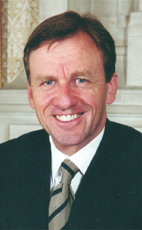
House of Commons photo

Crucial Fact

  • His favourite word was justice.

Last in Parliament May 2004, as Liberal MP for Etobicoke Centre (Ontario)

Won his last election, in 2000, with 56% of the vote.

Statements in the House

Referendums May 6th, 1996

Mr. Speaker, we do not believe democracy and the rule of law are incompatible concepts; the one is safeguarded by the application of the other.

There are important aspects of the rule of law arising from the position taken by the Government of Quebec in the Bertrand litigation. It may be that after considering the position we determine that we will not intervene. It may be that we conclude the matter is so obvious there is no need for us to assist the court. We might also await the disposition of the first instance and determine whether intervention might be more useful on appeal. All these matters fall to be examined.

In the meantime we are considering the position and I hope to be in a position in the coming days to make clear the course we will take.

Referendums May 6th, 1996

Mr. Speaker, the process of a population of a province or a country expressing itself by referendum is not new.

Naturally, the opinion of the population when expressed by referendum is important. No one contests that. Nor does anyone contest the right of the population of Quebec to express itself on any such question.

What has caught the attention of the national government is that the Government of Quebec in the litigation which raises the legality of l'avant de project de loi and Bill No. 1 has taken the position that after such a thing might occur, neither the Constitution nor the courts have any role or relevance in determining what would happen then, or in the declaration of sovereignty by the province of Quebec. That is a very fundamental issue.

As I have indicated to the House, we are considering whether we can assist the court on those legal points. That is why we are considering intervention in that case. It has nothing to do with blackmail at all. It has to do with fundamental principles of law and the rule of law. That is what we have under consideration.

Referendums May 6th, 1996

Mr. Speaker, as I told the House last week, the litigation before the court has become of interest because of the position taken by the Government of Quebec. Simply stated, it is that neither the courts nor the Constitution of Canada can have any relevance to a declaration by Quebec of its sovereignty. That proposition of course is profoundly wrong.

It is the question of whether the federal attorney general can assist the court in dealing with it that has attracted our attention. We are considering our position in relation to intervention. No decision has yet been made, but that is the reason we are considering it.

Edmonton Institution For Women May 3rd, 1996

Mr. Speaker, it is true we have encountered difficulties at that facility.

I told the House earlier this week that through discussions between the Solicitor General of Canada and Attorney General Evans of Alberta arrangements have been made to transfer inmates to a provincial facility.

Steps are being taken to overcome difficulties at the federal Edmonton facility to address some of the security items to which the hon. member referred. We are hopeful that in due course the facility will be ready to return to its function, housing inmates in accordance with the law.

Referendums May 3rd, 1996

No, Mr. Speaker. Our consideration of these questions, our consideration of the possibility of participation before the courts is merely, as I have said, related to the position taken by the Government of Quebec. I would also like to stress that we have not yet made a decision on this; we are considering our decision.

Referendums May 3rd, 1996

Mr. Speaker, it is true that the federal government is contemplating taking part in the proceedings before the Quebec superior court. I would, however, like to point out that our reason for this is not connected with the positions of either Mr. Bertrand or Mr. Singh, but rather the position taken by the Government of Quebec.

On April 12 for the Bertrand case, and May 1 for the Singh case, the Government of Quebec presented two requests for dismissal without a hearing of the two cases which challenged the legislation or other measures being used to make a declaration of sovereignty legally binding.

In support of those requests, the Government of Quebec takes the position that neither Canadian courts nor the Canadian Constitution have anything to do with Quebec's declaration of sovereignty.

The question we are asking at this time is whether the Government of Canada ought to have something to say in response to this position, that is to say the position of the Government of Quebec.

Justice May 2nd, 1996

Mr. Speaker, first, I know the hon. member is aware of the measures already taken. The Solicitor General of Canada has implemented measures through Bill C-45 which could result in parole being denied altogether to certain offenders, particularly sex offenders, who must serve their full time. There have been measures in bills which I have brought forward which provide for stiffer sentences for crimes of violence.

The question which the hon. member raises deals directly with the issue of how to manage high risk offenders. As the hon. member knows, because I have told the House before, the solicitor general and I are preparing proposals for cabinet which I hope to

introduce before we rise at the end of June to deal with high risk offenders, that is, for people who may not be categorized as dangerous within Part XXIV of the Criminal Code, but who, because of their violent conduct, are at a high risk to re-offend by harming others after their release from prison. These proposals would empower the court to impose periods of supervision as long as ten years after their release.

That and related changes, I hope, will deal with the concerns that the hon. member has raised. I will elaborate on those proposals with the solicitor general in the weeks ahead.

Firearms Act May 2nd, 1996

Mr. Speaker, I have a strong sense of déjà vu when I answer questions having to do with the Firearms Act, but the simple answer is yes.

Today I tabled the first segment of regulations which will help implement the Firearms Act and bring its principles to life. The purpose of tabling them at this time and having 30 days before the committee is to permit us to solicit and collect reactions.

The hon. member was kind enough to express already today some of his reactions to the draft regulations. I want to assure him and all members of the House that we will be taking note of the views of those who read the regulations and have an interest in them. We are more than prepared to make changes and adjustments in these draft regulations to deal with any reasonable concerns that are expressed.

Referendums May 2nd, 1996

Mr. Speaker, the referendum is not in issue in the Bertrand litigation. The court documents revealed that what is in issue is the constitutional validity of l'avant-projet de loi. That is the issue before the court, and it raises questions of legal significance.

As I have already told the House, it is my responsibility as Attorney General of Canada, having been made mis en cause in the litigation, to prepare and give advice to my colleagues and the Prime Minister, which I shall give.

Referendums May 2nd, 1996

Mr. Speaker, the federal government has no intention of preventing the people of Quebec from expressing their position on these matters. This is not why Mr. Bertrand launched his suit. Let us be clear about Mr. Bertrand's case. He began it as a private citizen, and he raised important constitutional questions.

As the Attorney General of Canada, it is my responsibility to prepare and to give advice to the Prime Minister and to my colleagues on the question of participating in this case. In fact, the federal government has been made mis en cause by Mr. Bertrand. We are therefore already involved in the case before the courts. In the days and weeks to come, we will be examining the matter and deciding whether we will participate actively with the other parties before the court in order to determine the important points in the case.