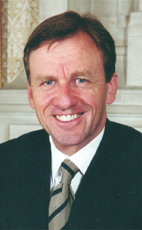
House of Commons photo

Crucial Fact

  • His favourite word was justice.

Last in Parliament May 2004, as Liberal MP for Etobicoke Centre (Ontario)

Won his last election, in 2000, with 56% of the vote.

Statements in the House

Department Of Justice February 8th, 1995

Mr. Speaker, when the government goes to the private bar to obtain lawyers for assistance the chief criteria for that selection are competence and merit.

In Brome-Missisquoi and in places across the country the Department of Justice, since the election of the government, has reformed the process of selecting legal agents to ensure that they are properly trained and supervised, that they act without conflict of interest, and that services are provided in accordance with the highest standards of competence. Those are the criteria upon which we select agents.

Gun Control December 14th, 1994

Mr. Speaker, the orders in council to which the hon. member refers were made not under section 116 of the code, which does indeed require the procedure he has described, but rather under section 84 of the code which does not.

Although there is a judicial decision of a trial court which holds that it is necessary even under section 84 to lay the regulations before the House, that decision is under appeal to the appellate division of the court in Alberta. We have every confidence that judgment was wrong in that respect and that we will succeed in the appeal.

Criminal Law Amendment Act, 1994 December 13th, 1994

I am grateful for this opportunity, Mr. Speaker. I just want to comment on one aspect of the hon. member's statement concerning these amendments to the bill.

As I understood the hon. member he referred to the change in the value of property involved in crime in an effort to influence the incidence of crime reporting or the crime rates. Perhaps I did not understand the hon. member's point. I apologize if I have it imprecisely but let me just tell the House lest there be any doubt what our rationale was as a government for proposing that change.

The dollar amount of property involved in such crime is the demarcation point for determining where the trial of such charges occurs. At and below that amount the trial of such charges occurs in the provincial court and within the jurisdiction of a provincial court judge. By increasing the amount we have increased the number of cases that will be tried in that court, without the necessity for the more elaborate procedures of preliminary inquiry and the prospect of a trial by judge and jury.

The change is intended to reflect agreement on the part of participants in the criminal justice system-the provinces that administer the system, the prosecutors, the defence lawyers and government federally that writes the criminal law-that we should encourage the disposition of as many of these cases as

possible in the least expensive and most summary locale, which is the provincial court.

It has nothing to do with crime rates, nothing to do with percentages, but everything to do with the more efficient administration of justice and always in keeping with the right to a fair trial and disposition. I am grateful for the opportunity to clarify the matter.

Criminal Law Amendment Act, 1994 December 13th, 1994

moved that the amendments made by the Senate to Bill C-42, an act to amend the Criminal Code and other acts (miscellaneous matters) be concurred in.

Mr. Speaker, I would like say a few words about Bill C-42.

The other place has now amended the bill in two respects but has otherwise passed it. I should add it has also made minor changes to certain parts of the French language version.

The two important changes which arise from the work of the other place should be mentioned briefly. Clauses 61 and 62 have been deleted. Clause 61 would have replaced section 604 of the Criminal Code. It would have prohibited the defence from publicizing information received from the prosecution in the fulfilment of the crown's disclosure obligations.

The limited purpose of the amendment was to ensure that this information would only be used to prepare the answer and defence in the courtroom.

The committee of the Senate felt that a number of related issues should be dealt with at the same time. I am able to tell the House that is going to be possible because the government is now looking at the prospect of codifying disclosure requirements arising from the Supreme Court of Canada judgment in Finchcomb as part of our work toward the reform of the preliminary inquiry and criminal procedure generally.

We agree with having clause 61 removed from the bill. Now it can be dealt with in the context of the broader treatment of

disclosure and we accept that change for the very good reasons given by our colleagues in the other place.

The second clause deleted is clause 62. That would have amended section 648 of the Criminal Code to restrict publicity about certain jury trial proceedings that occur before the jury is empanelled.

It was the intention of the government in putting this clause in the bill to fill a gap which has existed for some time and to provide for orders banning publication in those cases in which pretrial motions concerning the admissibility of certain evidence were heard in courtrooms before the jury was actually sworn in.

The publication of such pretrial motions, particularly as they relate to evidence that might eventually be heard, might contaminate members of a prospective jury panel, might give them impressions or information about the evidence which would make it more difficult or impossible for them to serve impartially.

It was pointed out by the committee of the Senate which considered this clause that the language which the government used to achieve that purpose might be overbroad. It might be mandatory where permissive language might be preferable. In any event the provision, however worded, should permit the publication of matters other than those which might sway a jury if they were made public before the panel was sworn in.

We are happy to have that clause removed as well. We will consider it and try to meet the legitimate concerns that have been expressed. We will try to improve it and bring it forward at another time.

The government is indebted to the other place for its characteristically careful work, particularly the detailed analysis done in a very constructive way by the committee of the Senate. We are grateful if its work will result in an improved bill, a better law for Canadians.

Human Rights December 9th, 1994

Mr. Speaker, I regret the hon. member's reference to the Liberal caucus. The commitment of the government to the implementation of that amendment is unquestioned.

Just the other day in the House I had the opportunity to reaffirm it. The Prime Minister, the deputy Prime Minister and this party stand firm with that commitment.

As I also said the other day, the question of timing is not the one that should be central. The question is one of principle and on that we are firm.

Gun Control December 9th, 1994

Mr. Speaker, every six days a woman is shot to death in this country. Seventy-five per cent of the female victims of homicide are killed in their home by somebody they know. By a margin of two to one the weapon of choice for such murders is a firearm. In 80 per cent of those cases that firearm is a rifle or shotgun legally owned. I cannot accept the premise of this question that gun control does not at least in part address the tragedy of domestic violence.

Gun Control December 9th, 1994

Mr. Speaker, the principles will be universal and invariable.

I visited the Northwest Territories to speak to the residents about firearms. I visited a remote community and was told that there are eight official languages in that territory, 75 small communities, some of them hours apart. It became clear to me, as it should be to all of us, that the universal principles in their application to such communities must be flexible. We are not proposing special legislation but flexibility in the application of universal principles to the reality of local circumstances.

Gun Control December 9th, 1994

Mr. Speaker, I can say in response that we emphasized in the material tabled last week that there will be principles which govern firearms in Canada. They will be universal, invariable and will apply to all. We also emphasized that in their application we shall demonstrate a flexibility which reflects the unique circumstances in various regions of this country, including aboriginal communities where for example some people hunt for sustenance.

Gun Control December 9th, 1994

Mr. Speaker, I would be happy to speak with the hon. member and tell him about the particulars of my meetings with the shooting federation.

The hon. member did not mention a particular handgun in the course of his question, but if he has a specific calibre or model of handgun in mind I would be happy to discuss it.

I can say there is a handgun which is specially registered. A .22-.32 calibre interchangeable barrel is used in international competition. We have already made it clear that firearm will be permissible because it is indeed used in that sort of competition.

Gun Control December 9th, 1994

Mr. Speaker, in the first place I met with representatives of that federation on more than one occasion. The most recent meeting was in my office here in Ottawa within the last six weeks.

Second, all of the international legitimate competitions using handguns were considered. The conclusion to which we came was not that the handguns proposed to be banned are primarily used in crime as the hon. member stated. We concluded that the handguns proposed to be banned are not used in legitimate competition. If they have no legitimate use then the logical question is: Why are they in the hands of Canadians?