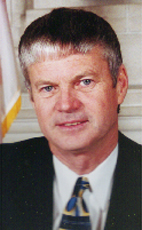
House of Commons photo

Crucial Fact

  • His favourite word was industry.

Last in Parliament May 2004, as Liberal MP for Prince Edward—Hastings (Ontario)

Won his last election, in 2000, with 50% of the vote.

Statements in the House

Agriculture March 25th, 2003

Mr. Speaker, the Canadian farm income program, which was in place in Canada for a number years, ceased as of December 31 last year. Farmers do not have a disaster income program in Canada for this year.

We will continue to work with the provinces and industry to ensure that because farmers need it and they deserve it. We will ensure that every farmer in Canada in similar circumstances, no matter where they live in Canada, will be treated the same.

Agriculture March 25th, 2003

Mr. Speaker, I am pleased that the hon. member has given me the opportunity to clear up an erroneous report that was on a national television channel last night. The report said that the wheat was 3 metres apart. That is incorrect. It was 1,500 metres apart. Scientists say that it only has to be 30 metres apart, but it was 1.5 kilometres away from any other variety of wheat.

Question No. 119 March 19th, 2003

Governments are currently in the process of finalizing all elements of the agricultural policy framework. This framework will guide the development of all aspects of government support for the agricultural sector over the next five years. The APF covers not only business risk management, but provides for protecting the environment, increasing our innovation and science efforts and better equipping farmers under the renewal element in a single, solid platform that will help Canadian agriculture maximize new opportunities at home and in the world market.

The crop insurance program will be an essential component of the APF. Its importance has been demonstrated once again with its quick payment of record levels of payouts in recent years. The APF will maintain successful elements of the current crop insurance program as well as offer additional flexibility and funding to expand and enhance the program. Specifically, full implementation of the APF will: encourage greater participation through the development of a broader range of program options and benefits; offer all farmers access to the maximum coverage level, 90%; provide farmers across Canada with the same level of federal premium support; target the greatest level of government support to severe production loss situations; and increase the federal government’s share of support from about 50% to 60% of the total government contributions.

Most provinces have or are about to announce their 2003 crop insurance program changes and therefore the projected premium costs for 2003 are becoming more clear.

Premium costs in Alberta, Saskatchewan and Manitoba will all be increasing for 2003. The amount and reason for the cost increases vary by province, however, all three provincial governments and the federal government have agreed that the producers’ share of total premium costs will not change for 2003.

Each year the provinces determine crop insurance premium rates based on actuarial formula. The 2003 premium rates will be increasing because of higher coverage due to the updated yields, recent large losses and the resulting change in a province’s cumulative financial position. Despite these increases, premium rates are still significantly lower than the levels throughout much of the 1990s. Governments are also contributing more, 60%, toward premiums in the current year compared to about 50% a decade ago. When good crops are produced, producer’s average premium decrease; in years where more losses occurred, the average premium increase to ensure the sustainability of the crop insurance program.

In addition, the total premium costs will also be increasing due to rising participation levels resulting from program enhancements to existing programs and the introduction of new programs. Both Alberta and Saskatchewan will be introducing new and expanding existing programs for 2003. Alberta’s premium cost estimates reflect participation increases of as much as 30% to 40% over the record levels obtained in 2002, for their forage and pasture programs.

Higher insurable prices in 2003 compared to the values used for 2002 will also factor in increased premium costs. As a result of these higher insured prices, producers will have more protection in the event of a crop loss. This higher level of protection means that farmers and governments will pay more premiums but producers have the option of selecting lower price levels to help keep premium costs affordable.

Based on the factors discussed above, the latest 2003 premium estimates for the Prairie provinces and a Canadian total are compared with 2002 values in the attached table.

Total Crop Insurance Premiums ($ millions)

Agriculture March 18th, 2003

Mr. Speaker, the hon. member was very vocal in stating that, for example, the Canadian Farm Income Program was not effective. He was very vocal about that in the past.

The government has moved toward and is proposing a new, far more effective program. That disaster program has been there in the past and will not be there this year. The government will ensure that farmers in Canada have a disaster program for 2003 that they deserve to have.

Agriculture March 18th, 2003

Mr. Speaker, Canada signed the biosafety protocol in April 2001 and we are on a plan to ratify it.

However, before ratifying it we need to resolve some uncertainties in the agreement. We are doing that in consultation with the agriculture and the agri-food industry. Based on those consultations we have drafted an action plan to identify and deal with those uncertainties.

There is still more work that needs to be done, but we are committed to resolving those uncertainties that may impact the agriculture and agri-food industry before we ratify.

Question No. 117 March 17th, 2003

The answer is as follows:

(i) The comment period provided in the official U.S. federal register notice for the interim voluntary country-of-origin labelling, COL, program ends on April 9, 2003. Upon completion of the comment period, drafting of mandatory regulations will begin through the normal U.S. rule-making process, which will include a proposal and an opportunity for public comment. Mandatory COL is scheduled to be implemented by September 30, 2004. Until this date, COL is a voluntary program in the U.S. As a result of the complexity of the provision and U.S. industry opposition to the measure, widespread implementation of the interim voluntary COL guidelines is not anticipated.

(ii) Poultry is not a covered commodity under the COL law.

(iii) Preliminary analysis of the COL provision indicated that it would have a serious adverse trade effect on Canadian exports of covered commodities to the U.S., for those items that are currently co-mingled at retail with U.S. product, and which now carry no distinction as to country-of-origin. While attempts have been made, it is very difficult to accurately measure the impact on farm income because of the complexity and sheer size of the U.S. agri-food industry, a great deal of uncertainty as to the possible response of the U.S. industry to mandatory COL, the high level of market integration among the U.S., Canada and Mexico, as well as the fact that the U.S. has not yet published regulations for the mandatory implementation of COL. Attempts that have been made to assess the impact of mandatory COL implementation, such as a congressionally mandated USDA study, as well as a study published by the George Morris Center, and most recently a report commissioned by the U.S. national pork producers council, confirm our decision to oppose mandatory COL.

Prior to U.S. farm bill being passed into law, Canada's opposition to COL was articulated at the highest levels. The Minister of Agriculture and Agri-Food raised the issue with cabinet-level officials (Agriculture Secretary Veneman and U.S. Trade Representative Zoellick) as early as September 2001. Deputy Prime Minister Manley raised farm bill issues with Vice-President Cheney during their meeting on March 8, 2002, and the Prime Minister raised these same issues with President Bush during their meeting on March 14, 2002.

On February 7, 2002, the Minister of Agriculture and Agri-Food again raised Canadian concerns about COL with Secretary Veneman, and on February 12, 2002, he raised the matter with Mr. Paul Cellucci, the U.S Ambassador to Canada. On March 18, 2002, Canada's ambassador in turn wrote to the congressional conference directors, who were responsible at the time with reconciling the house and senate versions of the farm bill. He detailed our specific concerns with the proposed legislation and insured that copies of these views were also distributed to other influential voices in Washington in order to re-emphasize these same concerns. During an April 2002 trip to Washington with Canadian industry representatives, and in a bilateral meeting with Secretary Veneman on May 3, 2002, held in Ottawa, the Minister of Agriculture and Agri-Food again expressed Canadian concerns that this legislation would disrupt bilateral trade. COL remains a priority issue for the Government of Canada, GOC.

Canada is currently focussing its efforts on marshaling the best-possible case for why U.S. stakeholders should demand the repeal of the COL law, including participation in a private U.S.-based consortium that is anticipated to produce analysis critical of COL from within the U.S. The government of Canada has been working with industry and the provinces to share information and to develop and implement a cooperative, strategic response to have the entire U.S. COL provision repealed before it becomes mandatory.

Consultations are ongoing with industry and the federal-provincial agriculture trade policy committee to share information and to gather input into strategy development. The Manitoba Pork Board, Canadian Pork Council, Canadian Meat Council, Canadian Cattlemen's Association, Canadian Sheep Federation, Canadian Federation of Agriculture, Fisheries Council of Canada and the Canadian Horticultural Council are among the participants in these consultations. Organized under the agricultural policy framework, the agenda of the recent beef value-chain round table that took place on January 27 and 28 in Calgary focussed on coordinating the beef industry's strategy on COL with that of the GOC. In outreach activities, government officials have made presentations on COL at a number of national industry association meetings as well as to the seafood sectorial advisory group on international trade, SAGIT, C-Trade (i.e. a federal-provincial committee of trade ministries and departments), and broader stakeholder meetings in Mississauga, Moncton and Fredericton and at a meeting in Chicago on COL.

Canada is active in the U.S. domestic debate through trade-advocacy initiatives targeted at provoking the repeal of the U.S. COL legislation. On July 9, 2002, the GOC, in consultation with industry and the provinces, submitted comments to USDA that were influential in shaping discussion in the U.S. in advance of the release of the interim voluntary COL guidelines. Similarly, on January 17, 2003, comments on the interim-voluntary guidelines were submitted to USDA on the “utility” of the measure and on January 21, 2003, comments were submitted on a USDA proposal for information-gathering related to the drafting of the mandatory regulations.

Other targeted advocacy activities in the U.S. have included Assistant Deputy Minister Mark Corey's participation in the tri-national accord meeting in May 14-17, 2002, in Nogales, Arizona, and a meeting in Chicago organized by the province-state advisory group in July 2002, which was dedicated specifically to COL. This meeting brought together U.S. states, provinces and federal government officials from both sides of the border. Canadian embassy and Agriculture and Agri-Food Canada, AAFC, officials presented Canada's position on COL on the margins of the U.S. farm bureau convention in Tampa, Florida, January 17-19, 2003 and at “Canada Day on Capitol Hill” in Washington on February 5, 2003. Embassy officials are also participating in a U.S. industry-led coalition in Washington and are engaged in other ongoing efforts to have COL repealed.

Bilaterally, Canada made strong interventions opposing COL at the November 15, 2002, meeting of the Canada-U.S. consultative committee on agriculture, CCA. COL is a priority item on the agenda of the next meeting of the committee scheduled for April, 2003. Interventions have been made by Canada on the U.S. notification of COL in the World Trade Organization's technical barriers to trade committee, and will be pursued in future meetings of the Committee and other international forums where appropriate. Development of a formal trade challenge is ongoing as information is made available and milestones are reached on the way to the scheduled mandatory implementation of COL in 2004.

Agriculture February 25th, 2003

Mr. Speaker, the hon. member knows that there is a submission up for review. That submission will take a considerable period of time, in fact, many months before it is completed. There are a number of factors that need to be taken into consideration, including the one that the hon. member just mentioned, before complete registration or the marketing of that product would take place.

Agriculture February 20th, 2003

Mr. Speaker, the hon. member knows full well that the present provincial and federal agreements end at the end of March.

The government will not stand by and have the situation happen where there is no disaster program for farmers for this year; no federal co-operation and no money going to farmers through the federal-provincial programs for not only business risk management but for food safety and the environment.

The industry and the provincial ministers and government have been working on this for 18 months. We need to get it done for farmers by the first of April of this year.

Agriculture February 20th, 2003

Mr. Speaker, I am certainly pleased that in the budget the government recognized the important role of the Canadian Food Inspection Agency, and the safety and the quality of Canadian food by further providing another $100 million over two years.

It will allow the agency to continue to enhance food safety in Canada. The regulatory system, along with the border control, will ensure the safety of food exported from our country to other countries and imported from other countries. It will ensure the health of Canadians as well as the health of animals and plants in Canada.

Agriculture February 18th, 2003

Mr. Speaker, I repeat that in the view of the Canadian Grain Commission, in conjunction with the monitoring of the actions and the economic activity of the Naber Seed & Grain Company, it was viewed to have sufficient bonding. However, there was a situation that occurred such that the assets of the company, for a short period of time, did exceed its bonding, and unfortunately it was not all covered.