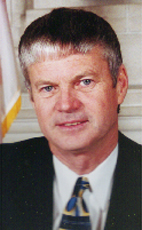
House of Commons photo

Crucial Fact

  • His favourite word was industry.

Last in Parliament May 2004, as Liberal MP for Prince Edward—Hastings (Ontario)

Won his last election, in 2000, with 50% of the vote.

Statements in the House

École de médecine vétérinaire de Saint-Hyacinthe November 22nd, 2002

Mr. Speaker, I have repeated a number of times that the government understands the role of the veterinary colleges, whether they be in Quebec or the ones in the other three provinces of Canada.

I also stated yesterday that they have the opportunity, as we as government are looking at ways of supporting them. In the future, they will have the opportunity of applying through the Canada Foundation for Innovation. I have since been informed that the University of Montreal has been successful in the past in applying to that arm's length organization with applications, and it has received $5.5 million to date.

École de médecine vétérinaire de Saint-Hyacinthe November 21st, 2002

Mr. Speaker, there is no intention at all. The provinces support the veterinary colleges all across the country, and every university and every college had an opportunity to apply to the Canada Foundation for Innovation fund. I have not had a chance to see whether that college did or not, but I do know that it had the opportunity to do so. If it did so and was successful, it would have to follow the use on which it applied for it.

École de médecine vétérinaire de Saint-Hyacinthe November 21st, 2002

Mr. Speaker, the money that went to the University of Guelph was money that came to the University of Guelph as a result of an application to the Canada Foundation for Innovation. All universities have had the opportunity to apply through that. When they do, they indicate in their applications how they want to use it and their applications go into the system for that fund like all others.

Question No. 28 November 20th, 2002

Based on recently completed analysis of the potential economic impact of reducing emissions, there would be very little impact on net farm income from meeting the Kyoto target.

Changes to energy prices resulting from the Kyoto protocol implementation measures would be expected to have a very small impact on the overall economy and agriculture.

Furthermore, it is thought there will be positive implications for agriculture and rural economies through expansion of bio-fuels production. This will increase demand for agricultural products that are used as feed stocks to produce ethanol, corn and wheat, and bio-diesel, soya, canola oil and animal fats, and would create new jobs in building and operating ethanol and bio-diesel plants.

Farmers have an opportunity to be rewarded economically for their new actions to address climate change such as adopting soil conservation practices which enhance agricultural sinks. The draft plan on climate change enables an emission trading system to be designed in a way that would allow farmers to be financially rewarded for the sinks or emissions reductions credits they generate by selling these credits into the emissions trading system. Agriculture also has opportunities to adopt more energy efficient farming practices and technologies which help to control costs and reduce emissions at the same time.

The potential for greenhouse gas, GHG, reduction from the agricultural sector can be broken down as follows:

--a potential of 10 megatonnes, Mt of CO2-equivalent, of GHG reductions in 2010 in the form of agricultural sinks resulting from actions currently underway, business as usual, and this is essentially due to farmers undertaking responsible environmental stewardship,and improved farm management practices promoted by federal government programs such as Action Plan 2000, Budget 2001, the Greencover program and the Agricultural Policy Framework, and provincial government programs; and

--further adoption of agricultural sink enhancing and GHG reducing initiatives could lead to an additional 8.4 Mt of reduction that could be used as offsets in the domestic emission trading, DET, sector.

Question No. 27 November 20th, 2002

On October 11, the government released a report which estimated the impact on Canada's economy of a policy similar to that contained in the draft plan on climate change.

Changes to energy prices resulting from the Kyoto protocol implementation measures would be expected to have very small impact on the overall economy and agriculture, based on the following outcomes from the analysis:

--fuel prices, gasoline and diesel, would not be expected to change;

--electricity prices would be expected to decrease; and

--natural gas prices would be expected to increase, but without significant impact on agriculture sector because of its small share of farm costs and because of the possibility for more energy efficient farming practices and technologies.

As Canada's plan evolves as a result of discussion with the provinces, territories and Canadians, my department will undertake further analysis of the economic impacts and opportunities resulting from action on climate change.

The cost of not implementing Kyoto could be high. The Intergovernmental Panel on Climate Change, IPCC, warns that severe droughts, such as that in southern Canada in 2001, are expected to become more frequent as the climate warms, perhaps doubling in frequency within the next century. Inaction is not an option.

Agriculture November 5th, 2002

Mr. Speaker, the hon. member knows very well that one of the key parts of the negotiating position that this country has put forward at the WTO in Geneva is that domestic marketing decisions will be made here in Canada, and that is referring to supply management in the dairy, egg and poultry industries.

Agriculture November 5th, 2002

Mr. Speaker, I signed with pleasure the communiqué at the end of the Cairns group meeting in Bolivia two weeks ago.

What we did reject was the desire of some Cairns group members to eliminate all de minimis support to agriculture, which would mean, if the hon. member wants that approach, that we could not provide programs such as crop insurance, NISA or ad hoc payments such as we just made to Canadian farmers. I will not agree to that.

Fisheries November 1st, 2002

Mr. Speaker, I know that the Minister of Fisheries and Oceans is very concerned. He is very conservation minded and knows the importance of the role of fish hatcheries. He will do all he can to ensure, through his ministry and through his department, that their work is properly done.

École de médecine vétérinaire de Saint-Hyacinthe November 1st, 2002

Mr. Speaker, I have already answered that question; I think that is the sixth time this week. We are looking at ways in which we can assist in order to help assure the accreditation of the four important agricultural veterinary colleges in Canada.

École de médecine vétérinaire de Saint-Hyacinthe November 1st, 2002

Mr. Speaker, as I said several times this week, the government recognizes the important role of veterinary colleges in not only animal health and safety but human health and safety. We are seeking ways in which we can work with the provinces in order to ensure the continued accreditation of all four of our veterinary colleges in Canada.