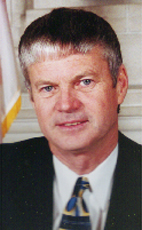
House of Commons photo

Crucial Fact

  • His favourite word was industry.

Last in Parliament May 2004, as Liberal MP for Prince Edward—Hastings (Ontario)

Won his last election, in 2000, with 50% of the vote.

Statements in the House

Agriculture October 13th, 1999

Mr. Speaker, I remind the opposition and all Canadians that even prior to last year's budget in February the government announced $900 million and, along with the provincial contribution, $1.5 billion to assist producers who are under stress and need that help across Canada.

Questions On The Order Paper June 9th, 1999

(a) Agricultural income disaster assistance, AIDA, provides a common basis of support to all commodities. The British Columbia whole farm income insurance program, which essentially follows the same rules as AIDA, has provided payments in different regions of the province where different commodities predominate. This reflects the fact that the gross margin can vary as much from farm to farm producing the same commodities as between farms producing differing commodities.

(b) An AIDA payment is trigerred by a change in a farmer's gross margin. Adding a particular expense would have a small effect on the AIDA payment, up or down depending on the producer, because it needs to be done for both the reference period and the claim year.

(c) A recent evaluation of the Alberta farm income disaster program stated that the program payments have been concentrated in areas with the largest decrease in farm incomes and that it responds well to back to back disaster years. The impact of back to back years of below average returns will depend on the magnitude of the decline in the margins.

In any case, AIDA is designed to address extreme, short term income declines; it is not the program's purpose to support income in a manner that is not consistent with each farm's recent experience.

(d) Data are not available to show the impact on AIDA of altering negative margins in the reference period. Artificially increasing past income would raise the possibility of trade actions as this would conflict with international guidelines.

(e) The British Columbia whole farm income insurance program has provided payments in different regions of the province where different commodities predominate. Besides farmers who have planted perennial crops such as tree fruits, farmers who have invested in essentially single purpose equipment or buildings such as hog barns will also have difficulty in switching to other commodities. These farms can be subject to high market risks because their revenue is related to the price of one commodity. These farmers should utilize all tools available to them to mitigate these risks. These include the use of government programs such as net income stabilization account and crop insurance. Producers must also look for ways to mitigate risks beyond utilization of government programs.

Agriculture June 9th, 1999

Mr. Speaker, I will be touring and flying over the area and stopping in both Manitoba and Saskatchewan on Friday. I have had discussions with my counterparts in Manitoba and Saskatchewan and the industry.

As I said and I will continue to say, we will look into this matter and do everything we possibly can in order to see what flexibility we can build into the NISA program and the AIDA program to assist the producers in this unfortunate situation.

Supply June 7th, 1999

Mr. Speaker, I thank the hon. member for her comments but I think the hon. member needs to get her facts straight. I believe if she looks at the contribution from the budget she referred to, it is about twice what she referred to. Fifteen per cent of the budget is used to support amateur athletes and amateur sport along with a considerable amount of indirect support for our athletes in Canada.

All of us in the House would like to have more money to spend in a lot of places. What we need to do and what we try to do to the best of our endeavours is make the best investment we possibly can with the money. We are proud of our level of support to amateur sport and recognize the importance of it for our athletes.

Supply June 7th, 1999

Mr. Speaker, I am just making a valid point. The Belleville Bulls had a very successful year.

We see the success that amateur athletes bring not only to their own team but to the economic activity and the spirit in their community. It takes nothing away from the pride the other amateur athletes in the riding of Prince Edward—Hastings and across Canada bring to us.

I want to congratulate the member for Broadview—Greenwood and his subcommittee for bringing to the attention of all Canadians the importance of sport right across our country.

I want to take a few minutes to talk about how the Government of Canada shows its strong support for amateur sport through a number of important programs, particularly through the direct funding provided to athletes under the athlete assistance program.

This program has provided outstanding benefits to Canadian athletes for many years. It clearly demonstrates that the Government of Canada has placed athletes at the centre of the support structure for amateur sport in Canada.

As a branch of the Government of Canada, Sport Canada supports the achievement of high performance excellence by Canadian athletes in international sport. By doing so it strengthens the contribution sport makes to Canadian pride, to Canadian identity and to our society in general.

One of the key components of this program is the provision of direct financial support to Canada's international calibre athletes. This support is provided through Sport Canada's athlete assistance program. The program was initiated in 1976 and since that time has provided a focal point for the government's support to amateur sport. The support contributes to the accomplishments of our athletes who in turn become heroes and role models for Canadian youth. It contributes to the strengthening of national pride and unity.

The program has evolved over the past 23 years to a point where now on an annual basis about 1,200 Canadian athletes, including those in such games as the Paralympics are financially supported through the program. These athletes represent Canada at international competitions on an ongoing basis in over 50 different sports.

In 1998-99 the government through the athlete assistance program provided over $7 million in direct financial support to these athletes to assist in their living and training costs. As well it provided over $1 million in tuition support to assist Canadian athletes in completing their post-secondary education.

The main goal of the program is to contribute to improved Canadian performances at major international sporting events such as the Olympic Games, the Commonwealth Games, the Pan American Games, the Paralympic Games and World Championships. To this end the assistance program identifies and supports athletes already at or having the potential to be in the top 16 in the world. Eligibility for program support is subject to the athletes' availability to represent Canada in these major international competitions and their participation in national team preparatory and annual training programs.

In addition to providing direct financial support to Canada's international calibre athletes, Sports Canada also provides financial support to Athletes Can. This is a program of services and leadership which benefits our current and retired national team athletes and works with others in the sporting community to ensure a fair, responsive support system for all athletes. Athletes Can was provided with a contribution of $200,000 in 1998-99. Similar funding will be provided in 1999-2000.

All of this support contributes toward the creation of role models and sports heroes for Canadian youth. Canadians can recognize and feel the sense of pride in the accomplishments of so many of our athletes. I could take the time to list a number of them but I know other speakers will refer to them, whether they be hockey players, track athletes, kayakers, paralympians, all of our athletes.

These are just a few examples of how we support and recognize the excellence of our amateur athletes in Canada. The government places the interests of amateur athletes at the heart of our concern.

Supply June 7th, 1999

Mr. Speaker, I will be sharing my time with one of my colleagues.

It is a pleasure to take a few minutes this afternoon to talk about the importance of supporting our athletes in Canada, Canada's amateur athletes in particular.

I want to take a moment to brag about the Belleville Bulls who this year were the champions of the Ontario Hockey League. They had a tremendous showing in the Memorial Cup. I know, Mr. Speaker, that they took out the team from your city of Kingston very early.

Agriculture June 4th, 1999

Mr. Speaker, the member points out the fact that applications are coming in now in response to all of us urging the producers to do that. The staff is working 12 hours a day, 6 days a week on a rotating basis so that we can make best use of the facilities, the administration and the equipment that we have.

I can pledge to the hon. member that we are turning the applications around as quickly as we possibly can because we know the need that the producers have for the support.

Farm Credit Corporation June 4th, 1999

Mr. Speaker, when we make any changes in the administration of the roles and duties of the Department of Agriculture and Agri-Food in Canada, we do it in such a way that we can maintain the efficiency and effectiveness of it so that every producer in Canada and everybody in the agri-food industry can be treated fairly and equitably. Wherever the actual people are does not really matter because the department is there to service all Canadians and all of the industry in every province.

Agriculture June 4th, 1999

Mr. Speaker, I assure the hon. member and the producers that we are looking at every possible way to assist within existing programs. I will also be visiting the area a week from today.

I am not questioning the disaster situation that is there at the present time, but I will be reviewing that. I will also continue to discuss with my provincial colleagues, the industry people, provincial officials and my officials the different ways that we can help.

Agriculture June 4th, 1999

Mr. Speaker, on a point of clarification for the hon. member, much of the assistance to the producers in the Red River Valley a couple years ago was part of a memorandum of understanding and part of a disaster funding assistance agreement. That is how much of that was handled at that time between the province and the federal government.

To date, the province of Manitoba has not asked to call on the disaster funding assistance agreement. It may or may not apply. It is up to the province to make its judgment call on that.

What I am doing is not leaving any stones unturned as far as looking at how we can use programs that are already in place and getting the flexibility in them that we can to assist these hard-pressed producers.