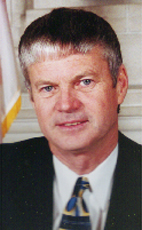
House of Commons photo

Crucial Fact

  • His favourite word was industry.

Last in Parliament May 2004, as Liberal MP for Prince Edward—Hastings (Ontario)

Won his last election, in 2000, with 50% of the vote.

Statements in the House

Agriculture November 16th, 1998

Mr. Speaker, I repeatedly tell the member and the industry out there, and the industry knows and the member knows, that we are working as quickly and as thoroughly as we possibly can in order to put together the best help that we can to assist those in the industry who need it the most.

Agriculture November 16th, 1998

Mr. Speaker, in co-operation with the provinces and the industry, this government and governments before it have put in place a number of risk management tools with the agriculture industry.

We are working with the industry and the provinces to make sure that every farmer makes absolute use of those if they possibly can. We are also working to do what we can as quickly as we can to address any needs beyond those.

Agriculture November 6th, 1998

Mr. Speaker, the federal government put $600 million a year into the safety net envelope for planning for these types of unfortunate situations. The provincial governments put in $400 million a year and the Canadian producers also add to that and in the NISA account receive a very good arrangement with that.

We are planning now to deal with the unfortunate situation we are in. But contrary to the member's party, we did not plan on taking close to $1.4 billion out of agriculture support in Canada.

Agriculture November 6th, 1998

Mr. Speaker, the safety net system that was there was designed with the best intentions of the federal government, the provincial governments and the agricultural industry.

We have a situation now of world commodity prices that are lower than anybody predicted. Right now, the prices of some commodities in Canada to producers are the lowest they have been in over 25 years. That is why we are working with the provincial governments, the industry and all of our officials to do all we possibly can, to turn every stone we possibly can to make sure that not only the tools that are there now—

Agriculture November 6th, 1998

Mr. Speaker, the hon. member and his party keep talking about lowering taxes. They do not seem to realize that we have lowered taxes. Those members should also realize that the problem is that we have a number of farmers who are not able to pay any taxes at all. How would they wish to address that?

We are working to address this to strengthen their industry and to strengthen their safety net. The other thing I would like to remind the hon. member is that in the third quarter of 1998, farm input prices went down.

Agriculture November 6th, 1998

Mr. Speaker, I gave my commitment the other day to work with the provincial governments and the industry to do all we possibly can to turn every stone possible.

I suggest that the member check Hansard . When I made those comments in standing committee, I said that GRIP was not the program. He is right. The provinces verified that because with the exception of one province the program that his government put in place is gone at the wishes of the provinces. I was proven to be correct.

Agriculture November 6th, 1998

Mr. Speaker, I had a meeting with all the provincial governments and farm leaders on Wednesday of this week. The message was very clear. I will be taking the message to my cabinet colleagues that the NISA program, the crop insurance program, in an alteration of what the member's government put in which was GRIP which is gone except in one province, that we recognize we have some tools there for assistance and farm income and we need to review that. We are reviewing it. We will work the best we can with our partners in the industry in this respect.

Agriculture November 3rd, 1998

Mr. Speaker, we can do two things in one day and I am sure the people in the province of Quebec can too. I respect them for that.

I discussed the date for this meeting with all ministers of agriculture and people in the farm organizations in Canada and they agreed that they could attend the meeting tomorrow afternoon with some of their officials, while some of their other officials are attending other meetings in Montreal.

I will be in Montreal tomorrow morning and I will be in Ottawa tomorrow afternoon.

Supply November 3rd, 1998

Mr. Speaker, if we put the forward thinking of the producers, the provincial and federal governments into the perspective of any good group of people in business, they plan for a time down the road that might not be as good or might not be as bad as today. That is forward thinking.

I commend the industry, the provincial governments, my colleagues on this side of the House, and those who sat before us on this side of the House for putting in place a system to prepare the industry for those future times.

Yes, it is a joint contribution, in comparison to the United States, but it is very significant. I said very clearly that it is not the be all and the end all. It is one of a number of tools that we have which we will continue to address and adjust in co-operation and in partnership with producers and the provincial governments.

Supply November 3rd, 1998

Mr. Speaker, if the member wants to take five minutes to ask his questions, I need equivalent time.

With respect to the debt load, this government has been very clear. We agree that personal income taxes in Canada are too high. We have taken steps to address that. Last year 400,000 Canadians were taken off the tax rolls. I could go on.

As far as NISA is concerned, I made it very clear that it is a business decision or an economic decision. For whatever reason, some people made that decision. Eighty-five per cent of participants with eligible production are covered. Well over 85% of producers in Saskatchewan are enrolled in NISA.

As I said earlier, I do not like to see farmers searching for other sources of income. I do not like to see somebody starting up a manufacturing business in the industrial park in Belleville who has to ask one of his family members to provide another source of income.

I will bring it closer to home. My son bought the farm from my wife and I. He is farming 800 acres. He is heavily in debt. He made a personal decision to burn the candle at both ends.

I do not like to see that happen, but he is working off the farm full time. I asked him why he is doing it and he told me he wants to pay his debt and mortgage down sooner. He said that if he did that for a while he would be in a better position to be able to be on the farm full time. That is decision. He made that for his own personal reasons. I do not like to see it happen.

I would like everybody who wants to farm, be a doctor, run a garage or start up a small manufacturing business to be able to do it. I would like to see them all succeed. Unfortunately that is not reality. There is competition out there. There are expenses.

Yes, there is a big debt, but we are now paying down the debt. We reduced the deficit from $42 billion to zero much faster than Canadians thought it could be done. We now have very low inflation. Our interest rates have been below those in the United States for a number of years. Nobody in the world denies that the economic fundamentals in Canada are the best they have been in many, many decades.