
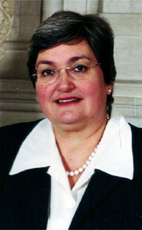
House of Commons photo

Crucial Fact

  • Her favourite word was opposite.

Last in Parliament May 2004, as Liberal MP for Thornhill (Ontario)

Won her last election, in 2000, with 65% of the vote.

Statements in the House

Immigration November 19th, 2001

Mr. Speaker, the member knows that it is not proper for me to discuss individual cases here in the House of Commons or outside the House because of privacy legislation.

What I can tell him is that there are appropriate means to make discrete inquiry to ensure that someone is properly treated and that all of the activities that take place are done properly and appropriately.

It is up to an individual to convince the immigration officer that they have legitimate business in Canada before they are entitled to enter the country.

Citizenship and Immigration November 9th, 2001

Mr. Speaker, the new Immigration and Refugee Protection Act streamlines the numbers of steps at the refugee determination stage: one hearing, one appeal and one judicial review will replace the multiple levels and steps that are in place today. That will give us a faster opportunity to make a decision, stay out of the federal court and be in a position to remove people more quickly. That is the way it is supposed to work.

While we are planning for volumes, we--

Citizenship and Immigration November 9th, 2001

Mr. Speaker, if the member would continue with the quotes, he would hear that the chair of the Immigration and Refugee Board of Canada is speaking about individuals who may not be well informed about the new legislation and how it will work.

I agree with the chair of the board who said that the new appeal procedure, when in place and functioning, will indeed be faster and achieve our goal of two things: first, have a fast determination procedure; and second, give us a system with integrity that will stay out of the federal courts so that we can not only have a fast decision but remove people who do not--

Immigration November 8th, 2001

Mr. Speaker, the member opposite knows that privacy legislation does not permit me to give details on individual cases. What he should also know is that there are procedures under the Citizenship Act of Canada where anyone who has information can present that information so that investigations can take place, and if an individual through fraud or misrepresentation obtains Canadian citizenship there are provisions to revoke that citizenship.

Immigration November 7th, 2001

Mr. Speaker, we do detain those who are a security risk.

I would ask the member, if he has any evidence or advice that he has seen that I have not, perhaps he would like to table it. I would like to see it because the premise of his question is quite wrong.

I would also say to him very clearly that the statistics he is quoting are wrong. Ninety-seven per cent of people mail in their forms. Some 77% of refugee claimants work at the very first opportunity. Canada's acceptance rates are consistent with those of other countries in the world that have refugee determination.

Immigration November 7th, 2001

Mr. Speaker, many people who are fleeing dictatorial regimes simply cannot get documents. They bring what information they have. Others have to resort to humanitarian smuggling in order to flee countries for their lives. They often do so in the middle of the night.

A valid document is a passport or a travel document. Other bits of information such as birth certificates and driver's licences are not considered valid documents but do help us to identify who people are.

Immigration November 7th, 2001

Mr. Speaker, I reject the premise of what the member opposite has said. I want to give him important information.

As Minister of Citizenship and Immigration, my officials are responsible at ports of entry for people coming into Canada. Last year they identified and stopped over 25,000 people coming into Canada from the United States when there were criminality concerns.

Border patrols of both U.S. and Canadian law enforcement do their best to patrol our borders but immigration stops people coming into Canada.

Immigration November 7th, 2001

Mr. Speaker, the Immigration Act gives the immigration officers the authority to detain anyone where they have reason to believe that person poses a security risk. They do detain.

However things have changed since September 11. Now, not only do we photograph and fingerprint, there is what some might call an indepth grilling of two to four hours and an assessment is made as to whether or not that person poses a risk.

I want to assure the Leader of the Opposition that when my officials have reason to believe that someone poses a concern or a security threat to Canada they detain without hesitation.

Immigration November 7th, 2001

Mr. Speaker, the Leader of the Opposition misinterprets the quote. We detain when we have evidence or concern about security, where we have evidence or concern about identity or where we have concern that the individual will not show up.

The overwhelming majority of those people who show up undocumented, if they are not detained, is because they do not pose any risk.

Immigration November 6th, 2001

Mr. Speaker, the member should know that before anyone is granted permanent residence status to Canada, he or she must undergo the statutory requirements of both security checks and criminality checks.

I would also say that further checks are done before citizenship. If, however, an individual knowingly lies or misrepresents himself or herself, citizenship can be revoked under the legislation.