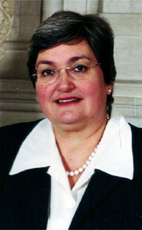
House of Commons photo

Crucial Fact

  • Her favourite word was opposite.

Last in Parliament May 2004, as Liberal MP for Thornhill (Ontario)

Won her last election, in 2000, with 65% of the vote.

Statements in the House

Immigration October 29th, 2001

Mr. Speaker, the security of Canadians is a top priority for the government. That is why we are working very closely with out neighbour, the United States, to ensure that we do everything we can to speed legitimate traffic at the borders and stop those who have no legitimate reason to enter either Canada or the United States.

I want to assure the member opposite that there are a number of things we are discussing to achieve that goal.

Immigration October 26th, 2001

Mr. Speaker, I attempted to explain this fully yesterday at the immigration committee hearing.

We discussed with the United States and other countries, but particularly with the United States, emerging trends in the world where there may be a need for a visa imposition or where a visa requirement could be lifted. That is ongoing business.

I would say to the leader that he gives the wrong impression to suggest that we are not consulting. We certainly are and we always have. Because of our good relationship with the United States, my officials speak virtually every day with our neighbours.

Immigration October 26th, 2001

Mr. Speaker, if we have any concerns that people who arrive at a port of entry, be they refugee claimants or potential visitors, pose any security threat to Canada, if we do not know who they are or if the immigration officers have reasonable grounds to believe they pose a threat, they are detained. That is the fact.

Immigration October 26th, 2001

No, Mr. Speaker. The Leader of the Opposition clearly does not understand either the safe third agreement or the fact that my officials speak with their U.S. counterparts and have talks about how we can better co-ordinate our activities and better co-operate on a whole host of very important issues.

Immigration October 23rd, 2001

Mr. Speaker, both the existing immigration law and the new immigration and refugee protection act known as Bill C-11 contain the provision for discussion of safe third country agreements.

In the past my department has initiated those discussions with the United States. For a number of reasons the United States at that time was not interested in concluding the agreement.

We have indicated our interest in those discussions. It is not the be-all and end-all as far as a solution goes but we do consider it one of the important methods whereby we can ensure that people are given a fair hearing at the first place where they arrive and--

Immigration October 23rd, 2001

In fact, Mr. Speaker, removals are a priority. Canada has a very good record of removal. Last year well over 8,000 people were removed. The number one priority for removal are those who are inadmissible because of criminality or security concerns and the second priority are failed refugee claimants.

Over the last five years there have been 45,000 removals. Of the people who were removed last year, some 1,700 were inadmissible because of security concerns. They were removed as quickly as we could do it.

Immigration October 23rd, 2001

Mr. Speaker, first of all, we do detain anyone where we have evidence that they pose a security risk to Canada and we keep them in detention as long as we have evidence to suggest that they are a risk. We move through the courts to remove them as quickly as possible.

I am the first one to say that sometimes those procedures take too long. That is why I brought forward legislation to streamline those processes.

The premise of the member's question is absolutely wrong. On the Canadian side of the border we have three times the resources in personnel than the Americans have at this time. What they are doing is actually going to--

National Security October 23rd, 2001

Mr. Speaker, members opposite have heard me say on a number of occasions that we are working very closely with the Americans as well as with law enforcement agencies in Canada.

Let me explain to the members what this means. When the RCMP says it cannot comment because there is an investigation and the FBI says it cannot comment because there is an investigation, surely they would recognize that there should not be a comment, because we do not want to jeopardize an investigation. If they were being responsible, they would understand that.

Supply October 23rd, 2001

Mr. Speaker, the question of the member opposite is a good one. A wrong impression is being created. At every border point there are immigration officers checking the people who arrive, whether they are immigrants, refugee claimants, visitors or students.

As I said, 110 million people come to Canada each year and they are checked by our immigration officers and customs officials. If our customs officers have a concern that someone poses a threat, if they do not know who they are or if they believe they will not show up for any kind of hearing, they have the authority to detain and they do detain. To suggest that is not happening is false and it is fearmongering.

Supply October 23rd, 2001

Mr. Speaker, existing immigration law gives authority to immigration officers to detain individuals if they are suspicious, if they do not know who the individual is, if they are concerned they will not show up for hearings, or if they have any evidence whatsoever to suggest the person poses a threat to national security. That is also contained in the new legislation. It would go a step further by stating clearly that if someone is undocumented and uncooperative it is grounds for detention.

We detain whenever we have concern and when we have evidence to sustain the detention. In Canada we must have evidence to be able to detain someone and take away their liberties. That is one of the important features of the Immigration Act. It gives my officers the authority to do that and they do it.

I would caution the Leader of the Opposition not to act as judge and jury on individual cases and not to do or say anything that might prejudice the outcome of an important investigation or trial. We want justice to be served by bringing people who are guilty to justice.