
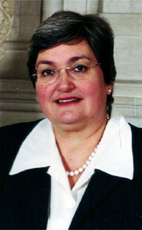
House of Commons photo

Crucial Fact

  • Her favourite word was opposite.

Last in Parliament May 2004, as Liberal MP for Thornhill (Ontario)

Won her last election, in 2000, with 65% of the vote.

Statements in the House

Citizenship and Immigration October 17th, 2001

Mr. Speaker, the premise of the member's question is incorrect. Anyone who shows up and makes a refugee claim in Canada is fingerprinted and photographed immediately, and an interview is conducted. If there is any concern regarding security, identity or that they might not show up for their hearing, that is grounds for detention.

Whenever we have that kind of evidence we do detain. If we know who the person is and we are not concerned that he or she poses a security risk, we do not detain.

Terrorism October 17th, 2001

Mr. Speaker, Bill C-11, which is before the Senate at this time, does exactly what the member opposite is saying today that he would like to see happen: streamline our procedures and make it more easy and more efficient for us to be able to remove those by denying access to the IRB and by removing appeal rights.

They voted against the bill. Further, they tried to reinstate appeal rights for security tests to Canada. They cannot have it both ways.

Terrorism October 17th, 2001

Mr. Speaker, the fact is that in Bill C-11 we have actually eliminated the right to an appeal of the immigration appeal division for those who pose a security threat to Canada.

Do members know what happened on June 4? That member and members of the opposition voted to restore the appeal rights to make it more difficult for us to pursue those who pose a security threat to Canada. That is the fact.

Terrorism October 17th, 2001

Mr. Speaker, again let me say that it is extremely important for the member to know the facts. The fact of the matter is that when someone arrives in Canada and makes a refugee claim, the first thing that we do is take his or her fingerprints. The next thing is a photograph. We then have an interview and right now those interviews are taking three to four hours. Wherever we have evidence to suspect that someone is a security risk he or she is detained.

The overwhelming majority of people who come to Canada asking for protection are working and paying taxes. We know who they are and where they are.

Terrorism October 17th, 2001

Mr. Speaker, the first thing it is important for us to deal with is fact and not myth, whether it is a member opposite or an officer of the RCMP.

The facts are these. For the overwhelming majority of people who come to Canada and make a refugee claim, we know who they are and we know where they are. They are working. They are paying taxes. They are undergoing intensive security screening.

There are those who would like to see them detained or forced underground. In this country we honour our humanitarian traditions as well as the rule of law.

National Security October 15th, 2001

Mr. Speaker, at no time did anyone suggest that there is a magic wand or a simple solution to stopping world terrorism. What I have said is that we are introducing a new permanent resident card for all landed immigrants. It is to replace the Imm-1000, which we have all recognized is in need of replacement.

This new card is tamper resistant and fraud resistant. It is state of the art. I think it is an important addition to increasing the security that all Canadians will feel about those who enter our border showing proper documentation.

Immigration October 5th, 2001

Mr. Speaker, let me repeat again. No country can unilaterally make the declaration that the member opposite is asking for.

We have over the past attempted to negotiate an agreement with the United States. Over 40% of all the refugee claimants in Canada come to Canada from the United States and, for obvious reasons, the United States has been reluctant to agree to such an agreement.

I also believe that since September 11 this has not been the highest priority for the United States or, frankly, for Canada. We are looking at taking efforts that will protect all of our citizens following those terrible events.

Immigration October 5th, 2001

Mr. Speaker, I will try once again to explain so that the member and all members will understand that while the authority is in both the existing Immigration Act and the new Immigration and Refugee Protection Act to negotiate bilateral agreements with other countries, a safe third agreement, it requires the agreement of the other country. It is not the sort of thing that any country can or should do unilaterally.

The member refers to the European experience. It was an agreement among all European states and there are some that do not think it is working very well at all.

Citizenship and Immigration October 4th, 2001

Mr. Speaker, the member is wrong. For many years, in fact as long as I think most Canadians would know, departments of government, different levels of government and police forces have worked together.

I have to tell the member opposite that there is a 24-hour, seven day a week warrant centre. All police forces across the country and different levels of government work together to check anyone who is apprehended to see if there is an outstanding warrant. We have worked together and we will continue to work together to make sure that those people who should leave Canada leave Canada as soon as possible.

Citizenship and Immigration October 4th, 2001

Mr. Speaker, when someone is in Canada illegally it can mean they have overstayed a visitor's visa. It can mean that they are a failed refugee claimant with a deportation order.

What I hear the member opposite doing, which concerns me, is equating refugees with criminals. When I think of refugees I think of Hungarians, of Vietnamese, of Kosovars and others who have come to us and who are in need of our protection.

It is simply wrong to broad-brush all of those who are in Canada who have deportation orders.