
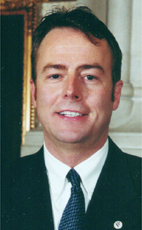
House of Commons photo

Crucial Fact

  • His favourite word was quebec.

Last in Parliament May 2004, as Bloc MP for Berthier—Montcalm (Québec)

Won his last election, in 2000, with 57% of the vote.

Statements in the House

Pearson International Airport Agreements Act May 9th, 1994

Mr. Speaker, the Liberal government thought that, by introducing Bill C-22 as a token of the political openness with which it wanted to deal with the controversial Pearson deal in Toronto, the opposition would approve of the legislation. Who does the government think we are? The fact is that this piece of legislation covers up a straight case of partisanship and the complicity between the old federal political parties. To help our good friends to a few bucks, everything is possible.

I am probably not the first one to mention that this bill adds to the doubts and the questions we have and stresses the need to have a royal inquiry to get to the bottom of this whole deal once and for all.

On April 26, 1994, the Minister of Transport, not a Bloc member or a Reform member, but a member of the Liberal government, stated in this House and I quote:

Our government after careful examination of the agreements and the report by Mr. Robert Nixon-

Again, the government shows how open it is by appointing a good old Liberal friend and a former minister to conduct this review. That is the person

-who described a flawed process clouded by the possibility of political manipulation.

As if that was not enough, Mr. Speaker, the minister added:

A reliance on lobbyists, the backroom dealings, the manipulation of bona fide private sector interests and the lack of respect for the impartiality of public servants are absolutely unacceptable.

And if we add the millions or rather the hundreds of millions of dollars at stake, we have all the ingredients needed for a real political scandal.

I think we ought to call this Pearson contract the now famous Pearson deal. We must have a royal inquiry to shed some light on this issue and to bring to heel the lobbyists and politicians who do not seem to care about public funds. However, the Liberal government, after careful examination of the ins and outs of this deal, is now realizing that the old chums of the Liberal Party as well as the long-time followers of the Conservative Party were all involved in this thing. And now it has a problem.

What do the Liberals do? They introduce this piece of legislation in this House, hoping that it will pass surreptitiously or that the Opposition will be completely hoodwinked. However, it is thanks to the vigilance of the Bloc Quebecois that were brought to light these dubious actions, which we have been discussing for a few days.

The voters are sick and tired of the political scheming, which allows the rich to fill their pockets while, by osmosis, the taxpayers or the middle class are going broke. At the federal level, everything is bigger, larger, more complex. Budgets, spending, partisanship, scandals, everything is ten times bigger, undoubtedly in the name of the Canadian unity.

Well, yes, handouts must be made to those who will stand up for our beautiful and great country when the time comes. Money

is the sinews of war. The old parties have known it for a long time. That is why they use it while they still can.

That is precisely what is trying the patience of Canadians and Quebecers. Anger is brewing up. Moreover, in this Pearson issue as in every other issue this government dealt with so far, Quebecers and Canadians feel they are taken advantage of and manipulated. This was an opportunity for the Prime Minister to demonstrate to the voters that he is a man of principle and a true statesman, as they have a right to expect, and to call for a royal inquiry before even bringing in this Bill C-22.

But no. It is easy to realize that he is a man of many words who needs a lot of persuading to keep them and to act on them. Yet, in the last election, when the Liberal Party was virtuously asking for the voters' confidence, they had a position on that. In the red book, this little Bible they are quoting times and times again in this House, it is said on page 95 and I quote:

-we will develop a Code of Conduct for Public Officials to guide Cabinet ministers, members of Parliament, senators, political staff, and public servants in their dealings with lobbyists. We will also take measures to better regulate the activities of lobbyists, particularly in the awarding of government contracts.

In particular, a Liberal government will appoint an independent Ethics Counsellor to advise both public officials and lobbyists in the day-to-day application of the Code of Conduct for Public Officials. The Ethics Counsellor will be appointed after consultation with the leaders of all parties in the House of Commons and will report directly to Parliament.

Where is that independent counsellor? When will the government consult him or her? Why is the government taking so long to act on that measure? Is there any political will to act? Where is that desired openness? Nowhere, because today, the Liberals are in power and when a political party takes power, it very quickly forgets its commitments.

Openness is the objective of the inquiry that the Bloc Quebecois desires and demands in the Pearson Airport affair. If the famous red book that I just quoted were not only election rhetoric, a royal commission would already be at work and we in the Bloc would applaud such an inquiry. But no, there is no such thing.

When everybody talks about lobbyists, patronage, political jockeying and shady deals and the government remains silent, I instantly see the image of a man who cannot move or talk because he put himself in a compromising situation.

To prevent any new agreement of this kind and to prevent further waste of public money, we must go to the root of the problem, and that is the financing of political parties.

Why does this government refuse to make the system of political party financing more democratic as we in the Bloc Quebecois have been advocating for months? How can the Liberal government dare say that it is making the system more open since it depends itself on big corporate donations?

How could it explain that the Top One Hundred Club, the party's donor and benefactor clubs or even the Laurier Club, with a membership fee of $1,000, are essential to ensure that the ordinary taxpayer has access to members of Parliament, to the party or to the back rooms where the decisions are made?

How can a party or the leader of a party tie their hands by accepting as much as a quarter of a million dollars from the banks?

For those who do not know, according to the latest figures available, the six largest Canadian banks contributed close to half a million dollars to the Liberal Party and the Conservative Party in 1992. According to the data I have, the Conservative Party received about $240,000 and the Liberal Party $245,000. As these contributions show, financial institutions have a great sense of equity towards political parties.

How much do you think Canada's richest families contributed to the old parties for the government to refuse categorically to review the tax treatment of family trusts?

How much do you think Mr. Charles Bronfman and the consortium he represents contributed to the Liberal Party for the Liberal government to try and hide millions of dollars in compensation in a bill without Parliament ever having the opportunity to consider the matter?

In Quebec, under René Lévesque's government, we cleaned up our act and raised our moral standards in politics. Today, thanks to that new image, Quebecers know that democracy is alive and well in that province, something of which they can be proud.

We have to change our political system to make it more receptive to the people, a move which would breathe new life into it.

Well-known complicity between some political parties and those who make large contributions to them undermines people's trust in our political institutions, which is very unhealthy. Things have to change.

I will conclude my remarks by saying that it is very important for the government to accept and respond to the Bloc's demands regarding the appointment of a royal commission of inquiry which would shed some light on the Pearson deal. It would be a first step towards the transparency that we want.

Then, the next step would be for the government to accept the motion proposed by the hon. member for Richelieu, a member of the Bloc Quebecois, regarding political party financing. The government must set in motion, as soon as possible, a process for the democratization of political party financing.

That democratization process, which has already taken place in Quebec, is undoubtedly the legacy that I would be the most happy to leave to Canada when Quebec becomes sovereign.

Member For York South-Weston May 4th, 1994

Mr. Speaker, the Liberal member for York South-Weston declared yesterday that the Canadian Security Intelligence Service should investigate the activities of the Bloc Quebecois and the Parti Quebecois.

Such a declaration is totally unacceptable. It seems the requirements of democracy are too much of a burden for some members who would like the federal government to illegally interfere once again in the major decision Quebec is about to make.

Quebecers remember. They remember the arrests without warrants, the wiretapping, the break and enter searches which occurred during the days when the federal government readily mistook, some would say deliberately, legitimate and democratic aspirations for illegal actions.

I truly hope that the member for York South-Weston is the only one in this House to wish for Quebec and Canada to relive such a dark period of their history.

Correctional Service May 3rd, 1994

Mr. Speaker, in light of his response, can the minister tell us whether the allegations of influence peddling involve any persons other than those mentioned in the weekend newspapers?

Correctional Service May 3rd, 1994

Mr. Speaker, my question is directed to the Solicitor General. The weekend newspapers reported that the RCMP was currently investigating an alleged case of influence peddling within the Correctional Service of Canada and the National Parole Board and that certain charges could be laid very shortly against employees.

Can the Minister confirm that an investigation is indeed under way into allegations of influence peddling within these agencies and that charges could be laid against certain commissioners?

Young Offenders Act May 2nd, 1994

Mr. Speaker, I welcome this opportunity to speak to the bill introduced by the hon. member for York South-Weston, a trial balloon being launched by the Liberal government on the issue of young offenders.

Since the opening of the 35th Parliament, the Department of Justice has been discussing amendments to the Young Offenders Act. For reasons known to the department, it seems this was one of its priorities.

Furthermore, in the famous red book people have been talking about since October 25, the Liberal party proposed to reform the Young Offenders Act, to offer real rehabilitation while cracking down on young criminals.

Since I assume no one is against real rehabilitation, today the Liberal government is testing the temper and sensibilities of voters on the issue of cracking down on young criminals. Considering the bill the hon. member has introduced, I understand why he sits on the extreme right of the Prime Minister.

Unfortunately, this shift to the right on the young offenders issue is based on a skewed equation of violence and young people. To the average citizen, youth is equated with violence and adolescence is synonymous with delinquency. However, nothing could be further from the truth.

In Quebec, since 1979, all crimes committed by young people have decreased substantially, by nearly 8 per cent across Quebec and by 34 per cent in the Montreal area. Was the government, or should I say, was the hon. member aware of these figures before he introduced the kind of bill we have before us today?

We cannot go on being alarmist to this degree, because it gives a false picture of reality and we end up with bills like this one which I consider to be very alarming indeed.

It is all well and good to ask for zero tolerance, but should this necessarily mean lowering the age limit of offenders covered by the youth courts, should this mean more severe sentencing and releasing the names of repeat young offenders? This interpretation of zero tolerance is tantamount to telling all young offenders: get in there and stay there. That is the easy way out.

That is a fifties petit bourgeois attitude. The emphasis should not be on the sentencing aspect as much as on assistance, guidance and reintegration of the young offender.

Obviously, I am against the simplistic bill before the House today. If this proposal would help the government save money, a government that is flat broke, perhaps we could discuss it and consider the benefits from that angle. However, by increasing sentences and lowering the age at which one is considered to be young offender, we are merely filling up our prisons faster and adding to the number of unproductive young people who will be a burden on society for the rest of their lives.

Current public pressure for a stricter Young Offenders Act is understandable, especially in western Canada. Sensational cases reported in the media add to the skewed perception of the problem. However, reaching directly with amendments like these reflects some confusion about, and represents a major departure from, the objectives pursued by the Young Offenders Act passed in 1984, in other words, deterrence, rehabilitation and the protection of society.

In Quebec, we understand the main principles behind the protection of youth and society. When dealing with young offenders, we rely on rehabilitation and reintegration. As much as possible, we avoid criminalizing cases involving young offenders.

The Quebec Department of Health and Social Services and the Youth Protection Branch take care of young offenders and assist them. The results have been astonishing. In Quebec, we invest in rehabilitation because we believe in it. Statistics are extremely revealing in that respect. According to a very sound study conducted in Quebec between 1968 and 1983, it takes society less than five years to recoup the money it invests to rehabilitate young murderers and turn them into productive young adults who work, pay taxes and spend money, all of which keep the economy going.

In western Canada, they are understandably intolerant because they do not invest in their youth as we do. It is not one of their concerns. They do not seem to have the resources; they do not take care of young offenders who are left to fend for themselves. They just lock them up in a different part of the prison than the adults.

Our assessment of this bill illustrates how distinct a society Quebec is. You know, it is not only our language and culture which make us different from the rest of Canada, but also our beliefs, concerns and philosophy. We just do not see things the same way and the bill before us this morning is a case in point.

I would be remiss if I did not mention that the goal aimed at by the amendments proposed in this bill could be achieved through a stricter enforcement of the present Young Offenders Act. It appears that, in his bill, the Liberal member is seeking to make

young offenders accountable and responsible for their illegal actions so that they can be tried in a regular court.

In our justice system, teenagers charged with indictable offences are seldom tried in adult court, even though the April 1992 amendments make it easier.

Being doubly concerned with the rehabilitation of the young offender and the protection of society, lawyers and judges are not surprisingly very reluctant, one to ask for a trial in adult court, and the other to order it.

In Quebec, according to the information I have, transfer to an adult court is requested in no more than 5 per cent of all cases.

This reluctance is easily explained: If a young offender is found guilty in adult court he will receive a very stiff sentence, offering very little opportunity for rehabilitation. Moreover, he will be eligible for parole only after five or ten years, depending on whether the crime was first or second degree murder.

Why force the hand of the courts if, for legal and social reasons, they do not do it? Even though they can try some young offenders as adults, accountable and responsible for their actions, they rarely choose to do it. If the hon. member wishes to help society, he should instead introduce a bill to make the public more aware that a program offering help in a responsible manner affords better protection than a punitive measure, which is effective only as long as it is in force.

More than that, he should support a complete transfer of jurisdiction to the provinces, with the necessary budget. This way each province could deal with its young offenders as it chooses.

The deterrent effect sought by imposing longer sentences is not supported by the information available. In fact, the reverse in true according to Crime and Delinquency which, in its January issue, published the results of a study carried out in several American States proving that.

Like his government, the hon. member misses the target completely with this bill. If the Criminal Code needed amendments, it would be to force rehabilitation and reentry into the community for young offenders, but this is outside the jurisdiction of this House.

Society should be more tolerant and its objective should not be to make all young persons conform with what their environment, their family, their school and society itself expect of them, but to make them able to become independent, with the minimum of limitations, and to make their reentry a success.

Witness Protection Act April 20th, 1994

Mr. Speaker, I welcome this opportunity today to speak to Bill C-206, an act to provide for the relocation and protection of witnesses, standing in the name of the hon. member for Scarborough West. I would like to comment first on the principle of the bill and then on its substance or content.

As far as the principle is concerned, I am glad to see that some government members think about the issues. We have at least one member who just showed us he had examined a situation that was deplorable and who has now introduced a bill on his own initiative, and he is to be commended for that. I agree it is intolerable that today we have no legislation to protect these people. Canada is a society that provides a lot of protection for the rights of offenders and the rights of defendants, but very little for the rights of people who go to court to testify so that the accused will answer for the crime they committed.

Yes, we have the Canadian Charter of Rights and Freedoms. I checked the Charter, because I thought there might be something in it to provide for this. The only section is section 7, which says: "Everyone has the right to life, liberty and security of the person-" Other than that, there is nothing in the Criminal Code or any other item of criminal or penal legislation that deals directly with the subject the member has approached through his private members' bill.

Today, there are certain ways, and certain funds are used, to protect these witnesses, but that is not enough, and the trouble is that it is at the discretion of the police. I think that a program of this kind, when we are talking about taxpayers' money, should be organized so that everyone is treated equally, and I think this bill takes that approach.

On what basis do people make a decision, when we say these decisions are discretionary? How do they decide whether or not funds will be allocated in a given case? Does it depend on whether one criminal is more dangerous than another criminal? Does it depend on the fact that some crimes are more repugnant than others? I think it is intolerable to talk about "discretionary" in this respect.

The police force that makes the assessment can also make a wrong decision without being made to account for that decision. Sometimes these mistakes are covered up. It is very difficult, and I will give you an example of what I mean.

Since being appointed Official Opposition critic for the Solicitor General of Canada on October 25, I have had two cases that fit in very well with the bill of the hon. member for Scarborough. I will ask this House a question.

What do Lucie Leblanc from New Brunswick, Sue Smith from Alberta and Mireille Martin from Quebec have in common? What they have in common is that they are the same person. In five years this person changed names three times. I am giving them because the last time she called me, she told me she would be changing her name for the fourth time since her husband, a criminal famous across Canada, had discovered her new identity. How did he do it? The people dealing with her case had made every conceivable change to her passport, driver's licence, social insurance number and other pieces of ID but made a mistake in registering the car she was provided with under the name of Mireille Martin from Quebec. She had been living in fear for a few months, not knowing exactly where to go, how to proceed, or where to find money. She asked me to approach the

Solicitor General of Canada to have her case dealt with expeditiously because she was living in a terrible situation.

I too came up against a brick wall. I could not get information or find anyone accountable in this case. However, she told me herself that after a few calls her case was finally dealt with, but only after a member of Parliament intervened.

If the mistake is very serious, the person who did not enforce the law properly, who made the mistake, should be held accountable and asked where the money went to.

I am not saying the mistake was intentional; honest mistakes can be made but they can have serious consequences for the individuals who are given money to protect them from potential harm.

With all due respect to the hon. member, it is not a matter of reinventing the wheel. I think this is a good bill but, as he said, we must look at what is done elsewhere. There is a similar program in the United States. I also looked at Italy where, given what is happening with justice in that country, legislation was passed to protect witnesses. Great Britain also has a similar program.

This means that all great societies concerned with the protection of victims and offenders, whether accused or charged, are also concerned with the protection of witnesses, because I think it is all tied together in the system.

This kind of bill, if passed-I will address contents later-will send a clear message to the criminal element as well as to witnesses and the public, the message that this House takes this matter seriously, that we will not let the people who testify in court down.

I think that any legislation that supports, not informers because I do not like that word, but let us say witnesses who come forward, is good for the system we live in. If we encourage people to come forward and testify, I think that it will show in rulings, sentencing and the entire system. I think the judicial system stands to benefit greatly.

In my legal practice, I have noticed that it is one thing for a witness to testify, but quite another to give convincing evidence. I may comply when served a subpoena, yet be extremely reluctant to answer questions, knowing that my life could be in danger as soon as I step out of the court. Perhaps I would feel safer and my evidence would be more convincing if I knew that, when I walk out of court, there will be people there to protect me.

I am not saying that such a measure should be applied in all criminal courts. The mere fact of witnessing a murder near my home does not automatically endanger my life. However, my life could be in danger if I testified in a case involving organized crime or a major case of fraud. I think that work could be done on this bill to amend it so that it could become very useful to Canada and Quebec.

I knew from Quebec statistics that many crimes went unpunished because no one was actually found guilty. I was surprised to see Canadian statistics for the period 1980-1992. Over this 12-year period, for murders alone, there were 1,455 unsolved murder cases. One can wonder how many cases of fraud, robbery, assault and well-planned crimes also went unsolved. We could then ask ourselves the same question about smuggling. I think that it is a very important subject and that this deficiency must be corrected as soon as possible.

So I think that this bill could encourage witnesses to come forward and say what they know in order to clear up some crimes and some cases for which the criminals go unpunished.

As for the principle, there is no problem, we agree 100 per cent. The Official Opposition, the Bloc Quebecois, will support you on this bill. I think that we have always shown that we co-operate when presented with a good bill, and I think that is a way to show it to you again and to tell you again that we will co-operate with you on this bill.

I do not have much to say about the form and content. Of course, some small adjustments could be made, including the following. I would immediately take the matter to the Solicitor General. I would say that he is responsible for applying this bill once it is adopted, not a member of the Privy Council. In the Committee on Justice and Legal Affairs, among colleagues and people working on that committee, we will easily be able to come to an understanding; I say "easily" because everyone around the table will be on the same wavelength, so we will be able to agree.

But on the whole-and I conclude with that-regarding this bill, I would ask the whole House to be unanimous and I would ask the government to pay very careful attention to this private member's bill, and perhaps we will have something to show that private members' bills can go somewhere, for the good of society in general that will benefit from it.

Controlled Drugs And Substances Act April 19th, 1994

Mr. Speaker, yes, I could give a few examples. First I must point out, as I said in my speech earlier, that criminalization of drugs is nothing new as it was done in the Narcotic Control Act, but I will give you three examples.

Clause 6(1) of Bill C-7 reads as follows:

No person shall traffic in a substance included in Schedule I, II or III or in any substance represented or held out by that person to be such a substance.

Clause 4(1) of the current Narcotic Control Act says this:

No person shall traffic in a narcotic or any substance represented or held out by the person to be a narcotic.

Another example, clause 7(1) of the bill before us provides that:

Except as authorized under the regulations, no person shall import into Canada or export from Canada a substance included in Schedule I, II, III, IV or V.

The current Narcotic Control Act says this: "Except as authorized by this Act or the regulations, no person shall import into Canada or export from Canada any narcotic."

I could give you other examples. Clause 9(1) of Bill C-7 is the same as clause 9(1) of the Narcotic Control Act with regard to the commission in Canada of an offence.

As I said earlier, I think the idea is to update the legislation; however, we want, through this House, to send the message that the law we will adopt on food and drugs will be enforced in every part of Canada. And I am saying that, at this time, the Narcotic Control Act is not being enforced everywhere in Canada.

Controlled Drugs And Substances Act April 19th, 1994

Mr. Speaker, the explanatory notes in Bill C-7 specify that the proposed enactment consolidates Canada's drug control policy to fulfill Canada's obligations under international conventions.

That consolidation, which is no doubt necessary, brings about major consequences, the most important of which is the repeal of the Narcotic Control Act, as well as of Parts III and IV of the Food and Drugs Act.

In the guise of that consolidation, the legal and statutory approach to a major problem is dramatically changed and this, without prior consultation. Yes, without consultation, and in a strange heavy context which raises concerns on this side of the House.

As you did, Mr. Speaker, I heard the comments that were made to the media by the Solicitor General of Canada on February 15, as I mentioned earlier. If it is true that there is an emergency, as if the present Narcotic Control Act could not allow the RCMP to stop the lucrative traffic of cocaine and other hard drugs, there is a problem with the system.

A country can have all the useful and necessary laws in some activity sector, but if the political will to enforce these laws in some areas of that country does not exist, they will be useless. So, we believe that it is necessary for Canada and for Quebec to have efficient and stringent legislation that responds to the present and imminent need to stop this plague. But, most of all, the police forces must feel that they have the support of those who will vote for that legislation.

From this House, we must give a clear message to anyone engaged in that black market that the legislator is serious in his or her willingness to counter narcotics and all other drugs. In order to do so, we should step up our effort and enforce the present laws while waiting for the updating wished for by Bill C-7.

In that regard, it might be useful to remind the Solicitor General of Canada of certain provisions of the existing Narcotic Control Act compared to provisions found in Bill C-7 dealing virtually with the same issue. If you read the bill, you will see that the legislator's intent was to criminalize the trafficking in designated substances as well as their import and export. However, the legislator does not criminalize trafficking since trafficking, and importing and exporting of narcotics are already considered a criminal activity under the existing Narcotic Control Act.

I could mention a whole list of provisions contained in Bill C-7 that are identical or similar to those contained in the existing Narcotic Control Act, but since I do not have the time, I will simply mention to this House that there is already an act that can efficiently counter cocaine trafficking or trafficking in any other narcotic, provided it is enforced everywhere in Canada.

As regards the statement of the Solicitor General of Canada who said that Bill C-7 would allow police forces to make sales under surveillance, which means that double agents could infiltrate smuggling networks and catch criminals by proposing deals, one can also question that novelty.

When the Solicitor General made that statement, he was referring to clause 54(2) of Bill C-7.

That provision reads as follows:

(2) The Governor in Council, on the recommendation of the Solicitor General of Canada, may make regulations that pertain to investigations and other law enforcement activities conducted under this Act by a member of a police force and other persons acting under the direction and control of a member and, without restricting the generality of the foregoing, may make regulations: (b) exempting, on such terms and conditions as may be specified in the regulations, a member of a police force that has been designated pursuant to paragraph (a) and other persons acting under the direction and control of the member from the applications of this Act or the regulations;

There is absolutely nothing new in this bill. Something similar exists in the current Narcotic Control Act. The investigative power of police officers already allows them to infiltrate a group that they are watching and further, section 18 of the Royal Canadian Mounted Police Act already provides for that procedure.

Then, why does the Solicitor General of Canada need the powers under clause 54(2) of Bill C-7 when the investigative power of police officers already provides for such measures?

Furthermore, infiltration is aimed at gathering information on dealers or on trafficking.

However, in the case quoted by the Solicitor General, the RCMP and the Sûreté du Québec-and I must emphasize that it is the Solicitor General of Canada who referred to the groups that I talked about earlier-mentioned that they were aware of the cocaine trafficking done by the Warriors.

So, this bill does not set forth anything new, nor does it provide any additional powers. We have to admit that the Solicitor General could act immediately to put an end to trafficking everywhere in Canada. That statement makes us believe that the Solicitor General is behind the anticipated passage of Bill C-7 in order to gain time and delay any intervention in those territories.

If the bill were so essentiel to the fight against drug trafficking in Canada, does it mean Canada never offered any resistance to drug dealers before the passage of the bill we are now studying? I hope this is only an extrapolation and that Bill C-7 is presented to this House with a view to modernizing a police procedure already in place and consolidating the Canadian drug control policy, as mentioned in the explanatory notes to the bill. However, one fact still remains: the government is not reaching its objective with this bill, it is presenting a faulty bill, one that is badly written, confused and difficult to enforce.

That being said, Mr. Speaker, to convince you, I think it would be appropriate to stress one of the points raised on Friday, February 18, by the hon. member of the Bloc Quebecois for Portneuf when he discussed Bill C-7. You will remember he was explaining to the House the deficiencies of Bill C-7.

After studying the bill, the Bloc Quebecois classified its deficiencies under four categories. I will review them briefly. First, the legitimate activities of doctors, pharmacists and veterinarians; were these people adequately protected by this bill? Second, the enormous powers given to inspectors designated by the minister; are they not of such nature as to allow, if not induce, mistakes which will unduly penalize health professionals and their patients?

Third, how will the confidential nature of medical records be respected when the law allows just about anybody designated as an inspector by the minister to copy the files held by health care institutions and to seize all their computer files? The last question is why does this bill call criminal and throw in jail individuals who, in fact, are drug addicts in need of treatment?

As the Official Opposition critic for the Solicitor General, I will deal mainly with the third question regarding the confidential nature of medical records.

I do think that, should this bill be passed without amendment, it will jeopardize the confidential nature of medical records. Under the provisions of the bill, the lawmaker will make it harder for policemen to search the home of a known drug dealer than for an inspector appointed by the minister to carry out what would amount to a seizure in a hospital or at the corner drugstore.

One has only to refer to Part IV of Bill C-7 to realize how far-reaching are the powers of an inspector designated by the minister to enforce the act.

Under clause 29 of the bill:

29.(1) The Minister may designate any person as an inspector for the purposes of this Act and the regulations.

The expression "any person" send shivers down my spine because this person is given a lot of power.

Under clause 30. (1) of the bill:

  1. (1) Subject to subsection (2), an inspector may, to ensure compliance with the regulations, at any reasonable time enter any place used for the purpose of conducting the business or professional practice of any person licensed or otherwise authorized under the regulations to deal in a controlled substance or a precursor and may for that purpose

We are dealing here with professionals, not smugglers or pushers, but real professionals who are licensed for this very purpose.

This small paragraph therefore entitles anyone designated by the minister pursuant to clause 29 to enter at just about any time-clause 30 even specifies at any time of the day-a doctor's office, a pharmacy, a hospital, an LCSC, or the office of any other health professional who has obtained the required licence.

What are the powers of an inspector doing an inspection? I will tell you. Among other things, he can: a ) open and examine any receptacle or package-

examine anything found in a place that: b ) -is used or may be capable of being used for the production, preservation, packaging or storage of a controlled substance- c ) examine any labels or advertising material or records, books, electronic data or other documents found in that place with respect to any controlled substance-

And the list goes on and on.

The inspector can even: e ) reproduce any document from any electronic data referred to in paragraph ( c ) or cause it to be reproduced, in the form of a printout or other output; h ) examine any substance found in that place and take, for the purpose of analysis, such samples thereof as are reasonably required;

As we can see, Bill C-7 gives the inspector powers that even a peace officer does not have to fight the most serious threat of all, cocaine trafficking. Obviously, we are off the track!

Even more disturbing, should Bill C-7 be passed as it is, the inspector can gather evidence which could be used against a pharmacist, a physician, a nurse or anyone else in criminal court, whereas normally any action likely to lead to a trial in criminal court cannot be undertaken without a warrant, except under very special circumstances provided for in the legislation.

I was saying a moment ago that the law is a lot more demanding for police officers than for these inspectors, and to prove it, I will read to you clause 12, subclauses (1) and (7) of the bill.

Under the title Search, Seizure and Detention , clause 12 says:

  1. (1) A justice who, on ex parte application, is satisfied by information on oath that there are reasonable grounds to believe that a ) a controlled substance-, b ) any thing in which a controlled substance [-]is contained or concealed, c ) offence-related property, or d ) any thing that will afford evidence in respect of an offence under this Act is in a place may, at any time, issue a warrant authorizing a peace officer, at any time, to search the place for any such controlled substance, precursor, property or thing and to seize it.

Subclause (7) provides that:

(7) A peace officer may exercise any of the powers described in subsection (1) -without a warrant if the conditions for obtaining a warrant exist but by reason of exigent circumstances it would be impracticable to obtain one.

These two subclauses of clause 12 clearly show that a police officer cannot act without a warrant, except under special circumstances.

As for clause 30 of the bill, it provides that an inspector can act, visit, seize, etc., as indicated, at all times and without a warrant. Thus there is a clear difference between the two.

The only time an inspector needs a warrant is when he wants to visit a dwelling, a private residence. It is normal to require a warrant in such a case. For the rest, there is a clear difference between a government inspector and a police officer doing his job, fighting against smugglers.

I find the wording of clause 30 quite strange, especially when referring to superior court judgements on the importance of search warrants under the Canadian Charter of Rights.

We must not forget that certain previous provisions of the Narcotic Control Act and the Food and Drugs Act authorized searches without a warrant anywhere but in a dwelling, when a peace officer had reasonable reasons to believe that narcotics were to be found there.

There were no such open-ended authorizations in the defunct Bill C-85, a bill similar to the one before us today, because they had been ruled inoperative and contrary to section 8 of the Charter.

Yet, subclause 12(7) would authorize, under exceptional circumstances, a peace officer to conduct a search without a warrant when the conditions for obtaining a warrant exist but it would be impracticable to obtain one. It could be that the time required to obtain a warrant would jeopardize the life or safety of a person or the very existence of capital evidence. Under the circumstances, a search without a warrant would be justified and could not be challenged under the Charter.

To wrap up, I sincerely think that the legislator would be giving far too much power to the inspectors if clause 30 were to be passed as is, as it has no foundation in law.

As the past gives us some indication of things to come, we know that it is not good to give this kind of discretionary powers to a person or group of persons without providing a restrictive framework, legally speaking. The War Measures Act is a good example of this. Never again must we relive such excesses.

In no time, these superinspectors would be living in a glass bubble that would promote excesses.

Furthermore, the powers of the inspector run counter to the provinces' jurisdiction. For example, Quebec has granted inspection powers to the Professional Corporation of Physicians of Quebec, as well as to the Quebec college of pharmacists and dentists. The corporation's or organization's inspector can show up, provided proper notice was given, at the office or place of business of doctors, dentists, pharmacists and others to ensure compliance with the principles of medical practice.

The Government of Quebec also allows the corporation's trustee to examine the practice of any physician, dentist or other professional with respect to a complaint to the effect that he or she has prescribed a hazardous substance to a patient.

It seems obvious to me that this part of the act once again enables the federal government to interfere in provincial areas of responsibility, which the Official Opposition considers both costly and unacceptable.

In closing, I suggest the government go back to the drawing board and come up with a bill that would be much more in line with the realities of modern-day life, one on which everybody

would have been consulted. I suggest that it holds consultations on this subject, as part of the multiple consultations it is carrying out these days. I think that consultation in that area would definitely be in order, considering the implications for future generations.

Controlled Drugs And Substances Act April 19th, 1994

Mr. Speaker, it is interesting to see the member who just spoke try to do a psychological analysis of the opposition's intentions, in particular regarding Bill C-7. However, I would like to remind him that when the Liberals were in opposition, they did exactly what we are doing.

As long as we think that a bill fails to reach its goal or is poorly written and is unclear and ambiguous, we will oppose it regardless of what the government says. I believe it is our responsibility, as the official opposition, to do so not only for Quebecers but for all Canadians. This bill is unclear and we oppose it in many respects. I will have later on the opportunity to dwell on a particular point.

But I am concerned by some statements made by the government members opposite regarding this bill. On February 15, the Sollicitor General of Canada stated to the press that it was important to amend the Narcotic Control Act as well as some parts of the Food and Drugs Act in order to be in a better position to fight the cocaine traffic organized by the Warriors on the aboriginal reserves.

I would like to know if the member agrees with this statement and, if so, if it means that the present Narcotic Control Act does not provide any means to control that traffic? Does the member agree with this statement and, if so, could he explain why?

Supply April 18th, 1994

Mr. Speaker, I did not intervene immediately for a very good reason; I wanted to hear the comments from both sides on the speech the Reform Party member just made. I think members interpret in various ways and disparage the reason why there are 54 members of the Bloc Quebecois in this House. I believe that some members live in a hothouse, totally disconnected from reality.

I would like to ask the Reform Party, and particularly the member who just spoke, where they were at the time of the Meech Lake Agreement and of the Charlottetown Agreement, when English Canada twice said no to Quebec. Where were they then? Maybe they will understand the reason for the Bloc Quebecois being present in this House, they will understand why 54 out of 75 members are here to defend Quebec's interests, to advocate and promote Quebec sovereignty.

Since we are drifting slightly away from the Reform Party's motion on bilingualism, it is easy to present various ideas and explanations, but in the member's speech, I never understood, I never saw any concrete measures-we are talking here about Quebec separating from Canada and I think both sides are speaking as if it were a fact, as if Quebec were separated already; but what are you going to do with the francophones? I understand the Reform Party members when they say that they will welcome everybody and treat all minorities very well. But they never made any concrete suggestions. What exact measures will the Reform Party put into place for francophones outside Quebec when Quebec becomes sovereign?