The total.

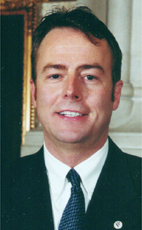 House of Commons photo
Won his last election, in 2000, with 57% of the vote.
Supply October 9th, 1997
The total.
Supply October 9th, 1997
Madam Speaker, I will attempt to answer this question. However, I fear it might take the rest of the afternoon.
I need not give a report on nine years of Tory government since the people spoke, very clearly, I believe, in 1993. With the exception of two MPs, they were all turfed out of the House of Commons. The message could not have been more clear, I think.
However, with regard to the present Liberal Party, I remember how in 1993 it ran on a platform almost exclusively dedicated to government ethics, claiming it was going to change the way things were done, and so on and so forth.
Those who were crying wolf in 1993 turned into wolves themselves by 1997. They are even worse than the previous Tories. Day after day we hear how the system set up by the Liberals had been planned all along. This is what is so revolting. This is the most serious aspect of this whole affair. One day we will learn that this is not limited to the Department of Human Resources Development, we are of the opinion that many other ministers are involved in this kind of practice to get cash.
Supply October 9th, 1997
If I understood the Prime Minister correctly, what a minister cannot do because of the code of conduct, he has his staff or political organizers do it. It is just terrible.
Once again, I get the impression they are laughing at us, that some members opposite are trying to fool the public. How can the Prime Minister suggest that the Liberal Party and the government are so much at arm's length when ministers of the Crown give confidential information on subsidies to Liberal bagmen? That shows that ethics is a consideration for Liberals only when it suits them.
What became of the nice principles they were so proud of in the red book? If I had time, I would go through the list of the irregularities the Liberals have done during the 35th Parliament. We already have a pretty long list after only a few weeks.
What we have seen this week is but the tip of the iceberg. How can you explain that the Prime Minister did not issue a directive on an ethical conduct to his ministers after the Minister of Human Resources Development informed him of the RCMP investigation?
How could anybody believe that the Liberal government made such an omission because it cares so much about the ethics guidelines. What are we to make of the fact that the Solicitor General of Canada, who is in charge of the mounted police, like the Prime Minister calls them—somebody ought to tell him that it is now called the RCMP—was the only cabinet minister who did not know the Liberal Party of Canada was being investigated?
How can we explain the long delay between March 1997, when the scandal was discovered, and the search in the premises of the Liberal Party of Canada on June 12, 1997, just a few days after the government was re-elected? Something smells funny in all this! Perhaps there would have been a different public reaction on June 2, and perhaps the government would not be where it is today.
Are we to believe, and this is an extremely important question the public is asking today, that no government minister was aware that a certain Mr. Corbeil, a Liberal party staffer, was collecting funds at $25,000 a shot? Do you think that no one in that government was aware of it? Come on! Everyone knows that within the very organization of the Liberal party, they knew what was going on. They knew the Corbeil fellow.
In light of these facts, we are saying that it would have been in the Liberal government's best interest to respond favourably to the Bloc Quebecois invitation, when it proposed the creation of legislation on the public funding of political parties. Adoption of such an act would, of course, have had repercussions on the millions in the Liberal Party coffers which come from multinational corporations and various lobbies.
But that would have been the lesser evil, considering that our entire democratic system would have benefited in future from funding from party members and supporters. Passing such legislation would have made it easier for the famous ethics I speak of so often to find a place in our federal political mores.>
But I can already hear those opposite saying that the member for Berthier-Montcalm is totally unaware that they have an ethics commissioner even. Let us talk about this ethics commissioner. I was involved when the position was created, but the government opposite completely disregarded the remarks and requests of the Bloc Quebecois, the official opposition at the time.
The commissioner is not independent, since he is appointed by the Prime Minister, advises the Prime Minister on the sly, on a confidential basis, and has no say in decisions. I therefore have little to say for the ethics commissioner, because, between you and me, he is not very good at his job and is certainly the government's accomplice in keeping silent on a number of matters.
The initial weeks of the new Parliament have revealed the true face of this patronage government with its taste for light ethics. Everything is permitted—from dubious practices to partisan appointments.
Since I have little time left and since I am the justice critic, I cannot resist raising the latest and most offensive of this government's patronage appointments, while we are on the subject of dubious practices and partisan appointments. I am referring to the appointment of the new justice to the Supreme Court of Canada. This appointment of Michel Bastarache is the worst of the government's political appointments. He was appointed a justice of the supreme court.
Who is Michel Bastarache? A former colleague in the law firm where the Prime Minister did his Liberal Party of Canada purgatory. He is a good friend of the Liberal Party of Canada. He was part of a firm that gave thousands of dollars to the Liberal Party of Canada in its funding drive. Michel Bastarache's appointment is one of the worst the government opposite has made.
The worst of it all is that I heard the Prime Minister himself say he did not know Michel Bastarache. I would remind him that the signature on the preface to the book written by Mr. Bastarache in 1986 was that of Jean Chrétien.
Supply October 9th, 1997
And what about the Prime Minister's statements to the effect that the code of conduct does not apply to the Liberal Party of Canada, but only to the government?
Supply October 9th, 1997
Mr. Speaker, I find it astonishing that a former member of the House is not familiar with the Standing Orders. I find this strange, since the hon. member has been a member of this House for nine years.
That having been said, I will proceed directly to the motion by the Leader of the Bloc Quebecois. I will use my brief 10-minute speech to describe the vision that haunts me when I put the terms “transparency” and “Liberal Party of Canada” together. It is certainly not the most appealing image and that is why I want listeners to know right off the bat that I intend to be very critical but realistic in my remarks. This is the sad price people must pay when hoping to gain more insight into the government they are dealing with today and, unfortunately, for a few years to come.
For over a week now, members have been trying to shed light on this dark side of the Liberal Party organization and, more specifically, the federal government. For over a week now, members of each of the opposition parties, particularly the Bloc Quebecois, have been trying to find out about this transitional fund scandal in the last election. Unfortunately for them, the Prime Minister has decided to dodge the embarrassing issue and take refuge behind the RCMP investigation. No matter, the Bloc Quebecois is there to ask the real questions and that is why we are presenting today an opposition motion on this extremely important matter.
Rather than go all over what has already been said by the leader of the Bloc Quebecois or other Bloc members who have taken part in the debate, I am going to denounce once again the unhealthy situation in which the Liberals have landed themselves. Indeed, who would not do a double take on hearing of certain odd doings like those engaged in by organizers of the Liberal Party of Canada, who had the lists of grant applications in their possession before they had even been approved? These are confidential lists. Who would not protest when we know that these same lists were used to blackmail potential contributors to the coffers of the Liberal Party of Canada? Could that be described as democratic? Nothing could be more ethical, we might say.
Let us now look at the issue of ethics, which I deeply care about and worked very hard for during the 35th Parliament. We discussed the famous Liberal code of conduct on several occasions in this House. Originally, the code was supposed to restore the government's integrity and image. This instrument has definitely, and unfortunately, not been overused. The Liberals were so concerned about projecting a positive image that they forgot that a code of ethics is not a makeup kit. Its primary purpose is to deal with conduct related issues that can hinder the proper operation of our democratic institutions.
Obviously, the Liberals do not use their code often, assuming they even know it. The scandal surrounding transitional funds shows without any doubt that the Liberals tricked us when they drafted this phoney code. How can the government claim to be acting in compliance with a code of ethics when it stubbornly keeps on its payroll people who are said to have deliberately tried to corrupt entrepreneurs for the sole purpose of bringing money into the party's coffers? Why was Pierre Corbeil not immediately suspended? Why is Jacques Roy, an assistant to the President of the Treasury Board, still working for the government in spite of the fact that his actions are currently under investigation? Mr. Roy is still working for the minister.
Money Laundering October 6th, 1997
Mr. Speaker, my question is for the Minister of Justice.
Here is a little quiz for the minister: What do Joseph Lagana, Vincent Vecchio, Richard Judd, Santiago Sanchez, Jean Lamarche, René Rodrigue and Giuseppe Tanaglia have in common? They were all found guilty of money laundering and they were all released just a few months after their sentence was handed down, that is after serving only one-third or one-sixth of the sentence.
What is the minister waiting for to introduce legislation on money laundering, as the Bloc Quebecois has been asking for a long time, so as to, among other things, prevent anyone from being released before serving a full sentence?
Speech From The Throne October 2nd, 1997
Mr. Speaker, I too have worked with the member on a number of occasions and I can confirm that he is highly intelligent. I do not understand why he is asking such questions today.
Two things. First, I did not discuss the subject of democracy in the matter of the two referendums in response to the throne speech, but I am pleased to answer. As regards democracy, yes there were indeed two referendums: one in 1980 and the other in 1995.
In 1980, and here I will give a little course in history for those opposite who so quickly forget, the Prime Minister was Pierre Elliott Trudeau. He told Quebecers to vote no for change. Quebecers voted no for change. What change was there in Quebec? There was a constitution, which we rejected, which the National Assembly unanimously rejected, and which was jammed down our throats. It was shoved down our throats with the words “Shut your trap, you Quebeckers”.
That is why there was another referendum in 1995. In between, they had their referendum on Charlottetown, which he forgot to mention, in which English Canada said no to Quebec because it was too much, and Quebec said no because it was not enough. They forgot that across the way.
In 1995, there was another referendum where—let me finish, I will not be long—there was no winner. It was 50:50. Here again there were promises from the Liberals, which never led anywhere and never will, because the federal system cannot be reformed. Quebec's only option is to vote yes in the next referendum, it is to become sovereign.
To answer his second question, neither the justices of the supreme court nor the government opposite can stop a people on the march toward its own country.
Speech From The Throne October 2nd, 1997
Mr. Speaker, unlike the Reform members, I find this an excellent question.
Unlike the Reform, I believe that it is not true that the rich in Canada pay too much income tax. On the contrary. The rich in Canada do not pay enough income tax. There is all manner of tax evasion. Even more than that, when it comes to such extremely important aspects as money laundering, who gains from it? Those with money. Canada is recognized world wide as the world capital for money laundering. What are the Liberals doing about it? Nothing at all.
It is almost as if they had both hands in the till themselves. The Liberals may need to wake up, and one day I will be asking them to co-operate with me—because I will be introducing a private member's bill on money laundering.
As for the hon. member's excellent question, I disagree totally with that, if the Reform indeed said it. I hope that they are not that out of touch with reality. If they did say it, however, I totally disagree with their position.
Speech From The Throne October 2nd, 1997
Mr. Speaker, I will be sharing my time with the hon. member for Lotbinière and, following that, all Bloc Quebecois speakers will do the same with a colleague from our party.
Although I have already criticized the government since the June 2 election, this is my first formal speech in this new Parliament. While taking part in the debate on the address in reply to the throne speech, I want to thank my organizers, my supporters and especially the voters of Berthier—Montcalm, who have renewed their trust in me in a proportion almost identical to that of 1993. Thanks to them and to a wonderful team I have the honour of representing them once again in this House. They can count on my undivided attention, on my availability and on my friendship.
I must also thank my wife and my children for their support and for allowing me to be here to represent the Bloc Quebecois of course, but more importantly to look out for the interests of the Quebec people. In my way, I want to contribute, in this House, to the creation of a country that we can call our own.
As for the throne speech, the Prime Minister said it would probably be the last one before the celebrations marking the new millennium. I will tell the Prime Minister—and I hope he will also make sure of it—that we will do our utmost to ensure that this is indeed the last throne speech before the next millennium. Because what we Bloc Quebecois members want first and foremost is to have a country by the year 2000.
What does the throne speech tell us? Many things were said, but I can think of two essential points: first, all the allusions made in the two previous throne speeches of the Liberals to devolution, change, respect and realignment of federal-provincial powers have disappeared. These words are no longer used by the government.
When it started making cuts to transfers, to social programs, to health, to education and to social assistance, the government talked about devolution and about respecting the powers of the provinces.
But today, because we are seeing that there may possibly be a budget surplus, because of the slashes the Liberal government has made in these programs and because the taxpayers are in the process of getting this government out of the red, now the Liberals are back to their old bad habits.
With the expected budget surplus, they are paying out big bucks for the right to trample over provincial jurisdictions. I will not go into all of the examples there are in the Speech from the Throne, because my ten minutes would not be enough, but I will list three of them.
First, they want to measure the academic readiness of our children. Today is not the first time they are being told that education is none of their business. Mr. Duplessis did battle on this in 1950. This is not yesterday's news. It is not just those wicked separatists, that awful Bloc, who are demanding this. It dates back to the fifties.
They also make no bones about wanting to get back into manpower training. Yet I thought they had just handed that over to the provinces. Now they want to make resources available to help young people get back in the work force. That has no concern of theirs. If they have money left over in their budget, let them give it back to the provinces from whom they stole it in the last budget.
They also want to set up some ten or twelve programs with a national slant, what they call Canada-wide programs. They have been told for more than 30 years that we in Quebec want nothing more to do with Canada-wide programs. Programs from sea to sea do not apply to Quebec. But they persist.
Where I come from, in my country of Quebec, we call that provocation. This federalist propaganda whose aim is visibility over efficiency has caused the leader of the Bloc Quebecois to say justifiably in his response to the throne speech that the speech was nothing more than big federalist talk. Unfortunately, that is the sad reality.
After bringing misery to the families of seasonal workers, after cutting payments to provinces and scuttling their budgets, the hangman becomes the generous lord of the manor distributing money over the heads of the provinces. It is disgusting and hypocritical.
Now the Liberal government is realizing that it cut too much and too quickly. Why not analyze the situation seriously? Why, with the expected budget surplus, does it not mend its ways by returning the money it took from the provinces in the area of health care, social assistance and education; why does it not lower taxes, lower employment insurance contributions and reform personal and corporate income tax as proposed in the 35th Parliament, as the Bloc put forward in its proposal, which was well received?
Why not go after poverty with a vengeance, improve the employment insurance plan and reverse all the cuts that were made?
The repayment of the debt should be debated. I agree with some members who have proposed a debate on the repayment of the debt. I think we should have a very serious debate on the matter.
For the time being, however, the focus should be on health, education, employment and the eradication of child poverty during this 36th Parliament. However, for this to be successful, the federal government should not meddle in these areas. It should give the money back to the provinces, as they know much better how to use this money where it is needed.
The second element of the throne speech that stands out in my mind, and it is of particular concern to me as justice critic, is the federal government's willingness to score political points by taking the hard line with Quebec. Why do I say hard line? Because the federal government intends to continue with its reference to the Supreme Court. It will carry on with its strategy of instilling fear about what might happen following a yes victory in Quebec.
On the one hand, the Liberals praise the merits of Canada, while on the other hand, they are trying to deny one of the most fundamental principles of democracy: the right to decide.
There is worse yet, and this took place after the Speech from the Throne was read. At his swearing-in ceremony, responding to journalists who asked him if there were plans for the Canadian armed forces to take action in Quebec following a majority vote in favour of sovereignty, the new chief of defence staff, General Maurice Baril, did not reject the idea out of hand. The general said neither yes nor no, but that the political question does not arise. He should have said, in a democratic country such as Canada: “There is no question of it, it is a purely political question”. This is very disappointing in a country that considers itself a frontrunner when it comes to democracy.
There are all the strong-arm tactics that are still going on with respect to the issue of Quebec's sovereignty, and to possible consequences for them as well as for us. We never say that, the day after a yes vote, the first people interested in sitting down with Quebec would be my friends across the way. I will not say “my friends” because I do not want my constituents to hate me, but the government opposite would be the first, following telephone calls, probably from all the financiers in the world, to want to negotiate with a sovereign Quebec.
Another thing that upsets me about this throne speech is that the Liberals take credit for the entire Calgary declaration that Quebec is a unique society. We are more than that, and have been for some time. This is not just nasty separatists, or nasty members of the Bloc Quebecois saying so. I will run through a short list of premiers of Quebec who, over the years, have said more than once that we were more than the Liberals wanted us to be, that we were a people.
In 1950, during the opening speech at the federal-provincial constitutional conference—because that is the second national sport in Canada—Maurice Duplessis said: “Canadian confederation is a pact of union between two great nations”. That was in 1950.
In 1960, Jean Lesage said that “provincial sovereignty must not be a negative concept incompatible with progress. Quebec is not defending the principle of provincial autonomy because a principle is involved, but for the more important reason that it views autonomy as the concrete condition not for its survival, which is henceforth assured, but for its affirmation as a people”. So said Jean Lesage in 1963.
In 1968, Daniel Johnson senior said that “a new Constitution should be so devised that Canada is not just a federation of 10 provinces, but a federation of two nations equal in law and in fact”.
I will conclude with one last quote from Mr. Johnson, again at a federal-provincial constitutional conference, in 1968: “The Constitution should not have as its sole purpose to federate territories, but also to associate in equality two linguistic and cultural communities, two founding peoples, two societies, two nations, in the sociological meaning of the term”.
You will understand that, in Quebec, we say no, no, no and no, as the Minister of Intergovernmental Affairs would say, to the Calgary declaration.
Appointment Of A Special Joint Committee October 1st, 1997
Madam Speaker, I am going to make a comment and, if he wishes, the member is welcome to pick up on it.
He says that, at the time the Constitution was patriated, there were members who voted in favour. In fact, 74 of the 75 members from Quebec were Liberals.
However, I have news for the member. This is why the Bloc Quebecois is here, to prevent this dual legitimacy in Quebec. The Bloc Quebecois, and increasingly all of Quebec, is very clearly unanimous on this as well.
Even the Liberals in the National Assembly, those close to the federal Liberal Party at the time, were unanimous in disagreeing with how the federal government wanted to proceed.
I think he should take another look at his history, including that of Quebec, because just because there were Liberal members from Quebec who were in agreement or who voted in favour of patriating the Constitution does not mean Quebeckers were in agreement. They were not in agreement. There was a Liberal party line and they toed it.
But in the National Assembly, and this is what counts, they were unanimously opposed to patriating this Constitution.