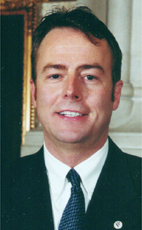
House of Commons photo

Crucial Fact

  • His favourite word was quebec.

Last in Parliament May 2004, as Bloc MP for Berthier—Montcalm (Québec)

Won his last election, in 2000, with 57% of the vote.

Statements in the House

Airbus Affair February 3rd, 1997

Mr. Speaker, if there is one principle this House recognizes, it is that of government accountability.

In this case, the Prime Minister has denied any responsibility. So have his ministers and the commissioner of the RCMP. But the decision to write the Swiss authorities and denounce a former Prime Minister was nonetheless made by someone somewhere in this government.

My question is for the Prime Minister, and I would like him to answer it. Who in his government is responsible for this blunder that will cost Canadian taxpayers millions of dollars?

Airbus Affair February 3rd, 1997

Mr. Speaker, my question is for the Prime Minister. The more we know about the Airbus affair, the less we understand.

What do we have here? A justice minister who claims not to be involved, but apologizes anyway; a solicitor general who admits having known for eight months, but takes no responsibility and did not inform any of his colleagues; the Clerk of the Privy Council, Jocelyne Bourgon, who denies knowing anything in spite of information to the contrary; a commissioner of the RCMP who denies any responsibility because he did not see the letter until January 1997, when the letter was written two years earlier; and a Prime Minister skirting the whole issue by saying it is none of his concern.

How will the people of Canada know who is responsible for the mistake that will cost them millions of dollars?

Canadian Food Inspection Agency Act December 13th, 1996

Mr. Speaker, I have been listening to the speeches by my hon. colleagues with great interest. It is becoming clear to me that this is an issue of great concern to all members of the official opposition, the Bloc Quebecois, whether they come from a rural riding or an urban riding on the island of Montreal, like the hon. member sitting next to me. This is an issue of great concern not only to the people of Quebec, but also to everyone in English Canada.

As far as I am concerned, this is a bill I followed closely because, as you probably know, the riding of Berthier-Montcalm is a major producer of poultry, quails, ducks and pork. There are therefore many slaughterhouses in our riding and this industry is very important for the riding.

Just recently, in my capacity as the federal member for my riding, I have had to fight quite hard to keep some slaughterhouses open and particularly to have the one in Saint-Esprit reopened. I am sure that you will see no objection to my saluting at this time the people who have fought to have this slaughterhouse reopened and I thank them because, as a result, 120 jobs were created and investments amounting to some $7 million were made in the riding of Berthier-Montcalm, all of this thanks to the support of the community, the investors and the pork producers of the Lanaudière region.

That being said, I gave these figures to show how important this industry is, in Quebec in particular, because Quebec is a major processor of raw material, be it the raw milk we have heard about on the hill, poultry or pork. It is therefore very important to us to have a bill dealing specifically with this industry, that meets the specific, or distinct, needs of Quebecers. There too lies our distinctiveness.

Unfortunately, I must say that Bill C-60 before us this morning does not meet these objectives. I think this bill will not meet the government's objective of facilitating the development of this industry. Worse yet, it does not give any guarantee concerning the whole inspection process. When there is no guarantee, one may be less tempted to invest money. If the changes made to the rules of the game are not very clear initially, investors will start asking questions, especially in Quebec.

Again in this area, Quebec is a distinct society, since we already have a complete food inspection organization. The Government of Quebec unified this whole field. If the Government of Canada had followed through with the resolutions that were passed here in this House, it would have done something about this. The government, and especially the Prime Minister and the Deputy Prime Minister, often remind us that a resolution was passed in this House to recognize Quebec's distinctiveness. We in the opposition say that this resolution was nothing but a smoke screen, that it gives Quebec no additional jurisdiction and means nothing to Quebecers.

The subject matter of this bill is really quite mundane. Food inspection is not nearly as important as constitutional matters-which does not mean it is not important. This bill should have reflected the government's resolution recognizing Quebec's distinctiveness, if it meant something, but it does not mean anything. There is nothing in it to prove otherwise. This resolution does not mean anything. Had it meant something, the bill we are studying this morning would have contained a whole chapter specifically for Quebec, as our distinctiveness extends to the food inspection area. But the government did not do anything because the resolution it adopted does not mean anything, and we will have to remember that.

That being said, the group of amendments introduced by the Bloc Quebecois is aimed at preventing patronage. Unfortunately, "patronage" and "Liberal" seem to be synonymous. After condemning the Conservatives during the 1993 election campaign, what are the Liberals doing today? The exact same thing.

Perhaps the only difference-one must render unto Caesar what belongs to Caesar-is that they may be doing it more intelligently than the Conservatives. They hide what they are doing. They work behind the scene. They give themselves nice little tailor-made laws to disguise patronage. This is a case in point. Listen to this: the government reserves the option to appoint the vice-chairman and the 12 people who will sit on the committee. It is the government that will decide who to appoint according to criteria about which we know nothing so far.

Furthermore, nothing in the bill guarantees that the current inspectors, who are doing a good job and seeing to the quality of products offered to consumers, will be hired by the agency. If they contribute to the coffers of the Liberal Party, maybe they will have a better chance of working for the agency. This is what the government is doing under the cover of law to ease their conscience. But one needs to review this in detail in order to understand.

We, in the Bloc Quebecois, are open in the way we collect the funds for our election campaigns, in the way we get our funding-since it is public funding, we are open, we show our books, we have nothing to hide-and we would like the government to do the same in its laws regarding staffing in order to avoid patronage and especially to force them to honour some of the commitments in the famous red book.

During the 1993 election campaign-you may not remember it, Mr. Speaker, the government may not remember it either-there were promises of transparency, integrity, ethics, non partisan politics, appointments according to predetermined criteria, should the Liberals form the next government.

Today, we are giving them the opportunity to be consistent for the first time in three years-it should not be too much to ask-and support the amendments we are proposing since in fact the thrust of these amendments is transparency. I am referring to Motions Nos 18 and 36 moved by Bloc Quebecois agriculture critic, the member for Frontenac, seconded by a member who has his constituents' interests at heart, I mean the member for Kamouraska-Rivière-du-Loup.

It might be worth reading them so that people who are listening can see that what we are proposing makes sense, and that the Liberal government is breaking another one of its election promises, in terms of transparency this time. We are asking the government to include the following requirement in the bill:

One year after the Agency is established, the President shall provide, for study, to such committee of the House of commons as is designated or established to consider agricultural matters, a detailed report respecting the criteria used in making appointments under subsection (1).

We want the government to clearly state the criteria used to hire employees. We want a level playing field for everyone, be it a member of the Liberal Party of Canada or not. Is this clear enough, is it not?

I believe the Liberal government should support this amendment. I believe the government opposite will pass this amendment, if it wants to follow through on its famous red book's promise of transparency. No doubt it slipped their mind. I am sure the government simply forgot to include such a provision, as it happens sometimes at the last minute when bills are being prepared. We are giving them the opportunity to keep their own election promises by supporting this amendment.

The other amendment is similar. Its purpose is the same: equal opportunity for everybody who might want a job in the agency and all the inspectors or employees already working for that department.

I see my time is up. It goes by so fast. I will speak to the other groups later on because, as I said earlier, this is a subject of great concern for me, given its importance for my constituents.

Fisheries Act December 6th, 1996

The members across the way have the nerve to tell me that it will be friends of the party. Yes, that is who it will be. I am glad to hear it from the benches across the aisle. Yes, the minister will appoint friends of the party. It is true, that is Liberal party patronage for you.

In addition, the friends of the party who will be appointed to this administrative tribunal will not even need to have legal background.

The only requirement is some ability in the areas of fish stocks or administration. In areas of such importance, legal training should have been a minimum requirement. I think this is extremely important given the administrative sanction that will be applied to people in the fishing industry.

This indicates the government's approach with the bill. They start off with fine principles, as we have often seen. They shake a lot of things up, they create great smoke screens and, in the end, little changes. Unfortunately, this government has a false front.

We have seen it on a number of occasions involving lobby groups and justice matters. I am the justice critic. The government makes grand speeches, great discourse on violence, against dangerous criminals, against this and against that. Why? For the voters. It sells well.

Things are not any different with the fisheries bill. I hear a Liberal member saying they never do that. He admits they do petty politicking in such a case. It is unacceptable, particularly on the part of the secretary in this matter.

We could have reached a consensus with the community, because it wanted changes. But no. The Liberal government, the minister, the minister's secretary were up to petty politics, as always, for their personal gain and their own political ambitions and not for the industry. This is why we will vote against the bill.

Fisheries Act December 6th, 1996

Mr. Speaker, I am very happy to speak to Bill C-62, on fisheries, which the minister repeatedly called the bill of the century. For his part, the critic for the Bloc said that the bill of the century was rather a botched job.

Why do we, from the Bloc, say that this bill is a botched job? Simply because it is not what the industry requires. It will allow all kind of activities and will leave the door wide open to patronage. I think that instead of helping the individuals and companies the minister said he intended to help, the bill will greatly complicate matters for them.

The Bloc thinks that there are three major flaws in Bill C-62. The first one concerns the provisions which allow the minister to choose the fisheries management agreements partners. It is obvious that the minister is giving himself all the leeway he needs to decide whom he will be dealing with, who will be making the decisions.

It is clear that the industry itself never wanted the minister or his top civil servants to make the decisions; lately, it has been seen that ministers are not very knowledgeable about their own departments. We have seen that, at present, top public servants, and even junior public servants, are calling the shots. At least that is the impression left by the answers given in this Chamber. So, those public servants will make the decisions instead of the people from the industry who would have liked to be heard and play a leading role in shaping the important decisions that are badly needed to improve the fisheries.

I repeat that we are not against legislation that would modernize and improve the situation of the fishers. In fact, that is what we are waiting for. But the minister's approach is wrong.

Therefore, the first major flaw of the bill is the discretionary power the minister wants, to choose the partners with whom he will make the important decisions for the future of fisheries.

The other major flaw is the devolution, which is certainly inadequate and inconsistent. The federal Minister of Fisheries and Oceans wants to transfer powers to the provinces, but he still controls the levers.

There is a major inconsistency since, on the one hand, the minister transfers to the provinces the authority to issue licences while, on the other hand, he wants to negotiate agreements on the management and protection of resources directly with industry stakeholders without the provinces being involved in the discussions.

That must be it, when we hear in every throne speech, year after year, that the federal government is a flexible government. Yes, the federal government is flexible as long as the other parties co-operate. That is the kind of flexibility it means.

This bill is quite simple, generally speaking. The federal government could prove its flexibility by giving the provinces more jurisdiction and authority, but this bill shows that the right hand of the government does not know what the left hand is doing.

My third point-and it is an important one-concerns the establishment of fisheries tribunals. This is only a front for the minister, and I would even dare say a real haven of patronage. Now, why should I focus on this? As you know, I am justice critic, and it is from this angle that I have looked at clause 65 and the clauses

that follow dealing with the establishment per se of the fisheries tribunals.

We understand that this was a response to certain difficulties being experienced by the department. However, there are two major problems with establishing these tribunals, and a look at Bill C-62 will show us what they are.

If we look at clause 65 in part III, administrative sanctions, the immediate conclusion is that these tribunals will be administrative in nature. If we are talking about administrative tribunals, the conclusion is that there will be decisions made that include administrative sanctions, with fines that can be very heavy. The Atlantic Fisheries Tribunal and the Pacific Fisheries Tribunal do have an area of jurisdiction.

Clause 69 sets out members' terms of office:

(1) The members of a Tribunal shall be appointed to hold office during good behaviour for a term not exceeding three years, but may be removed by the Governor in Council at any time for cause.

(2) A member may be re-appointed to a Tribunal.

A three year term is not that long, especially when we know that the minister will be laying down the ground rules. He will proceed the way he wants, often without Parliament's knowledge. He will establish regulations, and the people in the fisheries tribunals will enforce them. Three years is not a long term of office. The bill may well say that it cannot be exceeded, but if these people want their career to go on a little longer than three years, they are much better advised to dance to the minister's tune.

Everyone understands that, and I think that, on this three year criterion alone, it is contrary to paragraph 11(d) of the Canadian Charter of Rights and Freedoms. I also wonder about the appointment of these tribunal members. Who will decide on appointments?

Criminal Code December 3rd, 1996

Mr. Speaker, I too will begin by congratulating the member for Mississauga East on this bill. It is evidence of her concern.

However, I think that we must not ignore existing jurisprudence and legislation. There is no doubt that this sort of discourse sells extremely well. When particularly notorious cases are cited and we hear someone say: "I, as a member of Parliament, am going to try to amend the act, so that an individual serves a longer sentence", this goes over very well, particularly when the examples given have been in the headlines for weeks, if not months or years.

While I have a great deal of compassion, I think it is necessary to at least look at what actually exists, both in the Criminal Code, and in case law. We must not pass a bill because it sells well politically, in order to score political points. We must do more than that, particularly when it comes to parole.

I do not mean to say that the parole system is fully meeting the general public's expectations right now. What I am saying is that there should perhaps be a very serious examination of the parole system. Should this be done by a royal commission, or in committee? I really do not know, but there should certainly not be a piecemeal reform of the parole system.

Although the member's intentions are good, I think that her bill is a piecemeal approach to reforming a system that needs a complete overhaul, a very close examination.

It is a bill that is very brief, and very easy to understand. Clause 1 of Bill C-321 states that a sentence imposed for sexual assault-which comes under section 271 of the Criminal Code-shall be served consecutively to any punishment imposed for an offence committed at the same time, and consecutively to any other sentence already being served by the person at the time of sentencing.

This clause may seem rather simple at first sight. It may seem rather simple when first read, but its interpretation might modify the objectives set by the hon. member. For example, a judge already has powers and can, at his discretion, impose consecutive or concurrent sentences. Sentencing judges already have the power the hon. member would like to include in the Criminal Code.

There is discretion. Certainly, it is not very attractive to defend a murderer, but we must not go overboard here, either. Another member said: "If I go to the store and buy ten items, I have to pay for all ten items", and went on to compare that situation to that of a person committing ten murders and being sentenced for just one. That argument is spurious. It is a gratuitous statement which does nothing to help the cause of the hon. member for Mississauga East, because it deflects the real debate, it exaggerates, and it is inappropriate in a debate of this kind.

Let us say that someone has committed 10 murders. The judge has a head on his shoulders and, in sentencing a multiple murderer, he will take everything into account.

Mr. Speaker, I am sure that you will agree with me that making such statements in this House only deflects the real debate and undermines any credibility they may have. At the present time, judges have the discretion to impose consecutive or concurrent sentences.

Between you and me, even if a prisoner is sentenced to 255 years in prison, it will not make much difference in the end, because he will not live any longer just because he is in prison.

Similarly, I wonder what impact this bill would have on the Young Offenders Act. Will the same system be used? I think Bill C-321 would not be applicable under the Young Offenders Act. And I think that may indirectly be what the hon. member wanted to achieve.

Regarding clause 2, the hon. member is well intentioned, and I understand her position. However, her own government has adopted legislation along similar lines that sets similar conditions and is intended to extend the period of eligibility for parole. This is a recent bill. The official opposition even applauded the advantages of this bill, although we did think it was a little too much to the right, that it tended to respond more to demands made by the Reform Party than to public demand.

As the official opposition, we nevertheless supported major elements of this bill. We wanted to introduce amendments, amendments were made, and in the end the bill was passed. But I do not think the government should adopt further legislation in this respect.

Sure, anyone can see there are problems with the parole system. There are problems. Some day, the official opposition will demand that the government appoint a royal commission of inquiry on the entire parole system, especially since the Auditor General of Canada has raised serious doubts about public security. I think we could conclude that the parole system should be investigated by a

royal commission of inquiry, because the public's security is at stake.

I hope that the members who support the hon. member's bill will try to convince the government when the official opposition makes its formal request. I hope the hon. member will rise in caucus to say that the Bloc Quebecois is right to ask for a royal commission of inquiry on the subject. A long term solution should be considered. We must try and find a solution today, but not in a piecemeal fashion, not just to respond to lobbying by people who had a very traumatic experience.

I do not want to give the impression I have no compassion for these people. I do. I understand it must be very painful for them. However, we cannot base a bill on particular cases, put faces to victims and names to criminals. This legislation does not stand up in this case. There is more heart than head in it. Lawmakers must speak with their heads, even though I sometimes wonder where certain laws come from. In essence, this is the way they should be made.

Yes, I understand the member's desire to have a bill passed. It is a cause she believes in, and I congratulate her on it. However, as legislation and jurisprudence currently stand, it would mean duplication.

This sort of thing also raises a lot of questions, affects other laws, including, among others, the Young Offenders Act. What are the consequences for young people? We are currently looking in the Standing Committee on Justice and Legal Affairs at the approach to take on the whole matter of young offenders. Where would Bill C-321 fit if it were passed?

Sincerely, I understand the member, and I can understand wanting to make a little political hay-we are in politics-but the subject matter is not appropriate to making political hay. We should look instead at reforming the entire parole system to some extent. We must not forget that there are also cases where parents have been closely affected by this, where someone on parole for two or three days comes and kills their child.

There is the case of the Bolduc girl in Quebec. Her father is not advocating putting them in prison for 250 years or whatever. Quite the opposite. The public has to get involved. It has to come from the community. People do not just criticize, they want to make significant changes to the parole system.

Since the government whip seems very interested, I will conclude by expressing my hope that, when the Bloc Quebecois calls on the government to appoint a royal commission on the parole system to settle the whole issue, it will look into this very seriously. I also hope the government will support the Bloc's request.

Privilege November 28th, 1996

Mr. Speaker, it will be a free-for-all in here.

Privilege November 28th, 1996

She should apologize.

Employment Insurance November 28th, 1996

That is not what we are asking.

Employment Insurance November 28th, 1996

Be serious for once.