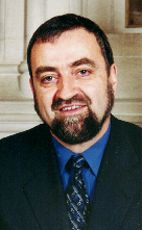
House of Commons photo

Crucial Fact

  • His favourite word was federal.

Last in Parliament May 2004, as Bloc MP for Lévis-Et-Chutes-De-La-Chaudière (Québec)

Lost his last election, in 2015, with 12% of the vote.

Statements in the House

Department Of Human Resources Development Act November 23rd, 1995

He encouraged us to pay attention to and analyze the outcome of the referendum. I would like to return to his recommendation, and look at the outcome of the referendum in his riding. In his own riding-Bonaventure-Îles-de-la-Madeleine-as he knows, it was not the no vote that won, but the yes. So, if he truly spoke for the people of his riding, he would be saying something different. It appears he did not listen carefully. Too bad for him.

I, however, remember. I have listened carefully to most of the speeches by the member for Bonaventure-Îles-de-la-Madeleine. I remember him from when I was a brand new member. There was a debate on the famous ferry that would run between the Magdalen Islands and Prince Edward Island. The solutions proposed by the Government of Quebec were not particularly to his liking. He said: "I will listen to what my people have to say, and, you watch, we will come up with a solution".

The solution the federal government came up with was to buy a secondhand boat from somewhere else, rather than have a new boat built. Since then, the president of the Société de transport des Îles-de-la-Madeleine has been running around after secondhand boats, with $30 million of federal money. Recently, someone said on his behalf, a representative of the Société said: "Unfortunately, the federal government took so long in the matter, I missed an opportunity. The boat was sold elsewhere. There are no more secondhand boats for sale".

Meanwhile, I know, because we are talking about real problems, we are not talking Constitution, we are talking jobs, I am the member for Lévis, where the Chantier maritime de Lévis is located, and where workers at MIL Davie remember what the member for Bonaventure-Îles-de-la-Madeleine said: "A second hand boat rather than a new one". Hundreds of unemployed workers remember that.

I listen to them and I say to the member, because sometimes we have to raise our voices so the member opposite understands: Not only did you not listen to the people of Lévis, you did not even listen to the people of the Magdalen Islands.

Before you warn me about the relevance of my remarks, Mr. Speaker, I will return to Bill C-96.

Department Of Human Resources Development Act November 23rd, 1995

Mr. Speaker, before he leaves, I would like to congratulate the member for Bonaventure-Îles-de-la-Madeleine for having successfully enlivened the debate this morning to some extent on that side of the House, because, up to now, things were pretty quiet.

Department Of Human Resources Development Act November 9th, 1995

Mr. Speaker, I would simply like to say that I listened with great interest to the remarks made by my colleague from the Reform Party. It makes me realize that, even though the members opposite, on the government side, would have us believe that they only have problems with Quebec, they do have problems elsewhere as well.

Now, regarding Quebec's position, it is quite clear. In a resolution adopted unanimously by the National Assembly under the Liberal government of Mr. Daniel Johnson, chairman of the no committee, Quebec has stated that it wants to be given exclusive jurisdiction over manpower, for example, as well as tax points equivalent to what the federal government is spending in this area at the present time in this province.

Quebec has been asking for that for a long time.

Department Of Human Resources Development Act November 9th, 1995

Mr. Speaker, I can see the hon. parliamentary secretary is more skilful with comments than with questions. But he did ask a question, and he said in his preamble that we seem to have a different perception of the facts, and I agree.

He is quite right, his point of view and mine are quite different. In my opinion, decentralization means that, in areas under provincial jurisdiction, the federal government should enter into agreements with the provinces. But they think decentralization means that Ottawa rakes in the money through the UI plan. Incidentally, the federal government has not put any money into the UI fund since 1991, but it is keeping control of the fund and goes so far as to imply that it is being generous, when in fact that money comes from the employees and the employers of Canada, including Quebec.

The parliamentary secretary should know that the federal government got involved in the UI fund through a constitutional agreement and then with the approval of the provinces. It was aware at the time that this is an area under provincial jurisdiction. That agreement allowed the federal government to establish the unemployment insurance commission.

Now, because the federal government manages the UI fund, it is using the power of money to do things, and it made a string of announcements. There may be one he does not know. One week after the referendum, the hon. member for Beauce made an announcement concerning the Minister of Human Resources Development. As you know, cuts in the employment centres had been announced right and left. The employment centre located in the constituency of the hon. member for Beauce was going to be transferred to the neighbouring Frontenac constituency.

The hon. member for Beauce made representations, obviously accepted to chair the no committee and announced, one week after the referendum, that the Minister of Human Resources Development had agreed to keep a number of employees in the Beauce constituency rather than transferring them all as previously expected. Furthermore, there would be a special project in this constituency. Within this kind of decentralization, an independent member-instead of a province-would be able to create a consultation or support centre to help industries train their own employees. We, the official opposition, are against this kind of decentralization.

Department Of Human Resources Development Act November 9th, 1995

Mr. Speaker, as you indicated earlier, I was not completely done with my remarks on Bill C-96. I would like to use the three or four minutes remaining to raise two major points.

I heard comments the minister and the hon. member for St. Boniface made to the effect that the official opposition was worrying for nothing, that it need not worry about clause 20 because, even though the minister was giving himself greater powers-these are certainly not duties or functions; we are talking mostly about powers here-he did not intend to encroach on provincial powers or responsibilities.

My father used to say: "To predict the future or to know how someone will perform in the future, just look at their performance for the past few months or years".

The Minister of Human Resources Development has been in office for two years now and we can clearly see two things. There are many things, but I will focus on these two. First, we will recall that among the many budgetary provisions contained in Bill C-17, there was one concerning cuts to the unemployment insurance program, which I would briefly summarize as follows: longer qualifying period, lower amounts and shorter benefit period. Let us bear this in mind.

The impact of these provisions was felt throughout Canada, but since I am from Quebec, let me point out that the labour minister mentioned again just recently how many more Quebecers were forced on welfare as a result.

The minister, in his speech this morning, spoke about young people, and said that, all things considered, there were not that many more unemployed young people. That is true, but in Quebec, at least, there are many more people on welfare, including young people. It think that has to be pointed out.

Furthermore, as the training and youth critic for my party, I would like to remind the House of what we heard in committee, which was that, in Bill C-28, the minister and the parliamentary secretary were giving themselves the right to designate the appropriate authority, when the previous act gave that right to the governor in council, meaning the provincial governments. Why? Because, in the Constitution, this is an area of exclusive provincial jurisdiction.

Moreover, in section 14(7), the minister dealt with the opting-out privilege which the government of Quebec has always requested and which it was able to use, but now there were some new conditions. Now, each element of the student financial assistance program had to meet the requirements of the federal government's financial assistance program. The minister was giving himself the right to determine how similar the two programs were. I just wanted to remind the House of all of this before concluding my remarks.

And finally, I want to thank the hon. member for Mercier, who is sitting right behind me, for her excellent work as deputy chairperson of the human resources development committee. As the official opposition critic, she spoke today more specifically to the people of Quebec, asking them to watch out, because Prime Minister Jean Chrétien was about to make them face the music, as he promised to do in answer to a question put to him in the House not so long ago.

Department Of Human Resources Development Act November 9th, 1995

Madam Speaker, as the official opposition's critic on training and youth, I am pleased to take part in the debate at second reading on Bill C-96, an act to establish the Department of Human Resources Development and to amend and repeal certain related acts.

This is an extremely important bill because it amends several acts, codes and regulations, in addition to repealing four important acts, namely the Employment and Immigration Department and Commission Act, the Department of Labour Act, the Department of National Health and Welfare Act, and the Department of State Act.

If its only purpose was to make these changes, which, according to the Minister of Human Resources Development, simply make official the structures in place since the Liberals returned to power in 1993, we would be entitled to ask why it took so long to make official something that is already in place. It took two years, Madam Speaker.

Later we will see that the impact of Bill C-96 is more significant than what the minister and even the hon. member for St. Boniface who just spoke first suggested. In fact, it changes the balance of power between the provinces and the federal government in favour of the latter, as this government is wont to do.

The most surprising thing in all this is that the government waited until after the referendum to move for second reading of this bill in the House, which involves a debate. As we know, there

is no real debate at the first reading stage when a minister introduces a bill in the House.

Why did they wait two years and why was there no debate in the House between June and now? If it was good for both Canada and Quebec, I think it would have been in the government's political interest to debate this bill even during the referendum campaign. This could have helped Quebecers better understand the government's intentions in some important areas.

I simply want to remind you that, if we forget about debt servicing, the Department of Human Resources Development will manage over 40 per cent of federal budget spending. This is considerable; it is by far the most important federal department.

Under these circumstances, one wonders why this is the case. I happen to think, and so do many Quebecers, that it is because there was a lot at stake, including the cuts affecting social programs. But the issue is not merely related to cuts: there is also a question of power involved.

Contrary to what the member for St. Boniface just said, our understanding of Bill C-96 is that, with this measure, the Minister of Human Resources Development is giving himself new powers which he did not have before. These are powers which he tried to exercise in an illegal context, through the spending power of the federal government.

We must constantly remind some people of that, because they do not always understand what we mean. This spending power is provided in the constitution and, surely, the federal government can use it on certain occasions, such as during a major conflict or crisis. However, it is contrary to the constitution to use that spending power on a permanent basis. It should only be used on an ad hoc basis. The bill before us is an attempt by the government to legalize its action, by using the spending power as a model.

Let me read the press release of the Quebec minister of state for joint action and employment minister. This will give you an idea of the Quebec government's reaction when it found out about this morning's debate.

It reads as follows: "While Quebec accepted the invitation sent by the Minister of Human Resources Development to participate in a meeting on human resources management, the federal Minister of Human Resources Development nevertheless intends to proceed, this very day, with second reading of Bill C-96. That decision sends quite a message to Quebec, considering the unanimous opposition to a bill which confirms the federal government's intentions to systematically bypass Quebec's jurisdiction and institutions to maintain, and even increase, duplication regarding manpower related measures in our province". This is the reaction ofMrs. Louise Harel, Quebec minister of state for joint action, Minister of Employment, and Minister of Immigration and Cultural Communities.

"Bill C-96 amounts to a flat rejection of the unanimous Quebec consensus to the effect that the federal government must completely withdraw from the manpower sector and give related budgets back to the province". The minister added that "Ottawa's tactic was formally denounced by all labour market partners represented on the board of directors of the Société québécoise de développement de la main-d'oeuvre by way of a resolution passed on October 2".

"By initiating second reading of Bill C-96, Ottawa has confirmed that it intends to pursue its centralist manpower policy and ignore the specific needs of the Quebec labour market, thus dismissing the consensus in Quebec on manpower issues which stresses the need to fight unemployment effectively by allowing for the differences in the various labour markets across Quebec and promoting the involvement of the socio-economic players in every region and community".

"Only a proactive labour market policy that is consistent, integrated and adapted to our situation can help us fight unemployment effectively, with durable results".

"Ottawa wields Bill C-96 like a sword of Damocles. Opportunities to implement such a policy are essential to the development of employment in Quebec", concluded Ms. Harel.

Since I am reading, I might as well quote the attached document. This document was not drafted by the Parti Quebecois government but by the board of directors of the Société québécoise de la main-d'oeuvre. It reads as follows:

"Whereas Bill C-96, an act to establish the Department of Human Resources Development, which in clauses 6 and 20 gives the Minister of Human Resources Development the power to enter into agreements with a province or group of provinces, agencies of provinces, financial institutions and such other persons or bodies as the minister considers appropriate, with the objective of enhancing employment, encouraging equality and promoting social security, moved by Gérald Larose, seconded by Claude Béland, president of the Mouvement Desjardins, and resolved unanimously: That the board of directors of the Société québécoise du développement de la main-d'oeuvre take the position adopted at the Conférence permanente sur l'adaptation de la main-d'oeuvre in November 1990;"

"That Quebec must have sole responsibility for manpower adjustment and manpower training policies within its territory and patriate, as appropriate, the moneys allocated by the federal government to these programs in Quebec".

"Under the Constitution as it stands today and to improve client services, Quebec will control and administer all services connected with employment and manpower development and all related programs funded by unemployment insurance contributions within Quebec's territory and will consequently receive the budgets commensurate with this responsibility".

"The board of directors asks the federal government, pending finalization of negotiations on the patriation of budgets, to refrain from setting up parallel partnership structures or taking steps to encroach on areas under Quebec's jurisdiction, since the Société québécoise de développement de la main-d'oeuvre is the dedicated structure for joint manpower programs in Quebec".

Nevertheless-and I could also quote a resolution adopted unanimously under Daniel Johnson's Liberal government which was along the same lines, in other words, patriation of tax points for manpower training in Quebec-nevertheless, in spite of a very close vote in the referendum and following promises for change, not by just anyone, by the Prime Minister of Canada, they said: "We will consider your desire for change". Nevertheless, ten days later, the Minister of Human Resources Development is embarking on phase two, namely the second reading of Bill C-96, which, according to Quebec political observers, is the most centralizing ever.

This morning, we listened to the minister and the member for St. Boniface talking about decentralization; they said that decentralization no longer necessarily meant cooperating with provinces in areas which are nonetheless under exclusive provincial jurisdiction; it no longer means this, it means that the federal minister has the authority to negotiate agreements with any organization, even municipal governments, and individual stakeholders. Does this take into account a people's desire for change as expressed to the federal government? Does this heed the results of the referendum? To the contrary. Nothing has changed.

The government keeps on going as if nothing had happened, following the same logic, using the same rhetoric, the same words as the green book-I am not allowed to show it-the same green book the minister tabled a year and a half ago after extensive consultations. Wherever he went in Quebec, he was told, not only by the Société québécoise de la main-d'oeuvre, but also by a multitude of stakeholders, and this is the consensus in Quebec: "Mister Minister of Human Resources Development, listen to us, please". In Quebec, we want to control education. We want our government, the Quebec government, to be in charge of manpower training, as provided by the constitution, by the way.

We want to run our own affairs. What is the minister doing? Like a steamroller, he keeps on going, making a mockery of decentralization, saying that there will be further decentralization. The federal government will deal directly with local communities, individuals and local stakeholders. He mentioned a club in his parish, in his Winnipeg riding, and said that the federal government will be able to help.

I have no problem with that. It may work for the other provinces, the member for St. Boniface may not see anything wrong with it, but all Quebec stakeholders are against it. They want no part of it. We have said it time and time again, especially since the Bélanger-Campeau Commission, in 1990. Nevertheless, the minister is sticking to his gun. For him, decentralization means keeping all the powers for himself, and hogging 40 per cent of the federal budget, excluding the debt, to deal with unemployment problems. Of course, people who hear that and are not familiar with government operation, may say: "Here is a man who is genuinely interested in creating jobs, here is a man who wants to train individuals". Of course, these are good intentions, but this is not his jurisdiction. This is not his field.

This government keeps repeating that we must cut spending, but continues to spend in areas outside of its jurisdiction and cuts transfer payments to provinces, so much so that they, in turn, have to cut services such as hospital care. We know about that in Quebec. We have to cut because the federal government reduced transfer payments.

It seems like the Minister of Human Resources Development and government members have not grasped the meaning of the referendum results.

I was listening this morning as the minister boasted about a youth program he implemented as a pilot project in Newfoundland. He was explaining that finally, after quitting school to go looking for work, 97 per cent of the young people had decided to come back to school. According to him that was quite an accomplishment. It is easy to understand that if young people cannot find jobs, they will go back to school but in fact, what they wanted was to find jobs.

They maintain the training programs, but they are carried out directly from Ottawa and entrusted to civil servants. I have some experience in that area; let me tell you about a specific incident.

In my riding, two or three organizations asked me to help them get some federal funds, since we are still part of that system, by finding or creating some employment programs. The minister said that if we supported the no, he would be happy to give a positive reply to those requests. He said it and then the parliamentary secretary had to come to his rescue.

When I saw, on Tuesday this week, only one week after the referendum, that the independent member for Beauce had announced in his riding a special project for an employment center, so that training could be provided directly by businesses, and that he was boasting to have been successful at that, I remind the House that the independent member for Beauce was the chairman of the no committee in that riding. Is this the federal government's new way of decentralizing management: giving things to people who are on the right side or support federalists? Is this the way of governing that they want to show Quebecers? If Quebecers had known this is how things work, a lot more would have said yes.

In the end, when you hear so much double talk- That reminds me, for instance, of the Minister of Human Development Resources, a disciple of Mr. Trudeau, who was saying this morning that he was flexible. That reminds me of Prime Minister Trudeau who said in a message that he sent recently: "Considering my legendary flexibility". If this kind of bill, of attitude had been debated before the referendum, the result-

Mr. Speaker, I see that you are inviting me to sit down because question period is coming soon, so I will conclude, and if I have a few minutes left, I will complete my statement later.

I am simply saying that if Quebecers had known that, perhaps we would be talking about something else today.

Department Of Human Resources Development Act November 9th, 1995

Madam Speaker, I could not resist asking the hon. member for St. Boniface whether, considering his comments and the tone of his reply, he himself would support the resolution adopted unanimously by the Quebec National Assembly under Liberal Premier Daniel Johnson, who this year was the president of the No committee during the referendum campaign?

This resolution is similar in every respect to another resolution adopted by the Société québécoise de la main-d'oeuvre, whose membership includes the Conseil du patronat du Québec and various institutions and labour federations. The Conseil du patronat is headed by Mr. Dufour, another supporter of the No side, who demanded the patriation of tax points for occupational training. The resolution asked the federal government to agree to relinquish these tax points and let Quebec act as it saw fit, as the people-he used the word people-as the vast majority of the people of Quebec want. Would the hon. member support this demand?

Department Of Human Resources Development Act November 9th, 1995

Mr. Speaker, I have listened attentively to the remarks by the hon. member for St. Boniface, and note that sometimes the more we talk, the less we understand each other.

The hon. member suggests that this clause 20 will lend much more flexibility and better harmony between levels of government. The clause must be read; it states "-the Minister may enter into agreements with a province"-may, not must-"or group of provinces, agencies of provinces, financial institutions and such other persons or bodies as the Minister considers appropriate".

In order to keep it short, I would just like to ask my hon. colleague from St. Boniface if he recalls that post-secondary education, for example, as well as social assistance, are exclusively provincial jurisdictions? If he does recall that, is he aware of everything the federal government has done to date, not just this one, but all those before it over the past twenty years, to intervene via their financial powers in these two areas, in areas over which provinces have exclusive jurisdiction? Is he aware of this?

Canada Labour Code October 17th, 1995

Mr. Speaker, I will try to make my remarks strictly relevant to Bill C-317, an act to amend the Canada Labour Code. On page 1a of this bill, it says, and I will read very slowly so that everybody can understand:

The purpose of this bill is to prohibit the hiring of persons to replace employees of an employer under the Canada Labour Code or of the Public Service who are on strike or locked out.

This is what the bill is all about. This bill was carefully prepared by my colleague from Manicouagan, who carried out a study and who is sort of making a new attempt to remind the House that we must do something in this area. Another purpose of this bill is to ensure that essential services are maintained in the event of a strike or lockout in a crown corporation and in the public service.

Bill C-317 was introduced by the hon. member for Manicouagan, whom I want to congratulate again for his insight. He was able to come up with this piece of legislation by relying on his work experience. The purpose of this bill is to expand on what we already have in Quebec. It tries to influence this Parliament, even though we are in the middle of a referendum, because a lot of the federal provisions included in the Canada Labour Code affect workers in Quebec. This is why my hon. colleague introduced this bill.

May I remind you that it is not the first time that such an initiative is undertaken and that such a bill is introduced in the House. Without going into details, I want to mention as an example that, in November 1992, the Conservative member for Abitibi had brought forward Bill C-376 that had essentially the same intent as the introductory paragraph of the bill introduced by the member for Manicouagan.

Before that, during the postal strike, the present member for Richelieu, who was then a Conservative, tried twice to get the House to adopt legislation to prohibit the hiring of scabs by crown corporations. The first time was in February 1988 with Bill C-282 and the second time was in April 1989 with Bill C-201. That last bill was defeated by 18 votes only, which means that the member for Manicouagan has a good reason for trying again today, having seen that a good number of members from different parties in the House had supported such a bill at that time.

The Liberal Party, then in opposition, had expressed its support for the bill. Many Liberal members were in favour of the bill at that time. If we go back a little further, in 1980, Ed Broadbent, then leader of the NDP, had introduced an antiscab bill. Since that time, several unions have asked various federal governments to pass a similar act. So, this is nothing new.

In October 1994, the present Minister of Human Resources Development promised that an anti-scab bill would be introduced in the spring of 1995. We all know what happened. A part of the responsibilities of the Minister of Human Resources Development were transferred to the present Minister of Labour, who seems to be to busy with the referendum because she has not yet introduced such a bill. Yet, the minister had made a priority of that issue after her appointment in February 1995. We are in October and nothing has been done.

I would like to remind the House that in Quebec, provincial anti-scab legislation was passed in 1977 and became part of the Labour Code. Since then, Ontario and British Columbia have passed similar legislation.

The preventive, dissuasive and indicative role of the Quebec act has resulted in a 35 per cent decrease in the average number of labour conflicts since 1979. And 35 per cent is not a figure to be sneezed at.

There is agreement between the partners in the Quebec labour market on the beneficial effects of the Quebec legislation on scab labour. Even the strongly federalist and strongly pro-business Conseil du patronat du Québec has abandoned its challenge against these acts before the Supreme Court, saying that there had been improvements in labour relations in Quebec over the years since its adoption.

And yet, as you know, there is a new government in Ontario and the new Mike Harris government which is chummier with business than with workers, has promised to do away with Ontario's Bill 40 by the end of this year. It is noteworthy that Chrysler Canada has publicly advised the Harris government not to move too hastily on this change and to weigh its consequences. The automobile manufacturer fears that precipitous action might upset labour relations in Ontario. This is a very recent happening and right in Ontario. Chrysler Corporation is not just any company, it is a huge company, an important one, and it is warning the government of Ontario not to take away the legislation.

In Quebec, 10 per cent of workers are governed by the Canada Labour Code, or about 217,000 people.

Now I will speak to you about one example of a labour conflict in Quebec which dragged on because Quebec's scab legislation was not enforced. That example is Ogilvie Mills Limited. Ogilvie processes grain, and somewhere in the constitution, in Canadian

constitutional law, it says that grain comes under federal jurisdiction. So what happened at Ogilvie? Because it was federally regulated, Quebec's anti-scab legislation did not apply.

This dispute, which was settled only recently, went on and on, despite all attempts to reach a settlement. I remember raising the matter as the member for Lévis. Although Ogilvie is mainly in Montreal, there was an impact across Quebec. In the notorious dispute at CN, we told the Minister of Labour: You do not seem as anxious to appoint a mediator to settle the grain dispute at Ogilvie in the Port of Montreal.

The dispute dragged on and on and on, until it was settled quite recently, but it went on for many months, and in fact it lasted about 18 months, if I am not mistaken.

So what did the workers at Ogilvie want? What caused the dispute? It seems they just wanted to maintain their working conditions, not improve them, only maintain them. The company wanted to backtrack on conditions that had already been agreed to.

In the circumstances, it was perfectly normal for the employees to act as they did. Not many people, and I would even include members opposite and, in fact, all members of the House of Commons, would be prepared to go back to what conditions were in the past. And that was the problem.

I could mention another case in Quebec to illustrate my point. I come from the riding of Lévis. MIL Davie, a marine construction firm, comes under the Quebec Labour Code because the sector is regulated by the province. The company does not have the right to hire strike breakers. However, a small shipyard like the one at Les Méchins, which does ship repairs and is thus in a related sector, would be subject to the Canada Labour Code because of the federal government's jurisdiction over marine traffic, and so the anti-scab legislation would not apply.

Today, these shipyards are being invited to bid for the same jobs but they are not subject to the same conditions, the same bargaining rules.

In the minute I have left I would like to say that-and it might look odd for a Bloc member involved in the current referendum campaign to encourage the federal government to pass anti-scab legislation-, if the yes vote wins, Quebec will do what it likes once it is sovereign. We can envisage that.

However, at the same time, as the areas of worker intervention are often interrelated and we want an open economy, we feel that our future neighbour, Canada, should be subject to the same conditions so that the rules for business-we are talking here of free trade-are consistent.

This is to be expected, and we want the members opposite to vote in favour of this legislation so that workers in all fields, particularly industry, enjoy the same conditions in this part of the North American continent.

Canada Labour Code October 17th, 1995

On a point of order, Mr. Speaker. I have been listening to the hon. member for a while and his remarks are not at all relevant to Bill C-317, which deals with anti-strikebreaking legislation.