Mr. Speaker, I move:
That this House at its next sitting consider the business of supply.
(Motion agreed to.)

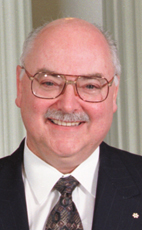 House of Commons photo
Won his last election, in 1997, with 54% of the vote.
Supply February 27th, 1996
Mr. Speaker, I move:
That this House at its next sitting consider the business of supply.
(Motion agreed to.)
The Constitution December 14th, 1995
Mr. Speaker, when the people in Quebec voted to elect the Bloc Quebecois we had to accept their democratic verdict. When they decided to elect the Parti Quebecois in Quebec we also had to respect their verdict because this is democracy.
When we give a veto to British Columbia we give it because we believe this is in the national interest. When we give a veto to Quebec we do it because we believe it is in the national interest.
I would hope that the leader of the third party would respect the democratic wishes of the population of Canada.
Supply December 11th, 1995
moved that the bill be read the third time and passed.
Supply December 11th, 1995
moved that the bill be concurred in.
Supply December 11th, 1995
moved that Bill C-116, An act for granting to Her Majesty certain sums of money for the public service of Canada for the financial year ending March 31, 1996, be read the second time and referred to committee of the whole.
Supply December 11th, 1995
moved that Bill C-116, an act for granting to Her Majesty certain sums of money for the public service of Canada for the financial year ending March 31, 1966, be now read for the first time and printed.
(Motion deemed adopted and bill read the first time.)
Supply December 11th, 1995
moved:
That the Supplementary Estimates (A) for the fiscal year ending March 31, 1996, be concurred in.
Recognition Of Quebec As A Distinct Society December 6th, 1995
Mr. Speaker, I have the great honour of supporting the motion before us today.
I am a Quebecer and it is as such that I associate myself with this motion. I do so because it is in the best interests of Quebec and because it opens the door to a renewed partnership for Canadian partners from coast to coast.
The ideal country does not exist, except in the imagination of certain persons. And we all agree that Canada is far from perfect. It needs to change. It must change to better reflect its own reality.
What is that reality? It is the reality of a vast country with a scattered, diverse population. It is the reality of a country in which regional identities are strongly expressed. It is also the reality of a country in which the francophones are concentrated in one province but a million others are distributed across the rest of Canada.
That is the Canadian reality. Not only must we take it into consideration and recognize it, but our institutions must also reflect this reality if we want this country to work and to achieve its full potential.
On October 30 Quebecers sent us a clear double message. While reaffirming their attachment to Canada, they indicated that they
wanted to see Canada change quickly to reflect their aspirations. We must know how to interpret this message. We must not only take note of it, but we must respond to it in a concrete way or this country will fail.
As the Prime Minister pointed out so well when the motion was tabled, the referendum results have taught us that we must not take Canada for granted. It was in this context that the Prime Minister made three firm commitments on behalf of the Canadian government during the referendum campaign. These three commitments were as follows: to recognize that Quebec is a distinct society within Canada; to refrain from making any constitutional change affecting Quebec without the consent of Quebecers; and to undertake changes to bring citizens closer to services and decision making.
[Translation]
The time has come to fulfil these commitments, to take action. Through the motion before this House, we are starting to give concrete expression to the commitments made by the Prime Minister. By putting it to the members of this House this quickly, the government is showing that it takes its commitments seriously. It is showing how important this issue is, not only for Quebec, but also for the rest of Canada.
Why do Quebecers want to be recognized as members of a distinct society? The reasons are obvious. Quebec is home to a French-speaking majority, a unique culture, and a civil law tradition. Quebec has been built around these essential elements for more than three centuries. Recognizing this is not only acknowledging reality, it is also agreeing that these characteristics of Quebec society must be preserved and nourished in a context where Quebec co-exists in North America with a population of about 300 million anglophones.
To adopt this motion is to recognize that the French character of Quebec must be protected. It is to assert that Quebec must enjoy cultural security. It is to recognize the linguistic duality that is in the very nature of Canada and contributes to its cultural and social richness.
By recognizing Quebec distinct nature and by admitting that the definition of distinct society contained in this resolution is by no means complete, this House is undertaking to let itself be guided by this reality. The legislative and executive branches of government will be encouraged to take this recognition into account in all their activities and all their decisions. This means that this resolution will have a positive impact on the way legislation is passed in this House and decisions are made in federal government departments and agencies.
There is more. The motion before us today is but one of a whole series of government actions. During the referendum campaign, the Prime Minister also pledged not to make any constitutional change without Quebec's consent. That commitment is reflected in the bill recently introduced by the Minister of Justice to provide a regional veto power. Under this bill, any constitutional amendment proposed by the federal government will require the consent of Quebec and the other regions of Canada.
The objective of the motion is clear: to protect Quebec from amendments that might reduce the powers of the Quebec National Assembly. By taking this action the Government of Canada is recognizing that the Government of Quebec, as the only government representing a francophone majority in North America, has a central role to play in the evolution of Canada.
This is a far cry from the so-called meaningless motion referred to by the separatists in recent days. Through this bill, the federal government strengthens the regions, particularly Quebec. We feel it is a first step toward a more flexible and more effective federalism.
It would be wrong to claim that the only purpose of the motion is to meet the aspirations of Quebec. Canada is not a melting pot, nor has it ever been. The issue here is proposals that reflect the deep nature of Canada. The issue here is ensuring not only our national unity but also its harmony and the effectiveness of its institutions.
I have followed the debate on the motion with interest. I have heard the criticisms of the official opposition, which were not really surprising. I have also heard the criticisms of others who claim to be defending Canada while at the same time opposing the motion. To them I would say that it is easy to criticize after the crisis is over. However, what will those who object today say when the separatists mount another attack? I invite them to answer right now, before it is too late.
Canada is a federation of partners. It is by preserving the spirit of partnership and co-operation and by recognizing both our differences and our shared objectives that this country will grow and prosper. The motion we are debating today deals exactly with this concept of partnership. The Canada we all want is a country in which each region has its own specific character and the freedom it needs to express it. That is the essence of what this motion contains.
The definition of a federation is not a grouping of equal partners. The purpose of a federation is to permit the differences of the various parts to be accommodated within one country. Otherwise it is a unitary state. We are not, because we have started as a group of people who were different and who founded a type of government able to accept the differences. It is really unfortunate that there is
now a party which does not agree that the differences the country has are part of its richness and of its wealth.
The motion before the House specifically relates to the concept of partnership. The Canada that we want is a country in which every region will have its own distinctive character and the means to develop it. This is the very essence of the motion.
Canadians want a united country. They are open to changes that will preserve its unity and promote its development, as evidenced by the resolutions recently passed by the legislatures of Ontario, New Brunswick, Nova Scotia and Newfoundland, to recognize Quebec's distinct nature.
I am convinced that the majority of Quebecers and Canadians recognize themselves in this motion. I would humbly submit to the Official Opposition, moreover, as well as to the Government of Quebec, that they are wrong to reject it.
Of course the separatists cannot accept propositions with the object of making Canada work better. This is an undemocratic attitude, for it denies the results of the referendum. It also condemns Quebec to immobility and rejection of any improvement to the system. It is thus in contradiction to what most Quebecers want.
We have no illusions about it. Since the Government of Quebec is interested solely in its own option, we shall not engage in constitutional discussions which would be doomed to failure from the word go. But that does not prevent us from taking steps today in the direction Quebecers and all Canadians want us to go. Needless to say, however, if Quebec and the other regions of the country consent, the Government will be open to including the changes contained in this motion in the Constitution.
Every member sitting in the House has the opportunity by voting for this motion to acknowledge Canada for what it is, a diversified country, an open country, a country that has always based its development on accepting and preserving its differences.
For, beyond those differences, the shared values and objectives we have always had as Canadians, regardless of where we live, remain: freedom, tolerance, the creation and distribution of wealth for individuals and regions.
The months and years to come will surely afford us the opportunity for a concrete demonstration of the fact that we go far beyond principles and pious wishes.
Supply December 5th, 1995
Mr. Speaker, the first question or comment made by the hon. member, to the effect that there has been no job creation, is just not factual.
The fact of the matter is that, since we took office, 509,000 new jobs were created in Canada. I am quoting Statistics Canada figures. More than 119,000 new jobs were created in Quebec. That is my answer to the first question.
When we look at the facts, we can seen that jobs, in fact more than half a million new jobs, have been created in the economy. Our economic and job creation policies work.
Second, regarding occupational training, we must make a distinction between two things. Quebec claims jurisdiction in the matter because education is a provincial jurisdiction. This means that we must withdraw from all training courses coming under their jurisdiction. But there is another jurisdiction involved which is a federal jurisdiction and, in fact, an exclusive federal jurisdiction. And that is unemployment insurance.
When we draw money from the UI fund to reduce unemployment, we are acting like any responsible person would in spending adequately the funds allocated to them; that is our jurisdiction. We are trying to limit future UI expenditures and to stimulate employment.
A measure designed, for example, to supplement a person's income to allow this person to find a job or to subsidize his company so that he can have a job clearly does not pertain to training. It is an employment measure coming fully under federal jurisdiction and involving the UI fund, over which the federal government has exclusive responsibility.
Supply December 5th, 1995
Mr. Speaker, what counts for Canadians is jobs, and that is what counts for the government as well. This is also the fundamental objective of the bill on employment insurance, which the opposition motion is so wrongly criticizing.
The bill does more than protect the incomes of the unemployed. It is based on the principle that we must more actively help people find work. And it is based on the requirements of a modern economy. Another question, however, is central to the debate. The employment insurance bill announces a completely new way to view the role of the provinces in the labour market. This is one indication of this government's flexibility in past matters and its continued flexibility in federal-provincial matters.
The issues on creating and maintaining jobs had to be gone at in greater depth. A serious look had to be taken at ways of combining our efforts with those of the provinces. This means understanding jurisdictional problems and finding solutions.
We take into account the fact that the provinces are responsible for education and job training. We accept the point of view held by many in Quebec and elsewhere that the federal government should not get involved in job training. We acknowledge that the federal government should not get involved in activities that risk changing provincial priorities in the area of job training.
Last Friday the Minister of Human Resources Development restated that commitment. He went further. He outlined how the new employment benefits under employment insurance would assist in getting Canadians back to work. Needless to say, they will be much more respectful of provincial responsibilities in this area.
Quebec provides an excellent example of this sort of active approach: collective organizations and partnerships such as the Société québécoise de développement de la main-d'oeuvre.
The employment insurance bill provides for a new balance to federalism. This is what we see in employment benefits. It is based on an answer to a very important question: Would a new set of roles and arrangements between the federal and provincial governments do a better job of getting Canadians back to work and would it do that more efficiently?
The answer to this question is yes. And now is the time to say yes. Quebec is the very place this answer has to be given. We will no longer be buying training courses from public or private institutions. We will withdraw from apprenticeship, work-study and training programs at the workplace. These measures are in keeping with the consensus in Quebec.
However, while the federal government no longer intends to play a role in manpower training, it does intend to continue its role in helping the unemployed return to work. The new employment benefits will represent an investment in people. We want to spend this money so effectively that our clients will never need us again. We want to spend this money on, devote it to activities that will ensure the best results.
Wage subsidies, for example, will help employment insurance clients find work, and we are talking here primarily about people such as those with a disability, who have a harder time of it.
Income supplements will help employment insurance clients find work; most of these people may need short term financial assistance.
Job creation partnerships will help create new jobs for employment insurance clients.
The five measures we have just mentioned are not programs; rather, they outline the types of needs on which we have decided to focus our efforts.
We are reaching out to Quebec and we are ready to work with its employment development programs and tools.
Through the strategic initiatives program, the federal government already supports two Quebec programs that should allow all of Canada to learn important lessons on the labour market. Federal support for PWA will help over 25,000 families throughout Quebec benefit from this important program every year.
As my hon. colleagues may know, PWA provides wage assistance to low income families. Parents benefit, of course, but so do tens of thousands of children, who can then grow up in families who are proud of their work.
The results will be clients who are better off with a simple process. That is a basic reason why we are insisting our programs be harmonized with provincial ones.
By reinvesting insurance savings, we will spend more on helping these Canadians. Expenditures will rise from $1.9 billion to $2.7 billion. This money will be spent on concrete measures that will make it possible for Quebecers and Canadians to find work.
Allow me, Mr. Speaker, to sum up these various arguments. Our government has said that it would withdraw from job training, and it is. We are going to focus our efforts on effective measures that have a tangible impact. We have made a commitment to harmonize efforts and to strike partnerships so that we can provide real benefits for our clients and for the future of employment insurance.
As part of this employment insurance proposal, we invite the provincial governments to collaborate with us in designing and distributing employment benefits.
I was therefore delighted to see that the Quebec government has taken an important step toward an agreement. When the Quebec National Assembly voted in favour of the Liberal amendment urging it to discuss with the federal government, it made a decision that gives us some hope. It took a step that should eventually improve the choices offered the unemployed throughout Quebec.
We are confident that our commitment to fully respect provincial jurisdiction over education and training is a step in this process. We feel that our commitment to harmonize our activities with those of the provinces is another.
The government has always been committed to flexible federalism and to flexible approaches on federal-provincial issues such as working together to help the unemployed.
Everyone will benefit from this type of collaboration.