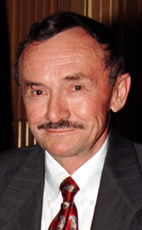
House of Commons photo

Crucial Fact

  • His favourite word was little.

Last in Parliament October 2000, as Reform MP for Cypress Hills—Grasslands (Saskatchewan)

Won his last election, in 1997, with 49% of the vote.

Statements in the House

Environment November 4th, 1997

Mr. Speaker, for several years I have been watching with fascination and disgust the transformation of the theory of human induced global warming from an interesting scientific hypothesis to widely accepted doctrine. This has been accomplished without the addition of significant new data by mere constant repetition of unproven claims.

When science becomes entangled with anti-technological ideology it takes real courage for a researcher to remain loyal to scientific principles and the scientific method of investigation. Mediocrities and charlatans need only parrot appropriate politically correct slogans about rising oceans and parched farm lands to receive grants and to have their egos massaged by gullible mass media.

A medieval culture of hostility to objective scholarship is emerging—

Supply October 23rd, 1997

Mr. Speaker, I am interested in the fact that although he comes from the Miramichi the hon. member has extended his comments to the outer shelf, which is what I want to address in my question. I know there are no sharks in the Miramichi except perhaps for a few Liberal bagmen, but we will not worry about them.

I want to speak for the sharks. I wonder what the hon. member thinks about the fact that the shark population in the north Atlantic, including our territorial waters, is being decimated. The sharks are being taken in almost unlimited quantities. It is a fishery of unbelievable cruelty. It makes any other branch of the fishery or the sealery seem utterly benign.

When they destroy sharks as they surely will—these things will become extinct—we will lose the main control on the seal population that exists. This in turn filters down to the fish which provide the increased numbers of seals with their sustenance.

Why is the DFO not out there doing a little surveillance, some controlling and keeping people from decimating the shark population?

Supply October 23rd, 1997

A precedent in this government?

Canada Marine Act October 10th, 1997

Mr. Speaker, the general thrust of Bill C-9 is compatible with Reform Party policy. Several of us voted in favour of its previous incarnation as Bill C-44. However that is not to say there is no room for improvement.

I had been looking forward to working with the minister and his department to address some of the concerns that have been expressed with respect to this legislation. I found them to be very forthcoming and helpful. It is regrettable that the co-operative atmosphere here has been so poisoned by the contemptuous, I might even say contemptible actions of his ministerial colleagues in the House a couple of days ago that it is going to be difficult.

During the summer I had the opportunity to discuss the legislation with many interested parties. Others have come to the Hill to express their views since Parliament reopened. During the Thanksgiving break I plan to go to Vancouver to consult with stakeholders there.

Up to now I have found remarkable consensus among shipping companies, stevedoring firms, unions, even shippers, both in general support for the legislation and in the identification of shortcomings. In the limited time available for me today I can only touch briefly on a few areas where we would like to see further work.

The clauses of the bill which define the capacity and power of port authorities are inconsistent with the stated objective of allowing them to operate according to business principles. They are neither fish nor fowl.

The port authorities will have the responsibility to operate with commercial discipline but they will be denied the tools to do so. They may not, for example, diversify by establishing new subsidiaries on port property. Their borrowing and investment powers will be rigorously constrained and they will be subject to the vagaries of ministerial discretion in the setting of the annual fee that they must pay to the federal government out of gross, not net, revenues.

Port authorities will have to be self-sufficient but the minister will be empowered to continue federal contributions to the seaway for capital works. This constitutes unfair competition for railways and deep water ports, courtesy of the Canadian taxpayer. Again, the legislation is inconsistent with the expressed objective of commercialization. It is the partial pregnancy syndrome that afflicts the government in so many of its endeavours.

The bill does not address the problem of excessive costs and featherbedding arising from pilotage monopolies. There is no incentive to cut pilotage costs by certifying the masters of Canadian vessels that ply the same inland waters back and forth on a routine basis or by the employment of available new technology.

The proposed boards of directors for port authorities are potential patronage havens as well as being a mechanism for continued political control. Government participation in entities which will be managing crown assets is normal and acceptable but if the government is serious about commercialization, indirect government control is not. Again, we are looking at partial pregnancy.

The size of the proposed boards, seven to eleven members, is far too large for most ports and the majority will be appointed by the minister, ostensibly in consultation with port users. Ah, patronage joy.

The Liberals should remember that governments come and governments go. They will not be forever in power. Do they really want to set up such a juicy system, not just for themselves now but for whomever comes behind them? Their mandatory provision for individual directors to be appointed by host municipalities and provinces is defensible and sensible. Each jurisdiction gets one.

It is unfortunate that there is no provision for labour representation on each board. This could readily be done by specifying that there be one on each board. It could be done without increasing the size of the board simply by reducing the number of ministerial appointments from these famous lists.

The elimination of ports police is problematical. I do not believe that was well thought out and it should be reconsidered. There is a lot more to port policing than guarding the security of cargo.

Sea ports, especially the larger ones like Vancouver, are wonderful funnels for contraband, for illegal entrance and they are targets for organized crime. When mobsters get the upper hand in a port they are extremely hard to dislodge.

Few municipalities have the resources to properly police a port. If the government is determined to do away with ports police it should seriously consider establishing a specialized branch within the RCMP.

Finally, there is no mechanism for the resolution of disputes with shippers. If the Canada Transportation Act can contain provisions with respect to railways, why can we not have something equivalent in Bill C-9 with respect to ports? Why should they be treated differently?

I cannot read the minister's mind. I do not know the intent of fast tracking this bill to committee. In theory, getting into committee early seems like a great idea, a chance for MPs to sit down and reason together away from the hurly-burly of the House and work together for the common good. It is a great theory but in practice in the last Parliament we Reformers learned the hard way that this is generally a policy for stifling any meaningful debate and ramming a bill through to the report stage according to ministerial specifications.

Therefore we do not support the procedure. We will vote against it. If subsequent events prove that our suspicions were unjustified I will personally apologize to the minister and nobody will be happier than I.

Speech From The Throne October 2nd, 1997

Mr. Speaker, I think the hon. member should produce a precise quote to show that any member of the Reform Party said that Conrad Black was overtaxed.

Speech From The Throne October 2nd, 1997

Mr. Speaker, I was rather taken by the hon. minister's comments about the revenue departments of the provinces and the federal government working together. That sounds like a partnership between John Dillinger and Lucky Luciano.

He was talking about how literate Canadian youth are. This is a bit of a contradiction because he also remarked about the programs to increase literacy in the population. If he thinks Canadian youth now are more literate than they were in the past, I would say he is betraying his academic origins. He is not aware of what is out there. He has not tried to hire anybody lately, to try to find somebody who can write a coherent paragraph, who can spell and who knows a thing about grammar. That is not his department, that is for the provincial departments of education. However, I wish he would not make statements about the high degree of literacy of our population.

With respect to the Canada millennium endowment fund, I understand that access to these funds is not going to be based on merit but on something called need which will be defined by the bureaucrats in whatever way they choose. Now if that is wrong I would like to be corrected. If it is not based on merit then this thing is going to be a very useful educational tool because it means the young people will be taught at a very early age how to work the system the Canadian way.

Speech From The Throne October 2nd, 1997

Mr. Speaker, I am a little bit curious about the hon. member's comments about the referendum section of the amendment proposed yesterday by the Leader of the Opposition.

It was very clear in his amendment that he was talking about a three-legged stool in which referendum was one leg. The amendment proposed by the Leader of the Opposition was in fact not that a referendum alone would determine constitutional amendment but that there could not be a constitutional amendment without a referendum in addition to the other clauses that he suggested.

I am wondering if the hon. member just did not understand what was going on or if he merely voted the way the member for Sherbrooke told him to.

Gun Legislation September 30th, 1997

Mr. Speaker, Morris Bodnar, Georgette Sheridan, Bernie Collins, Gordon Kirkby, Marlene Cowling, Jon Gerrard, Elijah Harper, Glen McKinnon. That is not a list of Canada's most wanted. It is a list of Manitoba and Saskatchewan Liberal MPs who are no longer with us thanks to the Liberals' draconian gun bill.

People in my part of Canada are still seething over that legislation. Talk of civil disobedience is rampant. So much anger in central Canada about a government policy would have this regionally oriented government scurrying to make amends. But of course to Liberals anything west of Ontario is extraterritorial.

We prairie people are Canadians too. Our devotion to individual freedom is our unique characteristic. In the name of national unity this government should readdress its wrong headed firearms legislation.

Speech From The Throne September 25th, 1997

Mr. Speaker, at the onset I congratulate you on your well earned appointment. I also congratulate the hon. member on her maiden speech.

The hon. member sang a hymn of praise to team Canada and told us about all the wonderful things that happened as a result of its overseas missions. The figures are in; I am sure she is aware of them. Our exports have dropped substantially to every area where there was a team Canada mission. This is a fact as presented in the government's own figures. If this is indeed the case, why is she so proud of the work of team Canada?

My second question, if she will be so kind as to address two of them, is with respect to internal trade barriers. She said the right things, that we have to bring down internal trade barriers. My question to her is when and how.

The Government of Canada has the constitutional power to do this. We have a constitution that says that interprovincial trade must be free and open. What does the government have in mind? When will it get off its tail and actually do it?

Petitions September 25th, 1997

They request that Parliament support Motion No. 300 which states that in the opinion of the House the government should authorized a proclamation to be issued by the governor general amending section 7 of the Canadian Charter of Rights and Freedoms to recognize the fundamental rights of individuals to pursue family life free from undue interference by the state and to recognize the fundamental rights and responsibility of parents to direct the upbringing of their children and urge the legislative assemblies of other provinces to do likewise.