
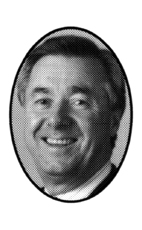
House of Commons photo

Crucial Fact

  • His favourite word was made.

Last in Parliament April 1997, as Liberal MP for Acadie—Bathurst (New Brunswick)

Won his last election, in 1993, with 66% of the vote.

Statements in the House

Air Transportation March 27th, 1995

Mr. Speaker, first of all, I know that the hon. Leader of the Opposition is very interested in this matter. I share his interest since we have been working on this without respite since we came to office. These are extremely complex situations that have existed for a very long time.

I wish to repeat once again that, when the announcement was made, it was not only a matter of granting landing rights in Hong Kong. It is not necessarily true that only the Hong Kong decision was delayed. All decisions based on national landing levels are at stake and that includes Canadian Airlines International's right to land in Germany.

The management of both airlines, including both presidents, Mr. Harris and Mr. Jenkins, reacted to all our air transport policy announcements by saying that they were very satisfied with the work done by the government, the negotiators and all those involved. The work was extremely difficult and very complex.

At the end of this year, both air carriers will have the opportunity to compete in all markets around the world, a first in Canadian air transport history.

Air Transportation March 27th, 1995

Mr. Speaker, the second designation policy which we announced is not limited to Air Canada and Hong Kong. The predetermined passenger volume levels setting off the process also apply to Germany, for instance.

All these decisions were made after a long period of reflection and extensive negotiations, and we feel that it is in everyone's interest to ensure total openness in granting landing rights.

I must say to the hon. Leader of the Opposition that I really appreciate the way Air Canada President Hollis Harris reacted by saying that he appreciated the work done by the Government of Canada with regard not only to the Hong Kong matter but also to the bilateral agreement with the U.S., and especially to Air Canada being given access to the Japanese market. That is something he had been seeking for many years.

Official Languages March 23rd, 1995

Mr. Speaker, when another hon. member raised the question with respect to ads placed by Air Canada looking for qualified personnel, the ads clearly stated that bilingualism in one case was required, a third language was an advantage to anybody applying, especially for cabin crew. There is no doubt the application of the Official Languages Act is essential to the operation of Air Canada. It is part of its mandate.

I want to assure my hon. friend the obligation extends to being able to provide service in both official languages on the flights of Air Canada and we expect that will continue.

With respect to the second part of his question concerning the commercialization of the air navigation system and the commercialization of CN, we will undertake to ensure Canadians who speak both official languages will continue to be served in the language of their choice anywhere in the country.

Rail Transport March 23rd, 1995

Mr. Speaker, the hon. Leader of the Opposition seems to be operating under a certain misunderstanding of the situation.

When we commercialize the operations and the assets of Canadian National I will not be selling CN. The taxpayers of Canada will be the ones who benefit from the commercialization of CN.

That is why efforts are being put forward to make sure that CN is viable and competitive and that it survives as a railroad from coast to coast. I know the hon. Leader of the Opposition is not very interested in what happens in Canada from coast to coast.

Points Of Order March 22nd, 1995

Mr. Speaker, a point of order. During question period the member for Mission-Coquitlam, in making a comment with respect to the appointment of two senators, aroused my ire to some extent.

I hope you will understand, Mr. Speaker, that we have had some experiences recently with the Reform Party commenting on the appointment of Acadians to various positions in government.

I want to withdraw the remark I made to my colleague. I withdraw it unequivocally.

Convenience Flags March 21st, 1995

Mr. Speaker, there is no doubt that the question of foreign flagging at Marine Atlantic is one we wanted to address once the matter was raised.

We have determined it has been ongoing, depending on the vessel, for a number of years. As I indicated to a colleague of my hon. friend in the House yesterday, we have asked the president of Marine Atlantic and the board to look into the potential for the commercialization of all the activities of Marine Atlantic.

Certainly we will be addressing the question my hon. friend has put to me one way or another. If the commercialization proceeds, we will have to take into account the implications of reflagging the vessels prior to sail. If the commercialization does not go forward, we will review the matter in the light of my hon. friend's question.

Air Canada March 21st, 1995

Mr. Speaker, I can tell from the performance of the hon. member in this House that he has plenty of time to go over all the ads from Air Canada and probably from other companies.

As I told him earlier, Air Canada must abide by the Official Languages Act. I will try to find out why Air Canada acted in this manner and we will ensure that the Official Langues Act is fully applied.

Air Canada March 21st, 1995

Mr. Speaker, while operating as a private corporation, Air Canada must abide by the Official Languages Act. I want to thank the hon. member for asking this question. I will certainly have the opportunity to examine why Air Canada acted in this manner, but I still hope that we will be able to settle the issue, because Air Canada has gained access, since last year, to the Japanese market, something it has been looking forward to for the past 10 to 15 years, and will be allowed to fly to Hong Kong before the end of this year.

Rail Transport March 21st, 1995

Mr. Speaker, every Canadian recognizes that the Government of Canada has a responsibility to maintain a transportation system that is viable, that is competitive, that is affordable.

There is no doubt that over a long period of time every effort was made by the unions and by the employers to try to find a solution to this problem. They have not been able to succeed.

We regret very much that companies, farmers, people across the country are faced with a situation that is very unfortunate, very difficult to overcome.

All I ask the Leader of the Opposition to do is to listen to what Canadians are saying, listen to what Quebecers are saying, and make sure that we can get the railroads back in operation so that we can find a solution to the problem that has escaped the negotiators on both sides of the table for 18 months.

Rail Transport March 21st, 1995

Mr. Speaker, I think that solving the problem in Canada's rail system is in everyone's interest. We much appreciated the fact that CAW president, Mr. Hargrove himself, said that special legislation was the best approach.

Some people understand full well that Canada's rail system must operate so that materials and products like those of Ford, GM and Chrysler can be moved. I have no idea with whom the Leader of the Opposition is speaking because all those with whom we have spoken, without exception, told us that, after 18 months of talks, the time has come to find a solution allowing the Canadian economy to continue to grow.