
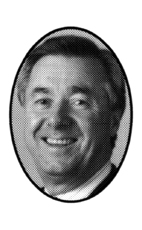
House of Commons photo

Crucial Fact

  • His favourite word was made.

Last in Parliament April 1997, as Liberal MP for Acadie—Bathurst (New Brunswick)

Won his last election, in 1993, with 66% of the vote.

Statements in the House

Starred Questions February 6th, 1995

The 70/170 highway project is part of the Canada-Quebec subsidiary agreement on transportation development signed in 1985 within the framework of the Economic and Regional Development Agreement (ERDA).

The transportation agreement, administered by Transport Canada on the federal side, expired on October 31, 1993, but commitments for registered projects were met with current funds under the agreement for an additional 12 months up to October 31, 1994.

The project concerned was registered when the agreement was signed. A $25 million portion was to have been financed in equal parts under the agreement between the Canadian and the Quebec governments, $12.5 million each.

The total amount allocated under the agreement from the early stages up to October 31, 1994 was $21,529,600, of which $10,764,800 came from the federal government. Since no additional funding could be allocated after October 31, this sum was for all intents and purposes the federal government's total maximum contribution to this project.

Each government's $1,735,000 shortfall relative to the $12.5 million initially promised was primarily attributable to delays during the course of the project.

The 70/170 project was not able to follow the originally planned schedule. Although the first section between La Baie and Jonquière was completed on schedule, construction was slowed down significantly in 1991 and 1992 because of environmental studies, cancellation of the Jonquière bypass road and budget restrictions in the Quebec department of transport. Later, construction resumed on the Jonquière-Alma section, a four-lane divided highway. The first 3.8-kilometre segment beginning three kilometres north of Jonquière is currently nearing completion. Expropriation for the remainder of the segment leading to the outskirts of Alma has also been completed.

It should be noted that funds which could not be committed to the highway 70/170 project were reallocated to another highway project under the agreement in order to ensure that these funds were spent. The Quebec government is expected to carry this project to completion subject to availability of funds.

*Question No. 114-

Western Grain Transportation Act December 15th, 1994

moved for leave to introduce Bill C-66, an act to amend the Western Grain Transportation Act.

(Motions deemed adopted, bill read the first time and printed.)

Aviation And Marine Safety December 14th, 1994

Mr. Speaker, the best measure is the support being provided by the aviation industry to the initiatives we are taking. I take exception to the hon. member's comment that some airlines are refusing to fly into specific areas where there are AWOS installations.

I hear the hon. member saying "speak to Canadian Airlines". The hon. member used to be an air traffic controller so we know the system is already working better because he is here.

The representative from Canadian Airlines who made the complaint about the AWOS happens to be a meteorologist. Again, we are trying to do the very best we can. I do not think it helps the situation in any way to suggest that the system in Canada is unsafe. We have the safest navigation system in the world.

Aviation And Marine Safety December 14th, 1994

Mr. Speaker, it is not unusual for the hon. member to mix apples and oranges but the fact is that the destaffing of lighthouses is based on technology that has been used around the world. For example, in the United States of America there is one staffed lighthouse remaining and it is a historic site at Boston harbour.

With respect to the AWOS concern, which is a very legitimate concern, I reassure the member, members of the House, and the travelling public in general that Transport Canada has reacted to the concerns raised by the aviation community. We are making certain that services are adequate. We have to deal in the light of the fact that the Air Transportation Association of Canada, the Canadian Professional Airline Association, the airlines themselves, would never fly into airports where there was not an adequate level of safety available to them.

As important as the question is, I would not want to leave the impression raised by the hon. member's question that somehow there is an unsafe situation in the aviation industry in Canada.

National Transportation Agency December 14th, 1994

Mr. Speaker, the question posed and even the suggestions contained in the remarks of my hon. colleague are very valid. I believe it is very important to make sure that we all understand the contribution that rail makes to regional development. The work of the Nault commission in looking at the commercialization of CN, the decision of the government to reject the unsolicited bid from CP, and our commitment to announce a national rail policy in 1995 reflects the kinds of concerns that were raised by the hon. member.

We will attempt to make sure that by encouraging CN and CP to leave the rail infrastructure in place, even though they have had the right to abandon it on the basis of a decision from the National Transportation Agency, it will help to address the concerns that were raised.

I expect that all members on both sides of the House will want to make a contribution to the exercise that is under way now,

being led by the member for Kenora-Rainy River, looking at the future of CN, particularly commercialization with employee participation.

National Transportation Agency December 14th, 1994

Mr. Speaker, we understand very well the concerns expressed by my hon. colleague. However, he certainly understands that a minister cannot easily bypass the decisions made by a quasi-judicial agency. That would not be acceptable.

In response to these concerns, we asked CN and CP, whenever the National Transportation Agency allows them to abandon rail lines, not to remove this infrastructure because we want to look for ways to maintain services in these regions. It is important not only in Quebec but across the country. We will try to maintain a moratorium on rail line removal until a national policy is in place.

Cp Rail December 13th, 1994

Mr. Speaker, the House will know that on September 21, CP Rail System tabled an unsolicited bid of $1.4 billion for the CN North America eastern rail assets.

I am announcing today that the Government has rejected CP's offer and is not prepared to entertain any further the sale of CN Rail assets.

In reaching our conclusions, we reviewed the business and policy cases beyond the financial implications of the deal. Canadian Pacific's bid would have had a substantial impact on employment, the rail network and the cost of rail service for eastern shippers. The government was also concerned about the impact that the transaction would have had on CN's remaining western operations.

We must address the fundamental problems facing the rail industry to ensure that the sector is viable, competitive and continues to meet the needs of Canadian shippers. A series of meetings have been held with shippers and other stakeholders in all regions of the country. This phase of the consultation process will wrap up with a national shippers' meeting in Ottawa tomorrow.

I have also asked a committee of members of Parliament headed by the member for Kenora-Rainy River to discuss with Canadians the feasibility of commercializing Canadian National. I look forward to the recommendations that the member and his colleagues will bring forward, particularly with regard to the possibility of employee participation in any commercialization of Canadian National.

We will announce a comprehensive and workable rail policy framework in 1995. We must put the Canadian rail sector on a stable footing and try to maintain a healthy level of competition within the rail industry and against other modes.

Air Safety December 13th, 1994

Mr. Speaker, this is not a matter that we are going to pursue in this House on the basis of when the incidents occurred. Anything that has to do with the safety and security of travelling Canadians we are going to take very seriously.

The report brought in by the board yesterday identified two major problems. The first was the depth of the audit that is conducted. We have undertaken to make sure that situation is corrected. The second was the follow-up. The first incident occurred in 1984. The last one referred to by the board occurred in December 1993.

My hon. friend knows that we are doing as much as we can to maintain a climate of confidence in the transportation system in Canada. We understand the import of what was recommended by the safety board. We intend to follow through on it. I can assure my hon. friend that a hell of a lot more will be done in the next few months than in the last 10 years.

Air Safety December 13th, 1994

Mr. Speaker, the question raised by my hon. colleague is a very serious one. We have read carefully the report of the Transportation Safety Board and taken note of its two major recommendations. First, air carriers must be subjected to much more minute inspections. Second, when faults of any kind are found in the system, there has to be a follow-up to ensure that these faults or deficiencies have been corrected.

The board's report takes into account all incidents since 1984, the latest one dating back to December 1993. We take very seriously every one of the recommendations made by the board and intend to act on them.

Via Rail December 1st, 1994

Mr. Speaker, I can inform the hon. member that, in the case of VIA Rail, these cuts are public knowledge and that we are to review VIA's role. I may add that this year, the government has not received a single request from VIA to cut services.

As for Marine Atlantic, during a meeting I had with the president this morning, I advised him that he would have to take a very close look at all the operations of this Crown corporation, since we intend to put the activities of Marine Atlantic on a strictly commercial footing, as we are doing in the case of all sectors for which I am responsible at Transport Canada.