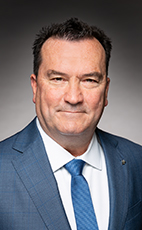
House of Commons photo

Crucial Fact

  • His favourite word was quebeckers.

Last in Parliament April 2025, as Bloc MP for La Prairie (Québec)

Lost his last election, in 2025, with 35% of the vote.

Statements in the House

Official Languages May 16th, 2022

Mr. Speaker, there were so many Liberals at the Bill 96 demonstration on Saturday that it was like being at their convention.

In attendance were the members for Mount Royal, Saint‑Laurent, Vimy, Saint‑Léonard—Saint‑Michel, Vaudreuil—Soulanges, Lac‑Saint‑Louis, Pierrefonds—Dollard and Dorval—Lachine—LaSalle. It was quite the party.

This raises questions. Is the federal government now going to wage war on Quebec's Bill 96? If not, will the Deputy Prime Minister tell her merry band of superstars to mind their own business?

Natural Resources May 12th, 2022

Mr. Speaker, they call it a loan guarantee, but we are not fooled. It is another subsidy in disguise. They are trying to surreptitiously finance their golden pipeline with our money again. They are embarrassed, so they are doing it in secret, but they do it anyway.

As for the $10 billion, either Trans Mountain, which is owned by the government, pays for it or the government pays for it. Either way, it is the taxpayer who will pay for it.

When will the government stop taking our money to support Trans Mountain? There are limits, at some point.

Natural Resources May 12th, 2022

Mr. Speaker, I am beginning to think that the Trans Mountain pipeline is made of solid gold. The government started by spending $4.5 billion in taxpayers' money, and now the tab has reached $21 billion. Why? For a pipe that will be used to sell oil.

That is the government's genius plan to fight climate change. What a bunch of heroes.

Best of all, today we learned that the government just announced another $10‑billion loan to Trans Mountain. That brings the total to $31 billion.

When will it end?

Official Languages May 10th, 2022

Mr. Speaker, French should be the language of work for everyone in Quebec, but the Prime Minister's Bill C‑13 makes French optional.

This is not hard to understand. He is telling Air Canada and CN that, if they want to make an effort for French, they can adopt the Charter of the French Language, but, if they do not, they can keep being bilingual, as they have been for the past 30 years. We see what the results are today.

If the government's goal is to anglicize French even faster, that would do it. It seems very hard to admit that bilingualism is not in jeopardy in Quebec but that French is. Why is that?

Official Languages May 10th, 2022

Mr. Speaker, there is a language crisis in Quebec, but the federal government wants to prevent Quebec from enforcing the use of French in all workplaces. With its official languages bill, Bill C-13, Ottawa is creating an exception for federally regulated businesses.

Thanks to Bill C‑13, these businesses will be able to continue to work “bilingually” or, as they say at Air Canada and CN, “in English only”. The Charter of the French Language will become unenforceable at these businesses.

Does the Prime Minister realize that allowing bilingual work at these businesses is not defending French, it is simply speeding up the English takeover of Quebec?

Business of Supply May 10th, 2022

Madam Speaker, that is not relevant.

Business of Supply May 10th, 2022

Madam Speaker, there are several parliamentary tools that can be used, including opposition days. We are using this opposition day because I already tried moving a unanimous consent motion in the House of Commons and it did not work. We did the same thing for the issue of Quebec's nationhood. Now we have been forced to use an opposition day to put forward a motion to vote on so that we can finally get rid of this prayer. That is what we are doing.

If my colleague cannot understand that this subject is not the only thing we are talking about, I wonder why he is even here in Parliament. There is a question period, there is committee work, there are bills, there are consent motions, and there are all kinds of other things we can do. If he wants to start judging what we do on our opposition day, I can tell him that the Conservative Party is in no position to lecture anyone. I would remind him that, on their opposition day, the Conservatives called for the elimination of pandemic restrictions when they do not even have the authority to do that. I will take no lessons from them.

Business of Supply May 10th, 2022

Madam Speaker, we can walk and chew gum at the same time.

The member from Winnipeg North tells us that people are talking to him about seniors and health. We have been talking about these issues for two and a half years, but he does not listen to us. Now he is lecturing us on how we should be talking about seniors and health. We talk about these things non-stop. We talk about health transfers. All the premiers of the provinces and Quebec have been calling for an unconditional increase in health transfers to 35%. He is not listening. What more will it take? Do I have to get out the puppets and crayons?

He does not get it. Now he is saying that things are terrible for seniors, but the Liberals are the ones who created two classes of seniors. They gave seniors 75 and over an increase, but they did not increase anything for seniors between 65 and 75. They tell them that if they want money, then they have to work. So much for championing seniors' issues.

The member then goes and lectures others. I would be embarrassed if I were him.

Business of Supply May 10th, 2022

Madam Speaker, it is my pleasure to speak to the motion today. I am not going to repeat the text of the motion, since we have been discussing it quite a bit for the last two hours.

I was elected not by God, but by voters. My job is to represent the people in my part of the country. I obviously do not bring up religion when I go knocking on doors. I am no better or worse than any other member. As members of Parliament, our job is also to meet with the people we represent. I have never asked anyone what their religion is. I have too much respect for people's beliefs. Religion is a personal matter and nobody else's business, especially not the government's.

Personally, I try to do a good job of representing the people and representing them to the best of my ability. I have looked up the statistics, but I am not going to talk about numbers or what the beliefs of various individuals are. I will not share with the House all of the comments that I had in mind when I saw the extremely broad range of beliefs.

Let us start with atheists. Atheists do not believe in God. Are they good or bad? I could not care less. The fact is that there are atheists, that is, people who do not believe in God. However, we are praying to God. The atheists must feel that they are not well represented.

Then there are the agnostics, that is, people who question whether God exists or not. These people do not care if God exists. They say to themselves, “Who am I to know?”

There are also people who believe in one god, namely the monotheists. Many religions identify with monotheism. This is the case with the most popular religions, if I may put it that way.

However, there are also religions where there are several gods. The prayer does not say “Gods”, but “God” in the singular. Those who believe in multiple gods must feel that the prayer does not reflect who they are, even if they are citizens of Canada. They must wonder why parliamentarians in a democratic institution are talking about a belief that is not their own. They must feel excluded.

Finally, some people do not have religious beliefs, but other beliefs.

As soon as we incorporate anything religious, we lose representativeness. We like to go on about how we have a duty to represent the people, the community and all of its diversity. It does not matter where someone falls on the spectrum of belief, because that is none of our business.

If we want to have a government that respects religion, that respects beliefs and that is inclusive, which is the operative word here, we need to come up with a solution.

For example, the Legislative Assembly of Ontario reads a rotating selection of prayers. One day, they read a prayer to one god. The next day, they read a prayer to another god, and so on. This puts the religions in a hierarchy. Some will say that various religions are included in the rotation, but not their own. That means this does not fulfill the objectives that the government should be pursuing.

Guess what? The best way to respect religion is for the government to stay out of it altogether. I am choosing my words carefully: The government must be secular and not display any religious symbols, at the risk of excluding a whole segment of the population or voters. This is really not what we should be doing.

Personally, that is what I say and what I think. Do people agree or disagree? We are going to vote on this.

Now let me read a few brief quotes along these lines. I want to show that I am not an outlier and that people have thought about this before me.

Sometimes we wish that we had said this or that, or we wish that we were the one who came up with such and such a quote. I do not want to take credit for these quotes, because that would be plagiarism.

In their book Secularism and Freedom of Conscience, Charles Taylor and Jocelyn Maclure provide a conceptual analysis of the principles of secularism. Here is what they have to say:

Although it is generally assumed that the aim of a regime of secularism is still to find the appropriate relationship between the state and religions, its broader and more urgent task at present is to make it possible for democratic states to adapt adequately to the profound moral and spiritual diversity existing within their borders. The state must treat with equal respect all core beliefs and commitments compatible with the requirements of fair social cooperation.

They are therefore calling for state secularism.

Marie-Andrée Chouinard had this to say in Le Devoir, on June 1, 2013:

...state neutrality is assured when the state neither favours nor hinders any particular religious belief, that is, when it shows respect for all postures towards religion, including that of having no religious beliefs whatsoever...

Thus, the idea of prayer is inconsistent with religious neutrality.

I was a member of Quebec's National Assembly for six years. As someone mentioned earlier, the National Assembly has a moment of reflection. That is the solution for us.

As of December 15, 1976, prayer was no longer part of the daily routine in the National Assembly. I would like to read an excerpt that will really enlighten us. This is what Clément Richard, Speaker of the National Assembly at the time, said:

Out of respect for the members of this Assembly, who are not all necessarily of the same religious denomination, and out of respect for the Assembly, I have chosen to allow every member to pray as they see fit. During the moment of reflection, each member will have the opportunity to say a prayer to themselves, and it is out of respect for the Assembly that I have made this decision.

We can discuss this at length, but everyone has their own religion. A moment of reflection will give these people a chance to reflect and pray if they so choose. Those who are atheist, agnostic or other will do other things, but I do believe that a moment of reflection will motivate them to do an even better job. We hope so at least.

In 2015, the Supreme Court said:

...the state must not interfere in religion and beliefs. The state must instead remain neutral in this regard, which means that it must neither favour nor hinder any particular belief, and the same holds true for non-belief.

I believe that everything is in place for us to achieve that.

When I arrived in the House of Commons in 2019, I was surprised that there was a prayer. I was really astounded. Honestly, I did not expect it. In Quebec, when people learned that this was the subject of our opposition day, they were shocked. They did not know that a prayer was recited in the House of Commons, and they thought it was absurd.

When I am told that no one sees us reciting the prayer, I answer that these are symbols, that we represent Canadian and Quebec democracy and that we must be respectful of these people. Setting aside the symbols, there are the people, and we must have absolute respect for them. The only way to do that is for the state to be neutral.

Right to Vote at 16 Act May 4th, 2022

Madam Speaker, I am very pleased to speak on this subject that keeps coming up. Obviously there is interest in it.

It also seems to appeal to young people, even though the member for Winnipeg North said that young people do not want to vote. In reality, 16- and 17-year-olds have gone to the Ontario Superior Court of Justice to seek the right to vote by challenging the constitutionality of the law.

My colleague from Skeena—Bulkley Valley talked about the benefit of having 16- to 18-year-olds vote. If these young people vote, participation in the democratic process is sure to increase as the pool of voters gets bigger. It is simple math, and it does not take a Ph.D. to know that. The question is more whether these young people will actually go out and vote, but I will come back to that a little later.

First, I want to respond to what my colleague from Winnipeg North said. He stated that we need to encourage people to vote and we need to find ways to encourage them. He is looking for ways because he is a dynamic guy, as we know. Everybody in the House knows him.

I can give him some ideas. When I was in Quebec City, sitting as part of the opposition in the National Assembly, we asked questions, and the ministers usually gave us answers. When they did not, we invoked a standing order to remind the ministers that they had to answer.

When I arrived in Ottawa, I was told to brace myself. Ministers in Quebec City do not always answer questions, but the federal government gives nothing but nonsense answers. No matter what question is asked, the government reads from the same talking points, even if the answer is completely unrelated.

If the Liberals really want to help get the vote out, they need to respect the voters' intelligence and answer the questions put to them by the opposition, because those questions are coming from the voters. If the government really wants to increase voter turnout, it needs to start treating the public and voters with respect and answer the questions.

If they respected the public, they would remember that on September 25, 2021, the people elected a minority Liberal government and the NDP was relegated to the opposition. That was what the people wanted, what they decided.

Had the government respected voters' intelligence—had it respected voters, period—it would have respected the fact that this government was supposed to be a minority government and that the NDP was supposed to be an opposition party, but the very people who make a big to-do about boosting voter turnout are the same ones saying that the way people voted does not matter and that they are entering into an alliance for whatever reason and giving a minority government a majority.

Maybe if people felt respected, more of them might vote. Voter turnout has been in free fall for forty-some years, and even though it edged up recently, that is nothing to get excited about. The point is, let us start by respecting voters 18 and up before we start talking about the 16- to 18-year-olds.

Let us look at voting rights for 16- to 18-year-olds. I find this so interesting. There are some main ideas I would like to work on with the member.

First, it has been proven that a voter who votes for the first time tends to vote more often throughout their lifetime. It is a habit. Some people pick up bad habits; others pick up good ones. Voting is a good habit.

Technically, if 16- to 18-year-olds vote more, that high level of civic participation will continue throughout their lives. That will make democracy in Quebec and Canada more accessible.

I am not against the idea. On the contrary, I find it interesting. That is why I asked my colleague the question. He answered me, perhaps because he is not in government. I asked him some questions, and he did not answer that the dog ate the answer. I thank him for that because it is rare to get answers here. I find this interesting, and I wrote it down in my notebook.

We now have examples, and since this is being done elsewhere in the world, we are watching and wondering how it could happen here. The member for Calgary Shepard also said something interesting. He looks startled, but I can assure him that I found it interesting. I did not fact-check what he said, but I will take his word for it. He said that in Austria, voter turnout increased initially, but it went back down once the excitement wore off. That is interesting.

It is important to understand that the ultimate goal is to allow 16- to 18-year-olds to vote. Someone once said that you do not need to be old to be wise. I think it was Xavier Dolan, but I am not sure. It means that a person can be very bright even at 16 or sometimes younger. I have met people in that age group who were really into the news, who read the newspaper and so on. I think it is an interesting idea, and I think something could potentially be done with it.

We in the Bloc Québécois sat down to begin reflecting on this issue. In fact, my colleague pushed us to do so by introducing this bill and asking our opinion. I weighed the pros and cons, and I will briefly outline what I came up with.

First we have those who are in favour. They argue that the school setting may encourage 16-year-olds to vote because, generally speaking, people that age still go to school. Their teachers will talk about this and explain who has the right to vote, and so on. Discussions could be geared to encourage voter turnout. Some studies show that this is not necessarily true, but I still find it interesting.

I have already talked about the fact that voting is a good habit to get into. Another important point is that party members have the right to vote in leadership races. The Conservative Party seems to have a lot of leadership races. Its members must have strong legs, because they are always running.

Young people are more affected by the climate crisis. I am looking at the members of the Green Party and the Bloc Québécois, not to mention the NDP, because we must admit that we are all part of the same team when it comes to the climate crisis. It would be good to hear from young people on this issue. I think that would be worthwhile.

People have the right to join the army at age 17, which is interesting. At age 16, they can get a driver's licence, and why not? Although it is true that you can kill someone with a car, that is uncommon. We can certainly give them the right to vote.

At 16, people can drop out of school. They can get a job and pay taxes, depending on the tax bracket they are in.

I will now talk about the cons. A person is a minor until they are 18. There must be a reason for that. It was decided that a person is a minor before age 18. Parental consent is required for getting married or enlisting. Maybe there would be more successful marriages if that were required. I probably should have asked for my parents' advice before I got married, but no matter.

Some say that 18-year-olds sometimes act like adults and sometimes act like minors. It is still the same thing. There may be reasons for that.

At 16, people are prohibited from smoking cigarettes or drinking alcohol. At least, they are prohibited from buying cigarettes and alcohol.

Quebec and the other provinces are not there yet. It would be rather strange for youth to have the right to vote in federal elections, but not in provincial elections. I do not know how that would work, but it is something we could study and work on.

Research has been conducted on this. My colleague mentioned some research findings. It is interesting. Is the research indisputable? No, it is not. It may be too recent. Not many jurisdictions have lowered the voting age, and often the countries cannot be compared. That affects the nature of the sample.

The issue is simple: People must vote. Will lowering the voting age to 16 increase voter turnout? I am not referring to the number of voters, but the actual percentage who vote. I believe this is something we must fight for to ensure that our democracy moves in the right direction, to improve the way we do politics so that we are seen in a better light and people vote because they know it is worth the effort.