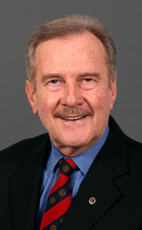
House of Commons photo

Crucial Fact

  • His favourite word was respect.

Last in Parliament March 2011, as Liberal MP for York South—Weston (Ontario)

Lost his last election, in 2011, with 33% of the vote.

Statements in the House

Canada-Colombia Free Trade Agreement Implementation Act September 14th, 2009

Madam Speaker, I listened to the member, who is a past chair of the Standing Committee on the Environment. I am not surprised that his remarks were coming around to sustainable development and the tremendous concerns that have been expressed for biodiversity in the Amazon Basin and in various regions of Latin America and South America.

If we accept that the objectives as he has outlined in this agreement are worthy of signing, and while he has said that Canadian companies have been sensitive to their social responsibilities, there are many international companies that are not subscribing to those same values. What mechanisms exist in our international trade agreements and in this free trade agreement to make sure that the government of Colombia will be accountable to making sure those objectives he has talked about, and they are very worthy, are achieved?

Canada-Colombia Free Trade Agreement Implementation Act September 14th, 2009

Madam Speaker, the member did not address it but I wonder if he would like to.

The concept of a rules-based trade agreement also has regional implications with respect to what is happening in Venezuela. I think that international peace is also a corollary to developing these kinds of rules-based trade agreements.

Is there hope that that kind of road would also follow a regional path that would be in the interest of international peace?

Canada-Colombia Free Trade Agreement Implementation Act September 14th, 2009

Madam Speaker, I am drawn to ask this question of the member because of the huge interest that he has taken with respect to economic development and trade ties not only with the Latin and South American countries but also with the countries of the Caribbean. The Prime Minister visited the CARICOM countries and talked about the kinds of issues that the member has addressed through his discussion of the bill before us.

Can the member outline for the House that there is a broader policy paradigm around which these free trade agreements are being developed? He has concentrated on the value added to children and families in Colombia, but is the government working with labour organizations, trade organizations? He mentioned non-governmental organizations, which are extremely critical to effective reciprocal agreements under this free trade umbrella. Could he outline what the government's rationale is in general terms and what the specifics are with respect to working with trade organizations and labour organizations that are fundamental to the advantages and added value that he alluded to in his remarks?

Petitions June 19th, 2009

Madam Speaker, I have a well-prepared petition from residents of York South—Weston entitled, “Fix Employment Insurance Now”.

The petitioners state that a healthy unemployment system is the most powerful of all economic stabilizers and that we have entered this new economic crisis with a much weaker EI system.

Therefore, they urgently petition Parliament to introduce these changes to employment insurance: 360 hours to qualify for EI benefits in all regions of Canada; increase benefit duration to 50 weeks for all workers in all regions; and increase benefits to at least 60% of normal earnings using workers' 12 best weeks.

Since there has been a special committee put together to look at this, I would urge that not only Parliament consider this through the RSD committee, but also that it be referred on to the special committee that will be meeting during the summer to look at fixing employment insurance.

Learning Enrichment Foundation June 11th, 2009

Madam Speaker, I rise today to extend my congratulations and appreciation for the work that has been accomplished by the Learning Enrichment Foundation as it celebrates 30 years of service to York South—Weston.

LEF has brought a holistic approach to employment in York South—Weston and across the greater Toronto area. From serving the unemployed by way of skills and educational training, to assisting new immigrants, to providing the self-employed with the tools to start a new business, LEF has become an integral part of job creation in Toronto.

On May 20, this momentous occasion was celebrated while remembering those past who helped LEF reach its 30th year. Former president, Donald MacDonald and former executive director, Eunice Grayson, were pioneers of this organization and have left behind a legacy that will contribute to the future growth of the organization.

I invite the House to join me in honouring the current president, and former mayor of the City of York, Fergy Brown, the staff and volunteers at LEF who continue to serve this community well, and we look forward to another 30 years of service.

Business of Supply June 11th, 2009

Mr. Speaker, it is an interesting proposal put forward with respect to raising personal contributions that would allow for an expansion of the CPP.

I understand the concern that is being raised with respect to the privatization and the erosion of the pension regime through privatization, but there is an interesting approach that has been suggested. That is to look at the large pension funds and recognize that the problem is underfunding.

Rather than going to the participants for an expansion of the CPP, it has been suggested that the large pension funds, like OMERS and teachers, be folded in with respect to a larger base to then drive a more equitable and expanded CPP.

Would the member give us an idea of whether that would be a plausible approach, looking at those very large pension funds and seeing if they could be used, rather than tax individuals--

Controlled Drugs and Substances Act June 5th, 2009

Mr. Speaker, it will probably be obvious that I am not a lawyer, so my question will have to be taken in that vein.

The member made a point of linking this legislation and the minimum requirements under it to a reduction in guilty pleas. He has characterized that as not being in the interest of the general public and the criminal justice system. However, an issue has come up in my experience recently, which is of concern, and that is with respect to the number of occurrences of plea bargaining, most graphically illustrated with the Homolka case, as well as others. People are very concerned about that.

Because the member is concerned with the reduction of guilty pleas, would it not be an argument in favour of the legislation if there were also a reduction in the plea bargaining system associated with guilty pleas? People are very concerned about that. I wonder if he would comment.

Canada-Peru Free Trade Agreement Act June 1st, 2009

Mr. Speaker, the previous Bloc speaker had an interesting thesis in which he argued that bilateral treaties of this ilk should be superseded by a broader multilateral regime that would deal with environmental and social responsibility issues and so on.

Rather than focusing on the bilateral relationship with respect to sidebar agreements, would he not back the Bloc member in terms of looking at the International Court of Justice, the International Labour Organization tribunal and those multilateral regimes that would deal with the kinds of issues he has raised, rather than suggest that a government should not enter into, in the better interests of its citizens, the kinds of agreements for the kinds of reasons as put forward by some of my colleagues?

Canada-Peru Free Trade Agreement Act June 1st, 2009

Mr. Speaker, I have been listening carefully to what the Bloc member has been alluding to and I have been trying to understand the thesis with respect to how he views free trade agreements. I would like to think they are fair trade agreements to some extent. He has argued that because there is no strong multilateral framework, these bilateral agreements will supersede issues as they relate to the environment, human rights and so on. I think the House is impressed with the knowledge the member has, but my question is, is there any other alternative?

When Brazil and Canada were engaged in an aerospace situation with respect to Embraer and Bombardier, there was a charge that the Government of Canada was unfairly benefiting one of our industries. Through the WTO, Canada was able to bring attention to that issue. There was a degree of voluntary acceptance with respect to the findings.

The House is seized with the argument that the member has put forward. However, without these kinds of agreements with the Caribbean countries of the CARICOM, and without the ability to stimulate capital transfers and investments in those countries, where would those countries be? My colleague has argued that this $2.8 billion balance is favourable to mining interests and so on.

Given that there can be strong human rights legislation in Peru, and I would argue that the Peruvians have capability in the area of labour jurisdiction and labour law, does entering into these kinds of agreements with Canada not give more protection to those countries?

Canadian Products Promotion Act June 1st, 2009

Mr. Speaker, let the record show that was not totally unanimous as there was a latent undercurrent, but I thank members of the House for allowing me to say a few words on this subject.

The Bloc is well motivated with respect to the desire to remind Canadians that within the global economic picture there still is an element, albeit in a permissive way, for there to be a concept of buying local, for example, buying agricultural products that are produced by our farmers which are the best agricultural products in the world. We are reminded of our forestry industry. We have the best fibre in the world and yet we have an industry that is in serious decline. It is affecting towns and communities rights across the country.

I appreciate and I am sure the House appreciates the spirit and motivation of the Bloc in bringing forward this bill. Within the context of globalization, the movement of capital, the serious competitiveness of the movement of capital and God knows that we need to have capital invested in the commercialization of technology, we are trying to transform our economy. At the time when we need to identify these global trends and not only stay within the spirit of the WTO and globalization, but also the law itself, this is not the time for us to disaggregate our capacity with respect to competitiveness.

I would suggest that while the Bloc may not intend that, we could see a disaggregation with respect to our national strategy to compete in a global sense. At the very time when we think we are doing the right thing for our regions and provinces, we would be doing the very opposite. While I understand the motivation, I think that the Bloc should reconsider this issue.

Very recently, for different reasons, we have been looking at drawing closer relationships, for example, with the CARICOM countries of the West Indies. We have been looking at more of a hemispheric approach with respect to our ties with Colombia and Peru. There is a serious debate in terms of why we should embark upon that particular strategy, but the reason I mentioned that is that those particular initiatives are in keeping with globalization and, where there is a balance of payments and a capital deficiency with respect to investment, to open doors that would redress that and to bring Canadian products into a competitive mode and to balance that out against our interests.

While the bill may not intend to undermine or be contrary to what our global strategy should be, in fact that is what it does. From my perspective it invites a retaliation. If it is not deemed to be in the interests of our national policies, if it is deemed to be protectionist, then the perception of that will drive those whom we are attempting to reach out to, to be in trade relationships and the extension of that to drawing capital and investment here, we would be going the very opposite way.

For those reasons, as I said, I believe the Bloc is well intentioned on this, but in actual fact the bill would have exactly the opposite reaction to what the Bloc is hoping to accomplish.