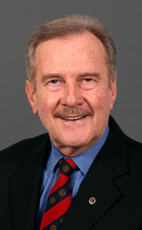
House of Commons photo

Crucial Fact

  • His favourite word was respect.

Last in Parliament March 2011, as Liberal MP for York South—Weston (Ontario)

Lost his last election, in 2011, with 33% of the vote.

Statements in the House

Committees of the House April 7th, 2008

Mr. Speaker, I compliment my colleague from the New Democratic Party on her research and on her articulation of the case to be made for supporting the international declaration.

I have heard her argument. The House has heard it. I have listened, as the House has, to the parliamentary secretary. It hinges on two arguments. One argument is the legal implications and an attempt to extrapolate that and apply it to existing treaties and so on. The parliamentary secretary says that the government has concerns because there may be precedence. My colleague from the NDP has based her argument more on natural rights, natural justice, a sense of morality and ethics when it comes to these inherent rights that the first nations peoples had and the circumstances of history. Because they did not have natural law and natural justice, they lost those rights.

Does my colleague come down on the side of, from time to time, articulating what are basic human rights, what is basic natural justice and articulating that without prejudice, to what perhaps the deeper implications may be with respect to the international justice system, or even justice systems in our country or in any other country?

Would she like to give us an opinion on which side she comes down on with respect to first nations and the international declaration?

Budget Implementation Act, 2008 April 4th, 2008

Mr. Speaker, I appreciate the comments made by my colleague across the floor with respect to housing and affordability.

One of the issues in my riding, which is equally very needy, is an issue that I come up against day after day. It is the issue of foreign credentials and having those foreign credentials brought into the mainstream of acceptance within Canada's workforce.

It appears that the government is attempting to expand the list of people who could come to this country and deal with the waiting list. The government said that it would establish an agency that would deal with the issue of foreign credentials. However, we have 300 referral offices across the country and we still have no resolution to this issue, much to the frustration of thousands of immigrants who are here and cannot practice their trade or profession.

I wonder if the member would address that as I think it is a concern and it is not being dealt with in the bill that has been presented.

Ontario Budget April 4th, 2008

Mr. Speaker, the Ontario budget offered a balanced approach to fiscal management with these elements of responsible leadership: investments in manufacturing, funding for job creation, targeted poverty reduction, and competitive taxes.

In his speech before the legislature, Ontario's finance minister addressed these areas where partnerships would serve Ontarians and Canadians better: strategic investment in transit, addressing congestion and climate change; a federal initiative to increase transfers for settlement services to match other provinces; and creation of a new border crossing at Windsor, the busiest international trade link in the world.

Ontario is moving forward with health care, infrastructure, manufacturing initiatives and appears to be in tune with mainstream thinking on what drives long term economic growth.

Historically, Ontarians in good times and bad have contributed through equalization to maintain a strong and fair union, and truly in the words of Robert Louis Stevenson, have been an honest and reliable friend.

I am certain this House agrees that it is in the national interest to nurture that friendship through partnerships that inspire a new legacy of hope for Ontarians and all Canadians.

Business of Supply March 31st, 2008

Mr. Speaker, I was rather amused that the finance minister quoted Robert Louis Stevenson, who came to the conclusion that what one needed in life was an honest friend.

I am not sure whether the finance minister is aware that he came to that conclusion on the basis of questions that he was asking himself: where he had been; where he was; and where he would like to go? He went to a book that was written by a priest in the sixteenth century who underwent the same sense of where do we go and how do we do it, and had chosen to walk across Spain with a donkey. He came to the conclusion that the honest friend was a donkey.

I know the finance minister in the House shares a huge respect for donkeys because they have a great sense of direction and a great spirit.

The minister will be aware that the former finance minister of Ontario, Mr. Sobara, had indicated that he felt that the province of Ontario was paying greater portion on equalization.

The member for Burlington has indicated that he is prepared to look at the harmonization of PST and GST. Is the minister serious when he talked about looking at equalization in terms of fairness and equity, and where does he propose to go--

Afghanistan March 13th, 2008

Mr. Speaker, I appreciate the inventory of successes and initiatives that have been taken.

I have a background in development. In an earlier part of my life, I spent some time with Canadian University Service Overseas. I see what is possible when we harness the capacity for people to focus on their issues and problems and bring dignity and hope into the lives of their families and their country.

That is what is happening in Afghanistan. That is the legacy for our young people, a more peaceful future and one that deals with the kinds of issues we see in Africa and around the world. It is set by this model--

Afghanistan March 13th, 2008

Mr. Speaker, as I said on CPAC when we were discussing this a few weeks ago with the parties represented at the table, I welcome the debate, the House welcomes the debate and the country welcomes the debate.

The debate can be a unifying force. It can be one in which we articulate in this House the concerns that have been raised by our constituents, and far be it from me to ever shy away from that opportunity. That is why we are elected and I thank the member for the opportunity to reply in that respect.

Another thing I would like to say is that it was not as clear then as it is now, as events have unfolded. I talked about the courageous disposition of so many Afghani people, and this is what is demonstrated to our troops. They are moved by this. I said earlier on, with respect to the national solidarity movement, that great initiatives have been taken and there has been a great deal of accomplishment. This is something that should give us encouragement to go ahead and to continue to show to the world that democracy is--

Afghanistan March 13th, 2008

Mr. Speaker, I am pleased to have the opportunity to rise today in the House on the issue of Canada's continued role in Afghanistan.

For the better of six and a half years Canada has carried a very heavy burden. Our military presence in Afghanistan has evoked emotions of pride and frustration, of honour and sadness. It is a difficult issue, a multi-faceted mission and one that I will support in the restructured form.

Since the fall of 2001, I have believed that Canada should play a significant role in the reconstruction of Afghanistan and that Canada, working with our allies in NATO under the United Nations mandate, should remain in Afghanistan after February 2009. At that time, Canada's combat role should cease and concentrate on humanitarian and infrastructure projects with troops carrying out our traditional role of securing peace.

I am happy to support the motion, as amended, with the following three important tenets that have been taken from the Liberal motions.

The Government of Canada must immediately notify NATO that Canada will end its combat role in Kandahar region in February 2009. After an additional two years of training Afghan troops and police and performing reconstruction projects, Canada's military presence in Kandahar will end entirely as of July 2011.

Also, NATO must secure troops to rotate into Kandahar to allow Canadian military personnel to be deployed pursuant to the mission priorities of training and reconstruction and the government must secure medium helicopter lift and high performance, unmanned aerial vehicles to support our peacekeeping and reconstruction efforts.

The government has agreed to accept these reasonable amendments to their strategic plan for the Canadian Forces in Afghanistan. This amended plan for Afghanistan is in the best interests of both the Canadian and Afghani people. There has been much rhetoric in the House and an elevated level in our media about supporting our troops. Our troops need support, yes, but they also need a clear vote of confidence and direction from the decision makers here in the House.

Support means an end to vacillation and mixed signals. We on the Liberal side of the House have been clear for over a year now. The government must notify our allies within the North Atlantic Treaty Organization that Canada will conclude its combat role in Kandahar region next year.

The government now seems to agree that after two additional years of training the Afghan police and performing reconstruction, Canada's military presence in Kandahar region should end. Canadian troops have courageously carried out the Canada, NATO, UN mandate and have sacrificed casualties that are disproportionate to even our NATO allies.

We parliamentarians and our constituents have supported our troops throughout the entire mission. Now we must lend our support to a re-energized effort toward peace building, reconstruction and the protection of a just society in Afghanistan. However, our support cannot end there.

I am pleased to note that the government has also accepted the Liberal recommendation to supply our troops with helicopters capable of what is called in military jargon, medium lift capabilities. These aerial military units, which are essential to our mission in Afghanistan, are frankly long overdue. Also encouraging is the government's commitment to supply our troops with unmanned aerial vehicles, or drones.

Any time we are able to provide our military with the option of risking a piece of technology rather than a Canadian soldier, we should take and make the most of that opportunity.

As we are all aware, when we speak of supporting our troops it means more than a flag on the lapel or a speech on Remembrance Day. We must keep our troops and their best interests in our minds every day. We must be certain that our financial, technical and tactical support is equal to the heart and heroism they demonstrate each and every day.

By voting in favour of this amended motion on Afghanistan, members of the House are supporting our troops by making it clear that at the conclusion of our current mission in Kandahar region, Canadian Forces should return to their traditional role of securing the peace in Afghanistan while our allies provide at least 1,000 more troops with clear orders to engage the Taliban in Kandahar region.

Canada's military has kept its word, performed admirably and exceeded expectations on the international stage. During this effort our nation has sacrificed a disproportionate number of lives. In one year it will be time for the Canadian Forces to be relieved from the front lines so that they may continue bettering the basics on the Afghani home front.

In the intervening year before us, Canadian soldiers will aid the Afghan government in the disbandment of illegally armed groups that were formed pre-democracy and continue to pose a threat. When combat operations cease, Canada's continued presence in Afghanistan will remain essential if we ever hope to assist the Afghan people in attaining the type of civil society we often take for granted here at home.

If nations as fortunate as ours do not undertake some responsibility to protect those who have fallen victim to ruthless regimes such as the Taliban, then I believe we are neglecting the values that our country has stridently upheld since the end of the second world war.

I am immensely proud to be a member of the party of Lester B. Pearson. As he did, I believe Canada must be the forerunner in the pursuit and protection of peace. In Afghanistan, where running water is an everyday uncertainty, where the threat of violence accompanies all activities, President Karzai and his people have valiantly placed a dignified and compelling call for help. It is a call we must not ignore.

Separate from combat operations, our troops in Afghanistan remain at the forefront of landmine removal. This mission is designed to stop the mounting number of children who have lost limbs due to the carelessness of armies who fought before they were even born. Canadian soldiers are building and protecting schools so that young girls can study, in many cases for the very first time. Our troops and Canadian Forces personnel are fostering nascent industries and economic alternatives for farmers who are otherwise trapped in the illegal manufacture of narcotics.

In addition, Canada is working with the United Nations Assistance Mission in Afghanistan as it works to create and re-establish many of the important civil institutions that were lost under the Taliban. One such initiative is the Afghanistan Independent Human Rights Commission which investigates and monitors abuses of human rights and recommends corrective actions to the government.

Canada and the UNAMA are helping the Afghan people to develop their own capacity to protect and promote human rights. Canada must continue to work with the United Nations, NATO and the international community to help Afghanistan become a stable, democratic and self-sustaining state.

Our involvement is helping to provide the security and stability necessary to ensure a systematic reconstruction of the country. We cannot retreat just as the Afghan people finally begin to see the reconstruction of their economic, political and judicial institutions.

Canada must continue to support such peace, prosperity and security projects. These types of initiatives can continue independently from a combat mission. In reality, to be completely successful, they must.

Lester B. Pearson once stood in this place and referred to Canadian diplomacy as “history in action”. He understood that the most difficult decisions were of the greatest importance. He knew that our nation would be judged not by how we thought of ourselves, as we are apt to do, but how other nations perceived our actions.

History is what becomes of decisions requiring great courage. Those decisions made by past generations of Canadians ensured that Canada is well judged by history. As Lester Pearson said when Canada was faced with another humanitarian challenge, “we must offer only our best effort and seize the day”.

Our best efforts can be harnessed into the reconstruction of Afghanistan. It is a noble challenge, one that Canadian troops will meet with a unique resolve that is respected around the world. They will seize the day and the Afghani people and the world will be better for it.

Afghanistan March 13th, 2008

Mr. Speaker, I know that my colleague has great knowledge, having been to Afghanistan and having studied very closely what is happening at the community level.

She may know that the minister of community development established the national solidarity program. During that program's implementation over five years, water purification, the funding of co-ops for agricultural transformation, local auxiliary police training, and revamping community medical clinics have transpired. That same minister is now the minister of education. He has set the goal to bring education and training to all of the very remote communities of Afghanistan.

Is that not a laudable goal at the community level, an approach that works? That same minister has said that the presence of troops is necessary to secure peace in order for that program to be successful. Does the member agree with that?

Afghanistan February 26th, 2008

Mr. Speaker, our colleague has spent a great deal of his time talking about both the military requirement with respect to holding the security in Afghanistan, particularly in Kandahar, and he devoted some of his comments with respect to the progress that is coming through the reconstruction of schools, the courts, municipal institutions and so on. I think the whole House would agree that those two go very much hand in hand.

The Manley report was a balanced commentary on both of those initiatives, but it seems to me that Canadians want to have a bit more assurance that it is not just the 1,000 troops we are asking from NATO with respect to securing the peace, but also that all of our allies are engaged in the reconstruction initiatives the member talked about.

One of the suggestions has been that this become more visible if there were a report from the House either through the foreign affairs committee or another committee. I wonder if the member could speak for a moment on that and elaborate.

Afghanistan February 25th, 2008

Mr. Speaker, my colleague from Markham—Unionville indicated in his comments that the position taken by the opposition was that maybe there should be an update with respect to progress made in the area of reconstruction and institutional revitalization and also with respect to the military initiatives.

The suggestion was put forward that a special committee should be set up to receive those periodic reports. I have my own views and I have heard other members of the opposition give different views on that, but I would be interested to hear the member's response to this suggestion that is being put forward.