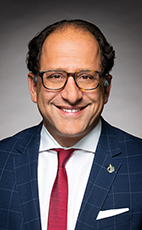
House of Commons photo

Track Ali

Your Say

Elsewhere

Crucial Fact

  • His favourite word is witnesses.

Liberal MP for Willowdale (Ontario)

Won his last election, in 2025, with 53% of the vote.

Statements in the House

Immigration, Refugees and Citizenship October 7th, 2022

Madam Speaker, we appreciate that these are difficult times for Canadians and that our companies are experiencing significant labour shortages. It is time we recognized the significant contributions of international students. I can tell members that in my riding of Willowdale many international students are contributing to the growth of companies.

I want to ask the Minister of Immigration if he could kindly inform the members of this House on what he is doing to support international students and the growth of Canadian companies.

Foreign Affairs October 4th, 2022

Mr. Speaker, today marks 1,000 painful days since the Islamic Republic of Iran shot down flight PS752, killing all 176 passengers, including 85 Canadians and permanent residents. Last week, Canada hosted the 41st assembly of the International Civil Aviation Organization in Montreal.

Would the Minister of Transport share with members of the House what Canada is doing to hold Iran to account?

Committees of the House September 26th, 2022

Mr. Speaker, I have the honour to present, in both official languages, the fourth report of the Standing Committee on Foreign Affairs and International Development.

Iran September 23rd, 2022

Mr. Speaker, for the last week, Iran has descended into mourning following the death of Mahsa Amini, an innocent 22-year-old murdered while she was detained by the Iranian morality police for simply not having displayed a proper head covering. Since her death, thousands upon thousands have taken to the streets in over 25 cities scattered throughout Iran. They are demanding that women not be discriminated against and harassed, and for the fundamental rights of all citizens to be respected. In each instance, they have faced the iron fist of the Iranian government.

Far too many protesters have been beaten and scores more have lost their lives, and now the Iranian government has throttled social media so it can commit more unconscionable atrocities. That is why Iranian Canadians across our country are heartbroken. Having spoken to many of them, I can say that, given that PS752 is fresh in their memories and they are now watching the savagery that is unfolding in Iran, they want action and they want that action now to demonstrate we are holding the Government of Iran to account.

Her Late Majesty Queen Elizabeth II September 15th, 2022

Mr. Speaker, it gives me great pleasure to join other hon. members of this House to pay tribute to our head of state for over seven decades, Queen Elizabeth II. It is indeed a great privilege to share my personal sentiments, which I can assure members are shared by many residents of Willowdale who are deeply saddened by the passing of our monarch.

Over the last several days, we have witnessed an extraordinary outpouring of grief by numerous individuals around the world. We have heard countless expressions of sorrow on the passing of an exceptional personality who found a very special place in very many hearts.

For each of us, our individual or personal reasons may vary. In other words, she endeared herself to legions for a wide variety of qualities and reasons. However, we all recognize that we are now mourning the passing of a tireless monarch who embodied the notion of duty and epitomized the very best of public service. She had a profound effect on many. She was a constant in so many countless lives over the span of many tumultuous decades.

During her seven-decade reign, she was a historic beacon of hope. She weathered countless global crises with steady determination, great dignity and boundless decency. Despite the whirlwind of developments the world experienced during her lifetime, she proved unflappable and always remained committed to remaining a tower of strength and an embodiment of determination during these uncertain times.

The public first caught an early glimpse of her steadfast qualities even before she ascended the throne, when, at age 14, she felt compelled to offer a radio address from Windsor Castle in 1940. It was addressed specifically to children to reassure youth of the promise of impending peace during the dark days of the Second World War. As she remarked during that address, “And when peace comes, remember it will be for us, the children of today, to make the world of tomorrow a better and happier place.”

It should also come as no surprise that a few years later, while still a teenager, at her own insistence, she joined the Auxiliary Territorial Service to train as a truck driver and mechanic to assist the war effort.

That very same sense of duty and service were constants after she assumed the throne. Her sense of obligation and fortitude never dulled. It is now estimated that the Queen presided over an average of 500 official appointments in any given year of her lengthy reign. It is also true that she is recognized as the most widely travelled head of state in history.

As Canadians, we were great beneficiaries of her attention and affections. She travelled to Canada on no less than 22 official visits as a monarch. Indeed, Canada was the country most frequently visited by Her Majesty. As she noted on one occasion about our country, “I am sure that nowhere under the sun could one find a land more full of hope”.

It should come as no surprise that she was among us here in Canada in 1957 when Her Majesty became the first Canadian monarch to open Parliament and deliver a speech from the throne. She opened the St. Lawrence Seaway in 1959. She attended the 100th anniversary of the meeting of the Fathers of Confederation in Charlottetown in 1964. She was present for our centennial in Ottawa in 1967.

She participated in Expo 67 in Montreal, and was present for the opening of the summer Olympic games in Montreal in 1976. She was present to mark the 100th anniversary of the admission into Confederation of Manitoba, the Northwest Territories, British Columbia and Prince Edward Island variously between 1970 and 1973.

In 1982, she was present in Ottawa to participate in the patriation ceremony of our new Constitution, which of course included the Canadian Charter of Rights and Freedoms.

It should also be highlighted that she appointed our first French Canadian Governor General in 1959, proclaimed our national flag in 1965 and established the Order of Canada in 1967.

During her lengthy reign, she conferred countless honours upon and sent congratulatory letters and messages to thousands of Canadians, and acted as a royal patron of countless Canadian charities, while also developing and maintaining a particularly strong bond with our military and the RCMP.

Of course, her greatest impact was on individual Canadians. This she did through her unforgettable Christmas addresses.

She noted this in a visit to Halifax in 2010:

Canadians have, by their own endeavours, built a country and society which is widely-admired across the world. I am fortunate to have been a witness to many of the developments and accomplishments of modern Canada.

I would also be remiss if I did not remark on her dedication to maintaining strong bonds with the widest array of countries, in effect allowing our country to broaden and deepen our ties with numerous countries as a member of the Commonwealth. Indeed, our membership in the Commonwealth alongside other multilateral institutions has allowed us to maintain with great pride for many decades that we are the most connected country in the world. During the Queen's reign, the Commonwealth grew from seven to 56 member states, in essence ensuring the Commonwealth was comprised of countries with an estimated 2.5 billion people. These bonds have allowed Canada to forge close ties and bonds of friendship with numerous countries.

The Commonwealth's objectives were first explicitly and expressly outlined in 1971, when the organization committed itself to world peace, the promotion of representative democracy and individual liberty. While we can all acknowledge the vicissitudes in the fortunes of the Commonwealth, there can be no doubt that Her Majesty reimagined the Commonwealth and was devoted to ensuring that the organization was devoted to improving conditions among all its member states.

The greatest example of this occurred in 1986, when 48 of the then 49 members of the Commonwealth agreed to adopt sanctions against the apartheid regime in South Africa. The then government of Prime Minister Thatcher was the only holdout. We now know, with the benefit of declassified diplomatic archives, not only that Canada assumed a leading role to cajole the United Kingdom to change its official position, but that the Queen also joined this endeavour, of course only from behind the scenes and with great dignity and decorum.

Allow me to offer my condolences to the royal family and, in particular, His Majesty King Charles.

I join millions around the world in saluting Queen Elizabeth for her tireless decades of duty and service.

May you rest in peace, Your Majesty.

Petitions June 22nd, 2022

Mr. Speaker, it is my pleasure to rise today to present two petitions on behalf of my constituents in Willowdale, both of which pertain to our government's response to Russia's illegal invasion of Ukraine.

The first petition has been signed by over 500 individuals from across the country, and it is put forward by youth activists who cite existing laws on hate speech and hate symbols. Against the backdrop of rising vandalism and intimidation in our country regarding Russian military emblems, petitioners are calling upon the government to ban the “V” and “Z” symbols, as well as the ribbon of St. George, on the basis that they serve as symbols of hate.

The second petition speaks to the ongoing humanitarian crisis in Ukraine and asks that our government uphold our tradition of peacekeeping and press for an urgent ceasefire and the securing of humanitarian corridors for aid to Ukrainians. The petitioners suggest that such an event might coincide with an internationally recognized humanitarian day of recognition.

Both of these petitions highlight our expressions of solidarity with the courageous people of Ukraine. I am grateful to the petitioners for drawing attention to the issue and I am honoured to present these petitions in the House on their behalf.

Mr. Speaker, allow me to join other colleagues in wishing you and your family a splendid summer.

Committees of the House June 13th, 2022

Madam Speaker, I have the honour to table, in both official languages, the third report of the Standing Committee on Foreign Affairs and International Development, entitled “Taiwan's Participation in the International Civil Aviation Organization”.

Pursuant to Standing Order 109, the committee requests that the government table a comprehensive response to this report.

Canada National Parks Act June 1st, 2022

Mr. Speaker, I rise to join my colleagues as we resume debate on Bill C-248 this evening. As members are well aware, this is in act to amend the Canada National Parks Act or the Ojibway national urban park of Canada. It is a great honour to join all of my colleagues here this evening.

Allow me to begin by acknowledging that I am joining this discussion from the traditional and unceded territory of the Algonquin Anishinabe.

In earlier contributions we saw in the debate with respect to this park, as well as what we have heard this evening, what has certainly emerged is that there is consensus in this chamber that it is imperative that we move forward with this specific park. I must say that it is great, on an evening like this, to see that there is consensus in this chamber.

It is important to emphasize that Windsor is one of seven cities where work is currently under way to create national urban parks. In fact, it falls under a new $130-million program that has the aim of designating up to six new national urban parks across Canada by the year 2026. Canadians expect us to be bold, and that is why we are fully committed to moving in the right direction with a time frame in place by 2026.

The national urban parks program is being led by Parks Canada and I should emphasize that it cannot be short-circuited. At the heart of the process led by Parks Canada, in this particular case and in others, is the premise that we should not forget that there needs to be partnership and collaboration between stakeholders and communities. Every one of us is committed to partnering and working hand in hand to explore opportunities and define boundaries and governance structures, as well as to achieve a shared vision. The process must be grassroots and bottom-up as well.

Since this process began, Parks Canada has been actively collaborating with key partners in the Windsor area, including, as was alluded to, the City of Windsor, Caldwell First Nation and Walpole Island First Nation. Engagement with key stakeholders has also begun, including with conservation and heritage groups, as well as universities, tourism stakeholders and economic development shareholders. I emphasize engagement and collaboration because I want to highlight one of the obvious weaknesses of the bill before us.

Though I think we can all agree the bill has very good, laudable intentions, the process is top-down and totally bypasses grassroots and bottom-up engagement. The failure to undertake appropriate engagement with indigenous peoples specifically on whose traditional lands the proposed park will occur violates the very spirit of reconciliation and risks undermining new relationships and the requisite trust that must always underpin such developments. Creating a national urban park without proper engagement with indigenous partners from the very start would be an unfortunate setback and would get in the way of achieving an important objective.

Bringing together communities and stakeholders to develop a shared vision would ensure that a national urban park is created that endures as a special place that would allow all of us to come together for generations. At this preliminary stage, key decisions require careful consideration and engagement, particularly with respect to the extent of lands to be included within the boundaries. The bill before us prematurely presupposes the precise limits of the park. Furthermore, the bill's identification of these lands, which includes lands currently owned by the provincial government, amounts to a taking of lands without consent and without consultation.

I re-emphasize that a robust, consultative process is being short-circuited. Imagine supporting a bill, for example, in which Ottawa automatically takes control of a park in Quebec or in one of our western provinces without a single conversation or negotiation with the relevant provincial authorities. This is not the spirit with which to launch an enduring national urban park, and it lacks respect for key partners who have ensured the conservation of the subject lands in the face of significant urban development pressures.

Although the lands identified in the bill may be those that should be included in the park, we must take the time and work collaboratively with our local partners to properly assess this question and to explore whether there are other lands that might be considered. This needs to happen before the boundaries of a proposed park are finalized. The bill before us defines the boundaries prematurely. It also closes the door on the possibility that private landowners or adjacent municipalities may identify lands that could be added to the Ojibway footprint. The bill would close the door to that.

We are already building an Ojibway national urban park. Last summer, over 50 local partners stood in Ojibway with my colleagues, the member for Windsor—Tecumseh and the Minister of Families, to declare our ironclad commitment to establish an Ojibway national urban park. A few months later, we announced over $580,000 in Parks Canada funding for the City of Windsor to begin pre-consultations. Just two weeks ago, the Minister of Environment and Climate Change announced to the House of Commons that we have an MOU in place between Parks Canada and Transport Canada to work together on transferring the Ojibway Shores lands from the Windsor Port Authority to Parks Canada for inclusion in the eventual Ojibway national urban park.

Ojibway Shores is the last remaining underdeveloped shoreline and natural habitat along the Detroit River, and it would connect the Ojibway Prairie Complex to the Detroit River. It has significant environmental value. It is an essential ecological gem and concentrates in its 33 acres some of the most diverse plants, as was alluded to earlier this evening, insects and animal species in North America. Many of them are rare and at risk.

The Windsor community has been fighting for 20 years to preserve Ojibway Shores. Our government got it done. Ojibway Shores will be preserved forever, and it will be part of a national urban park for generations of residents and visitors to enjoy.

This MOU that I refer to is a major step forward. It underscores the importance and the value of collaboration and consultation in setting the ground work for the national urban park. We are on the cusp of achieving something that everyone wants: A national urban park that will benefit the people of Windsor and all Canadians, contribute to our ongoing efforts to protect the environment and advance reconciliation with indigenous peoples.

Bill C-248 is well-meaning, but it is contemplating the wrong approach, and it sends the wrong message. That is why the House should not support this piece of legislation.

Ukraine May 13th, 2022

Mr. Speaker, two months after Putin's full-scale invasion of Ukraine, estimates suggest that over 2,100 Russian missiles have rained down on Ukraine, displacing 12 million, damaging over 200 health care facilities, and destroying 200 heritage sites throughout the country. While visiting Irpin, Bucha and Borodyanka last week, I witnessed first-hand the mass atrocities and unspeakable crimes Russia has visited upon Ukraine.

Despite such unconscionable brutality, every Ukrainian I encountered represented an awe-inspiring profile in courage and fortitude.

That is why the surprise visit by our Prime Minister, Deputy Prime Minister and Minister of Foreign Affairs to Kyiv was crucial, a testament to our country's unwavering commitment to support Ukraine and hold Putin to account. Proud Ukrainians will never relent, and neither should we in our assistance.

International Development May 10th, 2022

Mr. Speaker, the ongoing crisis in Syria has triggered one of the worst humanitarian crises of the modern era. Millions of Syrians have been displaced, seeking refuge in Canada and in neighbouring countries such as Lebanon, Jordan and Egypt. The situation is dire.

Could the Minister of International Development inform the House on what the government is doing to help Syrians in neighbouring countries?