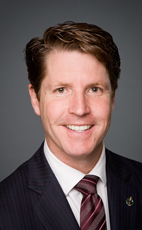
House of Commons photo

Crucial Fact

  • His favourite word was things.

Last in Parliament October 2015, as Conservative MP for Etobicoke—Lakeshore (Ontario)

Lost his last election, in 2025, with 39% of the vote.

Statements in the House

Situation in Ukraine December 10th, 2013

Mr. Chair, I thank my colleague for her question.

The Minister of Foreign Affairs went to Europe recently. He spoke with his European counterparts to encourage them to continue having discussions with Ukraine. It is important that we give our support not only to Ukraine, but also to our European partners. This economic and social integration is very important for Europe's future.

As everyone knows, the Minister of Foreign Affairs went to Ukraine this week. He expressed his support for the Ukrainian people. His unwavering support over the years shows that we want Europe and Ukraine to work together to build a better future for the Ukrainian people.

Situation in Ukraine December 10th, 2013

Mr. Chair, I appreciate the opportunity to participate in this debate. Like so many of my colleagues, I have been following the situation in Ukraine closely. I meet frequently with members of the Ukrainian Canadian community in Etobicoke—Lakeshore and I know how serious the current situation is.

The concerns are larger than a free trade agreement. We are concerned about the use of selective sentencing in the case of Yulia Tymoshenko and others. We are also concerned about the weakness of democratic institutions, the resulting damage to the Ukrainian economy and, of course, the lack of opportunity and hope for Ukrainians, especially youth.

Our government is deeply disappointed with the Ukrainian government's decision to suspend its association agreement and the deep and comprehensive free trade area negotiations with the European Union. We believe this decision is a lost opportunity and we stand with all Ukrainians who are fighting for a democratic, free, independent and prosperous Ukraine.

Ukraine's best hope for democracy and economic prosperity lies in closer alignment with Euro-Atlantic norms and institutions. Unlike Poland, Slovakia and other eastern European states that have made great progress since the fall of Communism, Ukraine's economic transition has been much slower and more difficult. Today, people of Ukrainian heritage make up almost 4% of the total Canadian population. Over the generations, we have developed a close bilateral relationship, a solid economic partnership and strong people to people ties.

I would like to take a few moments today to talk about Canada's work to help Ukraine achieve economic prosperity.

Canada is focusing on three broad areas of intervention to aid in Ukraine's economic growth through our development assistance plan that is focused on building democracy through strong economic foundations.

The first is to strengthen the investment climate in a sustainable way by building economic foundations. This means improving the capacity at all levels of government to deliver on the basic needs of citizens and to create a supportive framework for business growth, trade and investment.

The second focus area is building businesses, especially those that are micro, small and medium-sized firms, to make them sustainable and competitive.

I want to mention, Mr. Chair, that I will be splitting my time with the member for Mississauga East—Cooksville.

As I was saying, this means helping entrepreneurs access business networks and financing, value chains and productivity-enhancing technology.

The third focus area is investing in people, particularly women and youth, to build a skilled workforce that can thrive in a rapidly expanding labour market. Investments of development assistance in these three areas will lead to increased employment opportunities and enhanced business productivity in Ukraine, resulting in rising household incomes and reduced poverty over the long term. Canada's development program has contributed significantly to advancing Ukraine's sustainable economic growth.

One of the key sectors in Ukraine is agriculture. What is required for agriculture is agricultural insurance so farmers can invest with confidence and allow banks to loan to farmers with confidence. With support from Canada, Ukraine has implemented a new agricultural insurance system based on international best practices.

Canadian support has also helped increase the competitiveness of smallholder horticulture and dairy farmers who have invested in improved technology and are working together to market higher-value, higher-quality products demanded by the marketplace. With help from Canada, participating smallholder horticulture farmers in southern Ukraine have sold over 12,000 tonnes of produce for over $12 million and they have increased their household incomes over 30% since the start of the project.

The Federation of Canadian Municipalities has worked with municipal partners in Ukraine to develop and implement regional economic development plans that have helped attract projects that total more than $5.4 million of outside investment.

We are working to improve the planning and delivery of services and we are assisting with the development of a national demand-driven vocational skills training system across the country. Each of these initiatives will help to increase broad-based economic growth in Ukraine critical to creating a healthy and politically engaged middle class.

We are doing all of these things and so much more because we believe in Ukraine and its people and we will continue with this important work. We remain hopeful that preparations for the Ukraine-EU agreement will resume in the near future and Canada has been lending its voice to encourage Ukraine to continue those discussions.

As we know from experience, one trade arrangement with one bloc does not preclude concluding other trade arrangements with others. The fact that we have recently concluded an agreement in principle with the European Union does not prevent us from having a very profitable arrangement with North America, for example.

We assume that the Ukrainian people will continue their struggle and we will be there to support them. Hopefully, they will move forward to a more prosperous future.

Situation in Ukraine December 10th, 2013

Mr. Chair, some observers have indicated that the European Union could have done more. Ukraine was in a difficult financial situation and had to come up with $10 billion to avoid defaulting, so the European Union did offer certain things. For example, it offered to sell Russian gas to Ukraine at prices lower than Ukraine actually pays for the gas it currently gets from Russia, and Ukraine walked away from this arrangement. It did not want to jeopardize its relationship with Russia.

There is something going on here that is above and beyond just money. Could my colleague comment on the mindset of the Ukrainian administration, President Yanukovych in particular? What does he think is going on here, and what can Canada do to try to change some of that behaviour?

Situation in Ukraine December 10th, 2013

Mr. Chair, one of the questions when it comes to concrete actions that we could take is how we can do things that do not hurt the people of Ukraine. There are various forms of sanctions. For example, in the days of apartheid, one particular sanction that the international community took was a sports sanction. In a sports-crazed country like South Africa, it really compelled people to demand change from their government. That is one of the things we could certainly investigate with our international partners.

The other big question is the extent to which we stay engaged with Ukraine. Canada has a lot of investments in Ukraine's development. Ukraine is a country of focus when it comes to international capability building.

I am wondering if my colleague could talk about the importance of staying engaged with Ukraine, despite our disagreement with the current administration.

Economic Action Plan 2013 Act No. 2 December 3rd, 2013

Mr. Speaker, the government House leader alluded just a minute ago to some of the challenges within the House. He also mentioned some of the macroeconomic challenges. This budget was introduced in March of 2013. We had the first budget implementation act in June of 2013. Here we are in December of 2013. It would be an interesting, novel concept to get the 2013 budget passed in 2013. Therefore, could the government House leader maybe describe some of the unique economic challenges that we have in 2013 and why it is so important that we get the budget passed now?

Ukraine December 2nd, 2013

Mr. Speaker, this weekend we saw hundreds of thousands of Ukrainians protest against their government's decision to suspend economic co-operation negotiations with the European Union. These people were peacefully exercising their democratic rights in Kiev's Independence Square, but Ukrainian authorities used heavy-handed methods to disperse them.

We condemn in the strongest terms the violence by the authorities against these peaceful protestors. Freedom of speech and freedom of assembly are fundamental tenets of any truly democratic country.

This weekend I met and shared my concerns with Ukrainian Canadians in Etobicoke—Lakeshore, who were exercising their freedoms, demonstrating outside the Ukrainian consulate in solidarity with those in Ukraine.

We call upon the government of Ukraine to not only respect but protect the rights of its citizens to express their opinions freely. Our government stands with the people of Ukraine to build a society based on freedom, democracy, human rights and the rule of law.

Respect for Communities Act November 28th, 2013

Mr. Speaker, I appreciate that the member for Louis-Hébert mentioned, “If it ain't broke, don't fix it.”

Hopefully, the member who just gave a speech recognizes that the Supreme Court indicated that if we were to open any injection sites, community consultations were actually a requirement. Therefore, that is something that needs to be done. The Supreme Court has given us clear direction that we have to have community consultations.

Would the member please clarify whether he is against community consultations for future safe injection sites before they are implemented?

David Ernest Hornell October 30th, 2013

Mr. Speaker, I rise in the House to recognize the valour of David Ernest Hornell, a native son from Mimico in my constituency of Etobicoke—Lakeshore.

Flight Lieutenant Hornell was a brave leader who successfully completed 60 missions with the RCAF around Iceland, Scotland, and Canada's east coast during World War II. In 1944 he was aircraft captain on a patrol near the Faroe Islands when his plane was attacked and badly damaged by a German U-boat. Nevertheless, he succeeded in delivering his depth charges on target, sinking the submarine, and then brought his plane down, ablaze, on the heavy seas.

There was only one serviceable dinghy, which could not hold all eight members of his crew, so they took turns in the water. At one point, Hornell had to be restrained by his comrades when, though at the end of his own strength, he proposed to swim to a distant lifeboat that had been dropped from the air. When the survivors were rescued after 21 hours, Hornell was weak from exposure. He died shortly thereafter. He was awarded posthumously the Victoria Cross, the highest award for gallantry in the face of the enemy that can be awarded to Commonwealth forces.

This Remembrance Day, let us remember all those who, like David Hornell, died in the name of freedom.

Elections Canada October 28th, 2013

Mr. Speaker, the current law gives the Commissioner of Canada Elections the power to investigate in order to verify whether loans were used to circumvent donation limits.

An investigation is necessary in order to determine whether the Liberals are using loans to intentionally exceed the legal donation limits.

The failed Liberal leadership candidates seem to believe that the election financing laws do not apply to them.

In fact, the lawyer for defeated candidate and former MP Ken Dryden recently indicated that Dryden would not even attempt to pay back the money he owes in relation to the Liberal leadership race.

Elections Canada is aware of the situation and openly admits to knowing that this loan will likely never be repaid, basically transforming the loan into a donation.

Since Elections Canada admits to being aware of what is going on, what is stopping it from launching an investigation and getting to the bottom of this situation?

Economic Action Plan 2013 Act No. 2 October 25th, 2013

Mr. Speaker, I thank the member for Hamilton Mountain for her speech, in which it was perfectly clear to anyone listening that the NDP is on the side of the public sector unions when it comes to negotiations. I did not hear anything that said the New Democrats would stick up for the taxpayers who are paying the salaries of all of the people who are in the public sector unions.

Clearly there is a negotiation that will have to occur. The member has the audacity to say that the NDP is a government-in-waiting; well, it would be interesting to see if the NDP government-in-waiting would give away the store to the public sector unions. Can the member clarify whose side she would be on when sitting down with public sector unions and negotiating?