
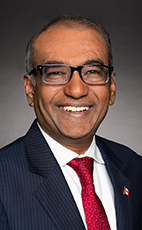
House of Commons photo

Crucial Fact

  • His favourite word was mentioned.

Last in Parliament April 2025, as Liberal MP for Nepean (Ontario)

Won his last election, in 2021, with 45% of the vote.

Statements in the House

Fall Economic Statement Implementation Act, 2022 November 17th, 2022

Madam Speaker, it is my pleasure to speak to Bill C-32, the fall economic statement implementation act for 2022.

The year 2022 has been very eventful. We came out of two and a half years of a pandemic. Canada faced the pandemic in a good state compared to many other countries. We listened to the opinions and recommendations of health care professionals and experts, and we came out of it better than many other countries.

The Canadian economy also came roaring back after the pandemic. We have recovered all the jobs that were lost during the pandemic. If members recall, we had lost around 8.9 million jobs. We have not just recovered all the jobs that we lost, but we have even added more. We are at about 117% of the jobs we had prepandemic.

The unemployment rate was at historic highs during the pandemic and now it is at a historic low. In fact, we have maintained that historic low unemployment rate for the last several months.

Our economic growth has been the strongest. Canadian economic growth is enviable amongst the G7 countries. We are doing better than many of our G7 partners, including the U.S., U.K., France, Japan and Italy.

We have the lowest deficit amongst the G7 countries. In fact, if members recall this year's budget, we had forecasted around a $56 billion deficit, and it is now predicted to be about 30% lower than what was projected a few months back. The budget deficit has also gone down about 3% from what was estimated. I think it is going down to about 1.3%. This is the best amongst all G7 countries.

Before the pandemic, we had the lowest debt-to-GDP ratio amongst all the G7 countries, and we continue to have the lowest debt-to-GDP ratio amongst all G7 countries. The fall economic statement also projects that we will reach a balanced budget in the foreseeable future. However, we are not making a big deal about that right now.

The problems created by the pandemic continue to exist today. The supply chain issues that we saw during the pandemic have continued during the postpandemic period too. The pandemic affected production worldwide. Now one of the biggest manufacturers of various goods in the world, China, is continuing with zero COVID policies, and that adds to the problems we are seeing in the supply chains. This has increased the price of numerous products across the board.

Also this year, Russia's illegal invasion of Ukraine has created its own major problems. There are huge security problems in Europe with repercussions beyond Europe. This has created problems in energy supply, raising the prices of fuel. It has created problems in the food grain supply. Ukraine, as we know, was one of the major supplies of wheat to the world.

All these factor in supply chain issues. Russia's illegal invasion of Ukraine, resulting in higher fuel costs and the spike in food grain prices, has resulted in inflation. Canadians are feeling the pinch when they go to the grocery stores for their essential purchases or when they go to the gas station to fill up their tanks with gas.

October inflation is at 6.9%. A few months back it was higher. From that high it has come down. It was 6.9% in September. It has stayed at 6.9% in October, which is a good trend. The interesting thing is that this number is much lower than what the private sector economists were forecasting. I think they were forecasting between 7.1% and 7.4% inflation, but it has stayed at 6.9%, which is a good thing.

Again, the inflation we are seeing in Canada today is lower than that in the U.S., the U.K. or the eurozone. The inflation pain that Canada is experiencing today is not limited to Canadians. This is something that is being faced by people all across the world, in developed countries, developing countries and everybody else.

To combat this inflation, the Bank of Canada started raising its rates some time ago. I think it has raised the rates dramatically. There is no pattern to the rising interest rates in the history of the Bank of Canada, if I am not mistaken, but it has to stay to its mandate of bringing down inflation to the targeted rate of around 2%. With the increase in interest rates and higher inflation, it does not require brains to forecast that the economy is going to slow down in 2023. It is expected.

To help Canadians today, the vulnerable Canadians who are facing the problem of inflation and the forecasted economic slowdown next year, we have already taken numerous measures. While we are taking numerous measures, which have been explained in the last few months in the budget and also in this fall economic statement, we are continuing to restrain the deficit, because we do not want to add fuel to the fire of inflation.

Canada is better placed today than any other country in the developed world to face this oncoming economic slowdown. However, because of the pain faced by Canadians today, it is natural for Canadians to worry about the current status and the future. Canada's prosperity and standard of living have been quite high compared to any other country in the world. That is because of the natural resources we have, such as oil, gas, minerals, metals and forestry products, and the hard work of several generations of Canadians.

We have good prosperity and a good standard of living, but the current status and possible slowdown has Canadians worried about the future prospects for our children and grandchildren. They are naturally worried about whether we can pass on the prosperity that we enjoyed in the past to our future generation. However, in spite of the inflation that we are facing today, in spite of the pain we are seeing today, we should not forget the big picture. There are huge economic opportunities ahead of us in Canada, and I will come to that in a minute.

The globalization and global trade that we knew before the pandemic is almost on its way out among the developed countries, even with our biggest trading partner, the United States. Its Secretary of the Treasury has stated that what they call “friend-shoring” is going to be a big issue going forward. The U.S. brought in the Inflation Reduction Act, which brought in the U.S. CHIPS and Science Act, and basically that is creating a new industrial policy.

We have to see what opportunities are available for us. One of the biggest opportunities I foresee for us in Canada is the critical minerals that are required to power the next generation of vehicles and energy storage batteries. We have the critical minerals, and we have already stated in the previous budget the support for the critical mineral sector.

Recently, the federal government signed an agreement with Ontario for the Ontario regional energy and resource tables to develop the natural resources sector, specifically the clean electricity grid, critical minerals, nuclear technology, clean hydrogen and sustainable forestry. The federal government is taking a team Canada approach in working with the provinces so that we can work together to align the resources, timelines and regulatory approaches to develop the critical minerals, forestry sector, nuclear energy and clean electricity. There are a lot of opportunities ahead.

We have also set up the Canada growth fund through which we want to bring in billions of dollars in private sector investment to achieve our economic objectives.

Coptic Orthodox Church November 15th, 2022

Mr. Speaker, recently Coptic Orthodox Church leaders visited Parliament. The delegation was led by His Grace Bishop Boulos and included Father Marcos Messih, Father Raphael Bichara, Madame Mireille Mishriky and Adel Boulos.

I had the pleasure of working with the community, and particularly with Father Shenouda Boutros of St. Mary Coptic Orthodox Church in Nepean. We cannot ignore the growing religious intolerance and sectarian violence against Coptic Christians in Egypt in recent years directly affecting the families of Canadian Coptic Christians.

I would like to use this opportunity to recognize the contributions that Canadian Coptic Christians have made to the socio-economic development of our country, adding to our rich, multi-faith and multicultural fabric.

Canadian Space Innovation November 1st, 2022

Madam Speaker, Space Canada represents Canada’s space innovators and allied industries to convey the value of space technology, research, investment and results to domestic and international audiences, and to position Canada at the forefront of the highly strategic new global space economy.

From vibrant start-ups to large global companies, Space Canada members are designing, building and implementing innovative new solutions on and around our planet, from launch to space-based communications, space exploration, environmental monitoring and Earth observation, among many other applications.

Space Canada employs thousands of highly qualified people across Canada and contributes $2.5 billion to Canada’s GDP.

I support Space Canada, which is calling on the federal government to create a national space council, chaired by the Prime Minister, to guide space policies and investments.

Prime Minister of the United Kingdom October 25th, 2022

Mr. Speaker, on behalf of all Canadians, in particular Indo-Canadians, I wish to congratulate Rishi Sunak on becoming the first person of colour and the first Hindu to become the prime minister of the United Kingdom.

His achievement is a proud moment for over 1.2 billion people of Indian heritage all across the world, including in Canada. It is a Diwali gift to about 700,000 Hindu Canadians. For me, another matter of interest is that his wife, Akshata Murty, comes from Bangalore, the same place I come from, and speaks the same language, Kannada.

I hope Rishi Sunak will be an inspiration for the next generation of Hindu Canadians and will motivate them to step forward for a more active role in public service.

Hazaras in Afghanistan October 21st, 2022

Madam Speaker, on September 30, a suicide attack in Afghanistan killed 54 people, mostly girls and young women, and injured another 120. These were students belonging to the Hazara community who were sitting for a practice university exam.

The Hazara community in Afghanistan is subjected to multiple forms of discrimination, negatively affecting its economic, social, cultural and human rights. A report by British parliamentarians stated that as a religious and ethnic minority, the Hazara community in Afghanistan is “at serious risk of genocide”.

Since the Taliban came back to power, Hazara community members have been killed through targeted bombings of Hazara schools and places of worship. I call on Canada to condemn these killings and ask the authorities in Afghanistan to protect the Hazara community.

Community Development Project October 7th, 2022

Madam Speaker, I am pleased that our federal government is investing $15.2 million to construct a new library and performing arts and cultural centre in downtown Barrhaven in my Nepean riding. The facility will also include a community centre for seniors and an outdoor urban plaza. This will provide Nepean residents with flexible spaces to foster social interactions and community engagement for years to come. This project includes a 15,000-square-foot cultural centre, a 3,000-square-foot seniors’ space and a 25,000-square-foot library.

I would like to acknowledge and thank the many organizations and individuals who advocated for this, including the Barrhaven BIA, the Barrhaven Seniors' Council and its president, Don Winchester. I give a special thanks to Ottawa city councillor Jan Harder, who was instrumental in proposing this project.

Smart Mobility September 27th, 2022

Mr. Speaker, last week in my Nepean riding, Invest Ottawa’s Area X.O, in collaboration with our federal government, hosted an epic Canadian smart mobility demonstration day. It was the first of its kind in Canada and brought together hundreds of innovators, entrepreneurs, technology developers, smart mobility partners and stakeholders from Canada’s capital and across the country. They experienced more than 30 interactive smart mobility demonstrations hosted by Canadian entrepreneurs and companies, from connected and autonomous vehicles to drones, low-speed automated shuttles, the Internet of things and smart city solutions.

I was on the board of Invest Ottawa before entering politics. Invest Ottawa is doing a great job in promoting the knowledge sector in Ottawa and keeping Canada at the forefront of advanced technologies.

Hindu Heritage Month September 22nd, 2022

Mr. Speaker, namaste.

I would like to begin by thanking my colleagues from all political parties for strongly backing the motion to designate November as Hindu heritage month. I am humbled by the support of dozens of organizations across Canada and from thousands of Canadians.

Hindu Canadians are a peaceful, hard-working community. They have made and continue to make significant contributions to Canada’s socio-economic development and cultural heritage. On Hindu heritage, Hindus have an ancient, magnificent and robust inheritance, which they have received from numerous sources: our wisdom traditions, our religious rites and rituals, our literature, the many arts and crafts, our elders, our fairs and festivals and, above all, from the many samskaras or sacraments in our home. That heritage not only gives us a drishti or world view; it also defines our purusharthas or aims of life and equally defines our sanskriti or culture. In short, the Hindu heritage defines our dharma.

What is striking about such an ancient civilization is not only the unbroken tradition of 5,000 years of recorded history but also the plurality or diversity of our tradition. Even in the absence of a monolithic religious dispensation, we Hindus, whether in Canada or anywhere in the world, are connected by an invisible thread that binds us together: the strength of our Hindu heritage.

Our wisdom traditions, which start from the Vedas and then flow into the Upanishads or forest discourses, followed by our puranas or our songs and stories, are philosophically rich and form the foundation of our temple traditions. It is the same vast heritage that informs our costume and cuisine, our habits and behaviour, our arts and crafts. The Hindu heritage does not restrict itself to religious matters: We have a strong aesthetic foundation, which leads to the celebration of saundarya, or what is beautiful.

We celebrate the beautiful in our lived lives through stories and paintings, song and dance, colour and cuisine, festivals and family events. Though ancient, our heritage is alive and growing. It is open to influences from other civilizations and freely adapts and gives to whomever we come in contact with.

Thus it is that for us Hindus, Canada is a comforting and embracing home away from home. For many people in the world, the term “cultural heritage” is still primarily tangible or material cultural heritage. There is a need to recognize, preserve, celebrate and promote the Hindu heritage as defined by UNESCO’s intangible or living cultural heritage. This intangible or living cultural heritage includes oral traditions such as songs and dramatic performances; performing arts, such as vocal and instrumental music and dance; social practices, such as rituals and festivals; traditional knowledge, such as cuisine and medicine; and traditional craftsmanship, such as pottery, metalwork and jewellery.

Proclaiming Hindu heritage month provides an opportunity to remember and celebrate Hindu heritage and the contributions of Hindu-Canadians to our great nation, as well as to educate both current and future generations.

I would like to again thank my colleagues in this House, dozens of organizations across Canada and the thousands of Canadians who have reached out to me in support of this motion. This support is so Canadian, in that people with different political ideologies and people agnostic of any political ideology are all coming together in recognizing and promoting Hindu heritage in Canada.

Attacks on Hindu Temples September 20th, 2022

Mr. Speaker, recent attacks on Hindu temples in Toronto, including BAPS Shri Swaminarayan Mandir and Vishnu Mandir, must be condemned by all as hate crimes.

Hindu Canadians arrived here from South Asia, Africa, Caribbean but mostly from India. They are the most peaceful and hard-working community and keep a low profile focusing on their families and children’s education.

The increasingly vocal and well-organized anti-India and anti-Hindu groups in Canada has resulted in increasing anti-Hindu sentiments. Hindu Canadians are legitimately concerned about rising Hinduphobia in Canada.

I urge all levels of government to note this and take remedial actions now. Let us all work hard to ensure that people of all religious faiths continue to peacefully coexist in Canada.

National Day of Remembrance for Victims of Terrorism June 23rd, 2022

Mr. Speaker, 37 years ago day, Air India Flight 182, operating on the Montreal-London-Delhi-Mumbai route, was blown up mid-air from a bomb planted by Canadian extremists. It killed all 329 passengers and crew members, including 268 Canadian citizens. The bombing of this Air India flight is the largest mass killing in Canadian history. It was the deadliest act of aviation terrorism in the world until 9/11.

Canada is a pluralistic country, and we honour the fallen. In this National Day of Remembrance for Victims of Terrorism, my sympathies are with the families of the victims, who still experience pain.