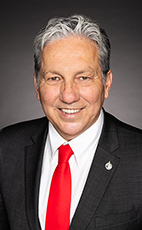
House of Commons photo

Crucial Fact

  • His favourite word was million.

Last in Parliament April 2025, as Liberal MP for Saint Boniface—Saint Vital (Manitoba)

Won his last election, in 2021, with 44% of the vote.

Statements in the House

Business of Supply June 3rd, 2021

Mr. Speaker, on the question of reconciliation, we have been clear that the overrepresentation of indigenous kids in care is a sad and dark part of our shared history that we must address.

Let me be very clear. Our government will provide comprehensive, fair and equitable compensation to all those impacted by the historic inequities in first nations and indigenous child welfare.

However, compensation alone—

Business of Supply June 3rd, 2021

Mr. Speaker, at the heart of everything our government has done since 2015 has been a commitment to reconciliation. It is explicitly written in the mandate letters of all of our ministers. We have been working with communities. We have been consulting with communities. We have been ensuring that communities lead the process. We must move at the speed of survivors and their families.

It is important to work with communities to ensure that they are able to access the funding that is there, and not all nations have the same objectives. Some want to memorialize sites collectively, while others want to identify every single individual.

Our government is already committed to reconciliation and to making sure that we identify the burial sites. It is something—

Business of Supply June 3rd, 2021

Mr. Speaker, I am speaking from my office in Saint Boniface—Saint Vital, the homeland of the Métis nation, Treaty 1 territory, a city that is now home to many Inuit.

I will share my time with the Parliamentary Secretary to the Minister of Indigenous Services, the member for Oakville North—Burlington.

Two days ago, in the House, we all came together as parliamentarians to express our devastation, heartbreak and outrage at the discovery of the remains of 215 children who were killed while attending the Kamloops Indian Residential School.

Canadians are rightfully outraged by the finding of this burial site, but this was not shocking to indigenous people. We have long known of the lost burial sites of loved ones. It is a reminder of the consequences of colonialism for indigenous people and our communities.

Yesterday, I, along with my colleagues, the Minister of Crown-Indigenous Relations and the Minister of Indigenous Services, announced that $27 million funding would be distributed on an urgent basis. Our department has been engaging directly with indigenous communities across Canada on how best to support them in finding our lost children, including on how to access support from the federal government to do this. We continue to listen to survivors and families. We know these communities want this to be indigenous-led, based on their priorities, based on healing. Reconciliation is all about that.

This discovery has reopened the conversation on reconciliation in Canada, but let me be very clear. From day one, our government has continued to work to promote reconciliation in a tangible and respectful way. Correcting the mistakes of the past takes time and can be extremely difficult, but it is the right thing to do. Our government will keep working on this.

Reconciliation is a complex and important process where every Canadian has a role to play. Reconciliation begins with respect, listening and working in partnership. We must respect cultures, our languages, traditions and the distinct identities of others in order to move forward.

Reconciliation is at the heart of today's debate. In 2015, the Prime Minister committed to fully implementing the calls to action of the Truth and Reconciliation Commission of Canada in partnership with the indigenous communities, the provinces and the territories. We remain determined to ensure that they are properly implemented.

Eighty per cent of the calls to action under federal or shared responsibility are either completed or well under way, and not all the calls to action will be easy to implement. We must not treat these calls to action as simply a checklist, but rather a true pathway to reconciliation. We must also recognize some of the calls to actions are outside of the jurisdiction of the federal government. That is why it is so important that we work in partnership with all orders of government, while always taking the lead of indigenous communities and nations in this work. It is absolutely vital to take a survivor-oriented approach to healing. We need to listen to survivors and their families when making decisions about reconciliation.

The abuse and forced assimilation have led to intergenerational trauma, which is the lasting legacy of the residential school system. By removing children from their traditional family structures and subjecting them to violence, abuse and forced assimilation into Euro-Canadian values, a cycle of abuse was created, which still affects indigenous families and communities today. It continues to affect my community, it continues to affect my friends. The abuse the children faced in residential schools is as undeniable; it is shockingly cruel. These young first nation, Inuit and Métis children deserve far more from our government; they deserved far more from Canada.

As a government, we are working to revitalize indigenous culture by empowering communities, by providing the necessary tools to indigenous people to learn about their own culture, language and traditional spiritual beliefs. Canada will provide the needed resources to support indigenous nations on their healing journey. In the coming months, our government will be working with survivors, their families, their communities and other partners to locate, identify and memorialize the missing children and their burial places.

As previously mentioned, we have provided $33.8 million to implement the TRC calls to action 72 to 76. We have funded the National Centre for Truth and Reconciliation to develop and maintain the national residential school student death registry and to establish and maintain an online registry of residential school cemeteries. We are engaging with first nation indigenous communities and will continue to do this work, but it must be led by the communities themselves and they must go at their pace. We as a government will be there to support these communities in their efforts through funding, but also through survivor and family mental health support.

The mistreatment of indigenous children in all residential schools, including those who attended St. Anne’s Indian Residential School, was tragic and horrific. In order to restore confidence, rebuild trust and maintain the integrity of the process, the court has, at the request of the government, ordered that an independent, third-party review be conducted. Ninety-six percent of all claimants from the St. Anne's residential school have received compensation and are working collaboratively with the parties to obtain clarity from the courts on this matter. This third-party review will determine the additional compensation owed to survivors.

Throughout the process, Canada will provide additional resources for the survivors. We are in talks to determine the best way to provide support and we will be in contact with the St. Anne survivors' organization, including Peetabeck Keway Keykaywin, to talk about the necessary support.

We are definitely committed to reconciliation, justice and healing for the former students of St. Anne and every residential school.

I will just finish by acknowledging that this last week has been extremely difficult for many people: for Canadians, myself included. I have appreciated hearing from other members of the House over the last number of days the need to work together, to work collaboratively and to move forward on the shared path of reconciliation.

It is important that we continue to hear the stories of survivors and families, and remember those who were torn away and never returned home.

Residential Schools June 1st, 2021

Madam Chair, that is a very important question from my friend from Winnipeg. From the very beginning of Canada's birth, Canada has had a racist policy toward indigenous people or Indians, as they were called in 1867.

The first policy objective was to civilize the savage, because indigenous people were deemed to be uncivilized; so to civilize was the first policy objective.

The second policy objective was to Christianize indigenous people because they did not have their own spirituality; it was totally devalued.

The third policy objective was to assimilate, to rid the Indian in the citizen. Complete assimilation was the policy.

What we have today is a direct result of those racist policies, which were adopted in 1867.

Residential Schools June 1st, 2021

Madam Chair, I thank my colleague for her question.

I can assure the House that reconciliation is our government's number one goal. Since we were elected in 2015, we have invested more than $30 billion in education, infrastructure and health care, in partnership with indigenous, Métis, Inuit and first nations communities.

This has been a priority for our government from the beginning, not just since last week. We are working in partnership with indigenous nations, and collaboration is important. It is all the more important today, after last week's discovery.

Residential Schools June 1st, 2021

Madam Chair, since we were elected in 2015, our government has invested over $30 billion of new money in infrastructure, in education, in health and in boil water advisories. I do not have a lot of that detail, but I believe it is already started. If it is not already started, it is something that we need to complete and I hope the member from British Columbia can offer her support to that initiative as well.

Residential Schools June 1st, 2021

Madam Chair, I will be sharing my time with the Minister of Indigenous Services. I also want to acknowledge that I am speaking to the House from my office in Saint Boniface—Saint Vital, in the city of Winnipeg, homeland of the Métis nation, Treaty 1 territory, a city that is now home to many Inuit.

The discovery of the remains of 215 children, 215 young lives tragically lost is a reminder of the consequences of colonialism for indigenous people and their communities. We must never forget the victims. We must never forget the children who were sent to these schools, those who came home and those who never did.

Still today, too many Canadians lack awareness about the tragedy of the residential school system and the systemic way indigenous children were taken from their families in the attempt to “kill the Indian in the child.” Children were forcibly taken from their homes with the aim of destroying indigenous people's spirituality and individual cultures.

Residential schooling followed a unique trajectory in the north. By the 1950s, there were six residential schools and one hostel north of the 60 parallel. In the 1950s, Inuit children began attending these institutions in large numbers. The tremendous distances that children had to travel to school meant that very often these children were separated from their parents not for weeks, not for months but literally for years.

The establishment of these schools and what were termed “small hostels” in over a dozen communities in the eastern Arctic contributed to a dramatic transformation of the Inuit economy and way of life. Many Inuit parents decided to settle in the communities where their children attended school on a year-round basis, so they could remain close to their kids.

Generations of Canadians have not known the truth of residential school systems. It is important that the House and Canadians not only call this historic, in the past; it is an ongoing situation and many people suffer intergenerational trauma. Families were destroyed. Children never came home. To call this historic actually diminishes the pain and the suffering faced by indigenous people today throughout Canada.

During the Truth and Reconciliation Commission testimony, thousands of survivors came out of the shadows to share their heartbreaking residential school experiences. Cast aside and shunned from the public view for far too long, these stories came into the light. We must honour the survivors who are able to tell their stories. We must certainly honour those who will never get that chance.

I continue to think of survivors, my friends, my community, the families of those who have never returned, as they learned of this heartbreaking news. Canada will provide, must provide the needed resources to support them on their healing journey. In the coming months, our government will be working with survivors, with their families, communities and other partners to locate, identify and memorialize the missing children in their burial places.

For a long time, Canada's Arctic and northern residents, especially indigenous peoples, have not had the same services, the same opportunities, the same standards of living as those enjoyed by other Canadians. There are long-standing inequalities in transportation, communication, employment, housing and education.

Reconciliation must be a collective journey. Together, we must create a new path forward with dignity in a true spirit of reconciliation.

Canada Elections Act May 7th, 2021

Mr. Speaker, an agreement could not be reached under the provisions of Standing Orders 78(1) or 78(2) with respect to the second reading stage of Bill C-19, An Act to amend the Canada Elections Act, COVID-19 response.

Under the provisions of Standing Order 78(3), I give notice that a minister of the Crown will propose at the next sitting a motion to allot a specific number of days or hours for the consideration and disposal of proceedings at the said stage.

Budget Implementation Act, 2021, No. 1 May 7th, 2021

Mr. Speaker, I thank my colleague for this important question. Her intervention included a number of questions.

Our government has invested over $30 billion since 2015 through partnerships with indigenous nations in the areas of education, public health, justice, and child and family services. I believe that we have made excellent investments, but we still have a lot of work to do.

The highlights of this budget are children's services and education, in which we will invest $31 billion over five years. In addition, we will invest $20 billion over five years in the environment. In these times of environmental crisis, such investments are essential. In partnership with indigenous nations, we will also invest $18 billion to address their needs.

Budget Implementation Act, 2021, No. 1 May 7th, 2021

Mr. Speaker, I agree that we all have much more work to do to meet the needs of indigenous women and girls. However, our government has invested over $30 billion since 2015 in new funding over and above the base funding of the departments for health care, education, justice and infrastructure. In northern Manitoba alone, we have invested over $1.5 billion for all of those preventative issues. We have introduced co-developed bills on child and family services and language.

We have made progress. However, there is so much more work to do. We need to keep working in collaboration.