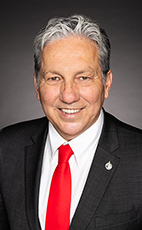
House of Commons photo

Crucial Fact

  • His favourite word was million.

Last in Parliament April 2025, as Liberal MP for Saint Boniface—Saint Vital (Manitoba)

Won his last election, in 2021, with 44% of the vote.

Statements in the House

Indigenous Affairs June 21st, 2017

Mr. Speaker, the Prime Minister has been very clear that no relationship is more important to him and to this government than the relationship with first nations, with the Métis Nation, and with the Inuit people.

Today, on what will now be known as National Indigenous Peoples Day, could the Prime Minister give the House an update on the government's plan for the former U.S. embassy across from Parliament Hill, as well as Langevin Block?

St. Boniface Hospital Research June 20th, 2017

Mr. Speaker, in mid-April, researchers at the St. Boniface Hospital Research centre announced an important scientific breakthrough that could help in the fight against antibiotic-resistant bacteria. PEG-2S, which could help in the fight against antibiotic-resistant bacteria, was developed by Dr. Grant Pierce and Dr. Pavel Dibrov to combat two of the top 10 antibiotic-resistant priority pathogens. This antibiotic is novel in that it does not affect healthy cells. It only targets bacterial cells that act as a form of energy supply that help the harmful bacteria proliferate.

Although we have to wait until this new drug passes through the necessary steps in order to reach pharmacy shelves, this announcement is important for the international medical community and represents the first potential discovery of a new antibiotic in the past 30 years.

This is a reminder of the impressive work being done every day by researchers at the St. Boniface Hospital Research Centre.

Indian Act June 13th, 2017

Mr. Speaker, I commend the hon. member from Winnipeg for his tremendous speech. Once again, he has talked about issues that are so relevant to so many people, not only in our city that we share but across Canada. There is simply so much history we cannot be proud of, beginning with Canada's relationship with indigenous people, the royal proclamation.

Our first policy toward first nations people was to Christianize. Part of the Government of Canada's policy was to make indigenous peoples Christian. From there, civilization became the policy objective, to drive the native out of the native person by any means possible. Assimilation, of course, was to make all indigenous people not indigenous, to make them Canadian. From there spawned the Indian Act, which still governs the way we deal with first nations people today, including what we are discussing today and into the future, Bill S-3.

Does the hon. member foresee a time in our lifetime, in our children's lifetime, when we will no longer have an Indian Act in our country?

Indian Act June 13th, 2017

Mr. Speaker, I am wondering if the hon. member could comment about the diversity of opinion on this issue. There are organizations such as the Native Women's Association of Canada that feels we cannot move fast enough on this. Other organizations such as the Indigenous Bar Association support the principle of the bill. All of us on this side of the House support the principle of the bill. These organizations have some real concerns about the drafting of the bill, the actual words in the bill, as does Senator Sinclair, who had concerns with its drafting but ultimately supported the spirit of the bill.

I am wondering if the hon. member could comment on those concerns.

Indian Act June 13th, 2017

Mr. Speaker, this is something that emanates from an August 3, 2015, decision of the Superior Court of Quebec, which at the time ruled that the Indian Act unjustifiably violated equality rights. The Superior Court of Quebec at that time gave Parliament 18 months to try to make the necessary legislative changes to right a wrong.

The hon. member appears to understand that this is in fact unjust to many indigenous women, yet her government, the former Stephen Harper government, chose not to right a wrong but to appeal the decision in September 2015. It is in fact due to the leadership of the minister and the Prime Minister that we withdrew the federal government appeal.

If the hon. member understands that this is a wrong, why did they choose to appeal the decision of the Superior Court of Quebec?

Indian Act June 13th, 2017

Mr. Speaker, first, I congratulate the minister for her leadership on many files in indigenous affairs, but specifically, for withdrawing the appeal by the previous federal government against the Quebec Court of Appeal so that we can find solutions to this.

There are impassioned arguments for a much broader reform for registration and membership under the Indian Act. Many argue that Bill S-3 would not go far enough. I know this is only the first stage of our response, the government's response, to the Descheneaux decision. Would the minister explain what is anticipated in stage II of the plan?

Budget Implementation Act, 2017, No. 1 June 9th, 2017

Mr. Speaker, irrespective of the member's perspective, this is an excellent budget for the province of Manitoba, which we both represent. Total transfers are at $3.7 billion, an increase of $150 million over 2016, which is the largest total transfer since 2006.

Because budget 2017 is a continuation of 2016, as we speak, there is $58 million currently being spent in Manitoba on 24 water projects for 24 first nations, including $20 million for freedom road. That is an increase of $10 million over our initial commitment. My question for the hon. member is a yes or no. Do you think that this $58 million for freedom road is a good thing for the province of Manitoba?

Budget Implementation Act, 2017, No. 1 June 9th, 2017

Mr. Speaker, I thank the hon. member for her hard work on the budget.

There is so much goods in this budget for Manitoba compared to previous budgets. The new budget shows an overall increase of $148 million from 2016. As we speak, $58 million are being spent on new water treatment plants for first nations and indigenous communities, including $20 million for Freedom Road, for which which we are grateful.

Could the hon. parliamentary secretary comment on the important relationship between our government and indigenous peoples in Manitoba and in Canada as a whole?

Manitoba Day May 11th, 2017

Mr. Speaker, tomorrow, May 12, is Manitoba Day.

Tomorrow, the province will celebrate its 147th anniversary as well as the 51st anniversary of Manitoba's flag.

From the Ojibway “Manito-bau” and the Cree “Manitowapow”, our keystone province is a remarkable place to live.

I invite all Canadians to celebrate our history at Fort Gibraltar, to take their family to Manitoba's Children's Museum, and to pay tribute to Louis Riel, the father of Manitoba, at Le Musée de Saint-Boniface.

They can take in the migratory bird season at Fort Whyte Alive or check out the world's largest mating dens for red-sided garter snakes in Narcisse.

I also invite them to visit St. Vital Park, Assiniboine Park or Riding Mountain National Park, and to spend the day at Lake Winnipeg or Lake Manitoba.

They can go out to Little Limestone Lake, the world's largest marl lake, a lake that changes colour with the temperature. The choices abound.

I wish friendly Manitoba a happy birthday.

Budget Implementation Act, 2017, No. 1 May 9th, 2017

Madam Speaker, I agree with the hon. member. There is nothing more important than our relationship with indigenous peoples. Mental health is clearly a priority in the budget. We have tabled extra dollars, new dollars, not repurposed dollars, for mental health with the provinces that sign on. No government in recent memory has invested in indigenous communities the way this government has over the last two years. That is simply a fact. There were $9 billion in new money last year, over $5 billion in new money this year, and that is over and above what is in the line items in the departments. It is not a sleight of hand that governments often do, calling it new money but taking it from somewhere else. These are new dollars.

In my province, there are $58 million being spent, as I speak, on water treatment systems and clean water for indigenous communities, and that is not enough. We know there is more work to do. We have to do a better job, and we are committed to doing it.