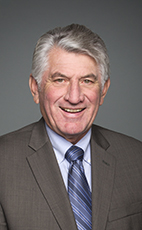
House of Commons photo

Crucial Fact

  • His favourite word was rcmp.

Last in Parliament January 2023, as Conservative MP for Oxford (Ontario)

Won his last election, in 2021, with 47% of the vote.

Statements in the House

April 27th, 2009

Mr. Speaker, I am pleased to speak today to the question raised in the House on March 4 by my hon. colleague from St. John's East regarding the report of the Office of the Correctional Investigator on the events leading to the death of Ashley Smith.

First, let me start by offering my sincere condolences to Ashley Smith's family and provide some reassurances that this incident has been taken very seriously.

A number of staff members and managers of Grand Valley Institution for Women have been disciplined and in some cases employment has been terminated. While I am not at liberty to discuss Ms. Smith's medical history, I would, however, offer the following information.

The Office of the Correctional Investigator's report contains 16 recommendations that focus on preventing future deaths in custody by identifying areas for improvement in the following: responses to medical emergencies, the delivery of mental health services and compliance with law and policy related to segregation, transfers, processing of offender grievances and use of force interventions.

Following Ms. Smith's death, the Correctional Service of Canada acted quickly to investigate and report on the circumstances surrounding the incident, identify weaknesses and to take corrective action where necessary. The service is committed to working with the Office of the Correctional Investigator to address issues and concerns in the area of deaths in custody.

An action plan has been developed to respond to recommendations of investigations into this incident and a number of measures have already been implemented. The following are specific actions that the service has taken to prevent deaths in custody.

First is a pilot project. A mobile interdisciplinary treatment and assessment and consultation team has been put in place to support women's institutions in the management of women offenders with severe mental health and/or behavioural difficulties. The pilot project will enhance the input and advice available to correctional staff when making decisions related to the management of women offenders with complex mental health issues.

The service has reviewed its capacity to address the needs of women offenders with complex mental health and behavioural needs. Short term and long term action plans have been developed on service, support and accommodation needs for women offenders identified in this group.

Mental health awareness training for staff has been developed and provided to many community and institutional staff across Canada. The service delivers suicide prevention training to all staff who have regular interaction with offenders in order to detect and respond to behaviours that may be indicative of suicidal or self-injurious intent.

The policy related to segregation has been amended to explicitly include a stronger role for the chief of health care and psychology. Although the service has had a mental health screening process for some time, in 2008 the service began piloting an enhanced mental health screening process to be administered when an officer is admitted. The service is committed to improving dynamic security to ensure that every inmate is engaged by staff members on a daily basis. The agency will strengthen the dynamic security training module for all new correctional services.

Finally, it is important to note that the service is working closely with the federal government's recently established Mental Health Commission of Canada, which has been mandated to develop a national health strategy and share knowledge and best practices for the benefit of Canadians.

Business of Supply April 27th, 2009

Mr. Speaker, I appreciate my colleague's keen interest in this whole area and for putting her time and effort into supporting this relationship between the two countries. The IBET is an integral part of the security of both Canada and the Untied States. It deals with cross-border crime and a variety of issues that are important to both of our countries. It also enhances the long term relationship we have with our American friends.

Business of Supply April 27th, 2009

Mr. Speaker, I wish the hon. member would pay attention to what is going on in this large arena that we call Canada-U.S. relations. Bilateral talks are going on every day in a variety of areas. Some of the areas, of which she speaks, I am certain other ministries are talking about with their American counterparts.

This is a relationship that is ongoing and building, and it is one that all Canadians should be proud of.

Business of Supply April 27th, 2009

Mr. Speaker, I appreciate the question from my colleague opposite because it gives me an opportunity to talk a bit about the history.

Somehow the members on the other side seem to forget that 9/11 occurred in 2001. Much of what they are now terming urban myths began back in September, October and November 2001. This party took over government in 2006. I would say to the House and to anybody watching that there seemed to be a long period of time between the late fall of 2001 and January 2006 where some of these urban myths were allowed to grow.

This government has made a great deal of effort to work with the current administration. The relationship between our Prime Minister and the United States president, and our minister and the secretary of homeland security, Ms. Napolitano, is excellent. I think the members opposite have a great deal of difficulty trying to understand how we could work that well with both the previous and the current administrations.

Business of Supply April 27th, 2009

Mr. Speaker, I appreciate the opportunity to join in the debate on the motion of the hon. member for Ajax—Pickering.

I will be splitting my time with the hon. member for York—Simcoe.

Canada is by far the most important security and trading partner of the United States. It is worth outlining some of the basic facts associated with this mutually beneficial border relationship. Every day, nearly $1.1 billion worth of two-way trade crosses the world's longest, undefended border. That amounts to almost $400 billion in trade each year.

It should also be noted that Canada represents the single, largest export market for 36 states. Nearly seven million U.S. jobs and three million Canadian jobs are directly supported by trade between Canada and the United States.

More than 300,000 people cross the border every single day for travel or business. This government is taking and has taken the necessary steps to ensure the new Obama administration and the U.S. Congress fully understand the critical importance of our shared border to the trade and economic security of both our great nations. Our government has taken considerable efforts already to ensure that this message is received south of the border. Moreover, our government will continue to champion this message over the coming months and years.

I would therefore like to use the time allotted to me to set the record straight on a number of fronts. Hon. members of the House will know that when our Prime Minister met with President Obama, he stressed the importance of trade between our two countries and emphasized that Canada is a secure partner to the United States. It is fair to suggest that we can be optimistic that there is a new tone and a new opportunity for Canada with the Obama administration.

The member opposite seems to be troubled by the fact that we have been able to nurture and develop a cooperative relationship with the Obama administration. I fail to understand why we would want to create and foster an antagonistic relationship with our friends to the south. We need to work with the new administration, to open our arms and embrace it, not criticize, chastise or ridicule it as we saw the leader of the Liberal Party do last week during the course of his visit to Washington.

This partnership and friendship in itself is vital to ensure that mutually beneficial security measures do not unnecessarily impede legal trade between our two countries. That is why, following their meeting in February, the Prime Minister and President Obama instructed their senior officials to meet at an early date to develop strategies to enhance our collective security in North America, which included a review of the management of the Canada-U.S. border.

The Minister of Public Safety has subsequently met with Secretary of Homeland Security Napolitano, Attorney General Eric Holder, and the Assistant to the President for Homeland Security and Counterterrorism John Brennan. It was an opportunity for the minister to build upon an agenda of cooperation between Canada and the United States, one that advances our shared interests and ensures that measures taken at the border contribute to both our security and our mutual economic prosperity. Those meetings afforded the minister an opportunity to express that Canadian security interests extend to all of the citizens of North America. As I am sharing my time with the minister, I will allow him to describe in greater detail the nature of these meetings.

Bilateral meetings are only one way that our government has been working to engage the new administration. As well, the government is working very closely with the new U.S. administration to implement a number of joint security measures at our border. All of us know that one of the best ways to underline the importance of our border to both trade and security is to work on joint initiatives which serve to strengthen the ties between our two countries and to ensure that we are working in harmony with one another.

In this regard, our government has strongly supported the work of the cross-border crime forum. The mandate of the cross-border crime forum is to serve as a forum in which Canadian and United States law enforcement and justice officials from the federal, state, provincial, territorial and municipal governments can identify major issues and national policy priorities related to the problem of transnational crime and terrorism.

The work of the forum addresses broad law enforcement and national security issues that affect both countries, including illicit drugs, counterterrorism, identity theft, firearms trafficking, mass marketing fraud, human trafficking and organized crime.

This forum, co-chaired by the Minister of Public Safety with the Canadian Minister of Justice and the U.S. attorney general, will have enhanced partnerships with our security and law enforcement counterparts in the United States.

There is an increased awareness of the respective Canadian and U.S. justice and law enforcement systems. We have created legislative and policy frameworks to address operational needs.

Additionally, we have developed action plans and threat assessments to help us respond to emerging threats as quickly and as efficiently as possible.

Each annual meeting of the cross-border crime forum culminates with a ministerial forum co-chaired by the Minister of Public Safety, with the Canadian Minister of Justice and the U.S. Attorney General. A high level meeting such as this provides yet another opportunity for the top officials from both countries to keep each other abreast of the latest developments. The next ministerial form will take place this fall.

We can rest assured that Canada avails itself of this and other opportunities to keep the U.S. administration informed of our interests.

Currently, six working groups drive the agenda of the cross-border crime forum. To give just a few examples of this work in action, the cross-border enforcement group has developed joint threat assessments to identify the areas of highest priority to concentrate the efforts of our integrated border enforcement teams. The counterterrorism group participates in personnel exchanges to heighten co-operation between the RCMP and the FBI. The mass marketing fraud group is using intelligence from recent threat assessments to target top echelon criminal organizations to protect citizens of both Canada and the United States. Other groups are pursuing priorities related to drugs and organized crime, firearms trafficking and prosecutions.

These integrated border enforcement teams, or IBETs, that I mentioned, and their expansion, is one of the most significant advances of the cross-border crime forum. These teams, strategically located at 24 areas across the border, are comprised of both Canadian and U.S. law enforcement officers. Together, they develop and share intelligence to combat cross-border smuggling, illegal immigration and organized crime.

In 2008, for example, IBETs made more than 400 seizures of narcotics and contraband tobacco and recovered more than $5 million in currency believed to be the proceeds of crime. What is more, they apprehended more than 1,300 illegal migrants attempting to enter the border between ports of entry.

The integrated cross-border maritime law enforcement initiative, commonly referred to as the “shiprider” initiative, is another example of enhanced border co-operation. Through this innovative policing model, specifically, trained RCMP and U.S. Coast Guard officers patrol the waterways and enforce the law on both sides of the marine border. Following the success of two pilot projects in 2008, Canada and the U.S. launched negotiations to develop a framework to formalize shiprider operations, negotiations which are very close to being completed.

Finally, I want to mention another project currently under development that underscores the level of co-operation between Canadian partners to enhance the integrity of the border.

In consultation with law enforcement partners, the RCMP and CBSA are examining a possible pilot project to enhance security at the U.S. border in Quebec. This project would complement and build on the network of IBETs and would target both unguarded border roads and marine crossings within the province of Quebec.

All these initiatives represent the Government of Canada's ongoing and earnest commitment to strengthen co-operation with the United States on border management. I stress the word “ongoing” because bilateral co-operation is always a work in progress.

By contrast, the motion before this House suggests that effective border management results from a finite number of necessary steps. This, quite frankly, is short-sighted and a paint-by-numbers approach to bilateral relations.

This government recognizes that our exceptional and enviable relationship with the U.S. demands constant attention to changing circumstances and priorities. We are determined to do and to keep doing everything possible to promote greater co-operation, greater understanding, a more efficient gateway and a greater friendship between Canada and the United States on all issues affecting our shared border.

Canada-U.S. Border April 24th, 2009

Mr. Speaker, perhaps the member did not hear what I said. We did not go out and trample on dolls that represented the former American presidents. We have been dealing with the current secretary.

What we will not do is hurt the businesses in her riding by increasing taxes on Canadians that affect everybody's business.

Canada-U.S. Border April 24th, 2009

Mr. Speaker, it is ironic that the party on the other side, which created so many problems with the previous administration in the United States, has trouble now that we can deal with the current administration.

Things are happening. We have been dealing with the current Obama administration. Quite frankly, things are better now than they have been in a long time.

Business of Supply April 21st, 2009

Mr. Speaker, I listened to my colleague across the floor and she mentioned a number of people who support the registry.

I have a quote that I will read and wonder if she would like to comment on it. This was stated by a senior police officer in the province of Ontario. The quote is as follows:

--a law registering firearms has neither deterred these crimes nor helped us solve any of them. None of the guns we know to have been used were registered...the money could be more effectively used for security against terrorism as well as a host of other public safety initiatives.

That was a quote from former Toronto police chief Julian Fantino dated January 2003. He is currently the Commissioner of the Ontario Provincial Police. I would suggest that he is a fairly well-known and respected senior police officer in this country. I wonder if she would have any response to the comments made by Mr. Fantino.

Disappearance of Child April 21st, 2009

Madam Speaker, I rise in the House today to draw the attention of members to the disappearance of eight-year-old Victoria “Tori” Stafford, who was last seen on April 8 in Woodstock, Ontario. I would like to extend my deepest sympathy and concern to the family and friends of Tori as they go through this most difficult of times.

I would also like to thank the police, the fire departments and all agencies involved in the continuing search to locate young Tori, and I would like to especially thank the community for their true concern and the support they have shown.

To see a picture of Tori, please visit Crime Stoppers' website, or to provide any information about Tori, immediately contact Crime Stoppers at 1-800-222-TIPS.

Let us bring Tori home.

Business of Supply April 21st, 2009

Mr. Speaker, it is fairly obvious that not everyone has registered his or her firearms. That is one of the problems and the fallacy of this whole thing.

I appreciate the member's comments with respect to some of my former colleagues and the organizations they represent, but those organizations do not represent every officer and every chief across the country. They represent a body, which is fair and fine and I have no problem with that.

I would say to my friend opposite that we do get along very well. He said it would be foolish to dismantle the system already set up. However, the gun registry is by no means complete. Only seven million of sixteen and a half million guns that are in Canada, according to government import and export records, are registered. The system has not worked.

All we are doing is putting people at risk of being criminals because they own firearms. They have been law-abiding citizens. They have had their firearms for 40 years. It is time that we looked at this in the sense that we need to be careful about who has the firearms, not the firearms they necessarily have.