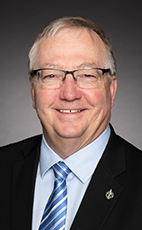
House of Commons photo

Crucial Fact

  • His favourite word was course.

Last in Parliament April 2025, as Conservative MP for Red Deer—Mountain View (Alberta)

Won his last election, in 2021, with 64% of the vote.

Statements in the House

Business of Supply October 27th, 2016

Mr. Speaker, that is what we have done. There are changes and situations that need to now come into play. Whether or not it was completed in the way it should have been, this is something we need to continue looking at.

It is interesting that today the Liberals speak about all the things they are going to do. The government ends up being constantly pushed into action, as on the Yazidi genocide that we looked at, and even on the Liberal private members' bills we dealt with last night, the review of aboriginal youth welfare, and the special envoy. These were in reaction to the good work presented here on Yazidis and the good work being presented by the NDP today about Jordan's principle.

The Liberals are reactive. There were things done on Jordan's principle, and we were proud to be part of that.

Business of Supply October 27th, 2016

Mr. Speaker, at the outset, I would like to let everyone know that I will be sharing my time with the member for Fort McMurray—Cold Lake.

Mr. Speaker, about 40 years ago, I had the opportunity to go to Saddle Lake. I was there for the centennial commemoration of the signing of Treaty No. 6. I took a memento from there, which I kept in my classroom for the 32 years I was teaching, and it has been in my office, as well.

It is the saying “as long as the sun shines, the rivers flow and the grass grows”. It is so critical and it is also the main reason I have the commitment I do to our aboriginal communities.

In the city of Red Deer and in Mountain View and Red Deer counties we do not have a reserve, but we do have friendship centres. We have some great people who make sure that these friendship centres are able to give some security and some information to our community, and of course, we have great elders who work with us to help the children.

I was on the Standing Committee for Aboriginal Affairs and Northern Development. I had the opportunity to travel with our committee to northern Canada and to be in each of the territories to talk to the people, who feel that there are severe barriers to development.

Part of it has to do with the way funding can come in, but a lot of it has to do with how they are managing to keep their people together and are helping those who are in serious condition.

As a teacher, when our government came in with the first nations education act, I asked if I could come back on the aboriginal affairs committee so that we could see it through and see all the things we knew would help in the education field.

I was saddened to see that fail, but I am also saddened by the treatment of children on reserve.

One of the other things I did when I first was engaged with aboriginal affairs was read a book called Dances with Dependency by Calvin Helin. He offered strategies to eliminate welfare dependency and to help eradicate poverty among our indigenous population. He reframed the prevailing impoverishment and despair directly as a dependence mindset forged by welfare economics and advocated a return of native peoples' 10,000-year tradition of self-reliance based on personal responsibility and cultural awareness.

There are many examples of native groups that are trying to follow this path. Although that might be a great goal to strive for, it does not mean that it is a reality, nor is it likely to be obtained in the near future.

That is why this particular motion is so important. I want to thank the member from Timmins—James Bay for presenting it today.

The first part of the motion speaks to investing $155 million in new funding for the delivery of child welfare and looking ahead to have adequate funding in the future.

We have heard in our discussion today that it was not that difficult for the Liberals to spend $4.3 billion outside of Canada, but they could not find $155 million for Canada's most vulnerable children. Some of the reasons that have been given have to do with the Liberals' commitment and their failure to deliver.

The Conservative government ended the boil water advisories on reserves and were looking at ways to improve it. The Liberals committed $360 million a year, whereas our Conservative government had been averaging $400 million a year previously.

With respect to funding for mental wellness on reserves, the Liberal commitment was $271 million, whereas we had been providing $300 million for that same commitment.

With respect to a broken education system, the Liberals committed to $2.6 billion over five years, with no plan to fix the current system. We looked at equivalent dollars but with a plan that was designed by and for first nation communities. There were minimum standards for education certification, core curriculum, and graduation requirements. This is such a critical part of helping communities, especially when we look at the situations that occur as students move in and out of school into difficulties they may have and as they are involved with the welfare system.

I knew Jean Crowder very well and enjoyed being on the aboriginal affairs committee with her. Bringing in Jordan's principle was so very important at the time, and it is important that we continue to recognize its significance. It aims to make sure that first nations children can access public services ordinarily available to other Canadian children without experiencing the service denials, delays, or disruptions related to their first nation status.

The payment disputes between federal and provincial governments over services for first nations children are not uncommon. What is important is that we need care first. We can worry about jurisdiction later.

It includes all the services. It includes services in education, health, child care, recreation, culture, and language. Jordan's principle calls on the government of first contact to pay for the services and to seek reimbursement later so that a child does not get tragically caught in the middle of government red tape, as was the case with Jordan.

On January 26, 2016, the Canadian Human Rights Tribunal ordered the federal government to immediately stop applying a limited and discriminatory definition of Jordan's principle and to immediately take measures to implement the full meaning and scope of the principle. That is what we are hoping for today.

It is a case of complying with the orders made by the Canadian Human Rights Tribunal and stopping the practice of fighting indigenous families in court who are seeking access to services covered by the federal government. Certainly that money would be better spent giving services than paying legal costs.

The final point in the motion is a discussion of the Human Rights Tribunal. It found that the federal government's funding model and management of first nations child and family services resulted in denials of service and created various adverse impacts for many first nations children and families living on reserve.

The decision also says that the government must cease this discriminatory practice and take measures to redress and prevent it. It calls for a redesign of the child welfare system and its funding model, urging the use of experts to ensure that first nations are given culturally appropriate services.

In the discussions we have heard today, that has been one of the questions. How are we going to redefine this, and what are we going to do to redesign the child welfare system? We know what the situation is right now, and we recognize the need to act immediately.

Many times, on the aboriginal affairs committee, Cindy Blackstock would come and speak about issues and concerns. This is an opportunity for us to take that one step further.

The final part of the motion is to make public all pertinent documents related to the overhaul of child welfare and the implementation of Jordan's principle. It is important that we all look at this and realize that it is a point of accountability as well. We are talking about putting more money into a system. We have all looked at transparency and at ways in which this can be done properly. This is a great opportunity for us to bring those two things together. Having the dollars that are sent spent in the proper manner is what we should all be striving for.

We can do better as a government. First nations people want to do better for their children. They want to return to their 10,000-year tradition of self-reliance, so let us work together to make this happen.

Business of Supply October 20th, 2016

Mr. Speaker, that is important. Even in the case of the Syrian refugees, it was very difficult. The school system was not ready and had to make many changes.

We should start by looking at private sponsors. Many of them put their hearts out, and are looking for opportunities to assist. They understand the need to bring in refugees, and are looking to help those who have been hurt the worst in some of these situations.

It is true that it is difficult for people to leave their homes, but to suggest that it is any different for the Yazidi women and girls to find a place of refuge than it would be for any other refugee perhaps goes beyond the point that needs to be made.

We have the good hearts of Canadians, and they will make sure it gets done.

Business of Supply October 20th, 2016

Mr. Speaker, I thank my colleague from Mégantic—L'Érable for his very relevant question.

As a former school teacher, I am very concerned about the issues surrounding young people as they try to get a basis for where they are going in the future. When we see those individuals who have been tormented and have gone through terrible stress, opportunities for them are something we should be extremely concerned about.

There has been discussion over the last number of hours about how Syrian refugees are being looked after. I know that in so many ways it has been left to the school system to help coordinate and provide training, but it is even more important when we think about the terrible atrocities that have taken place against women and girls who have come from such a difficult place.

I know that if we work together, we will find ways to assist.

Business of Supply October 20th, 2016

Mr. Speaker, to start, I would like to mention that I will be sharing my time with the member for Kitchener—Conestoga.

It is an honour to speak to today's opposition day motion on the plight of the Yazidi people. I would like to start by reflecting on how Canadians have helped the oppressed around the world.

A good friend of mine worked with an NGO in Afghanistan for decades. Her role with this NGO was to help widowed women and their families, especially young girls, and teach them how to run businesses and look after their families as they survived war-torn Afghanistan.

When the Taliban took over, she was forced to leave and ended up working with displaced Afghan women and children in Pakistan. It was the world's military effort to go after the Taliban, including Canada's great sacrifice of our own men and women in our Armed Forces, that made it possible for her to return to Afghanistan and restart her courageous work. This has also helped return millions of young girls to school and to the beginning of a normal life.

I say this for three reasons. First is the need to recognize the need for a military presence in conflict areas. Second, humanitarian aid provided by Canadians is crucial. Third, people with big hearts make a difference. That passion, that commitment, that dedication is something we can show the Yazidi people with our words and our deeds as we debate this motion.

Today's motion dealt initially with five critical elements. It has since been amended.

First is that we recognize that ISIS is committing genocide against the Yazidi people. I know that when this discussion was first presented, the government was reluctant to use the term “genocide”, but I welcome its acceptance of the horrors and systemic crimes against humanity.

The June 15, 2016, United Nations Human Rights Council report, “They Came to Destroy: ISIS Crimes Against the Yazidis”, made clear what we have been saying, which is that the Yazidis are victims of genocide, and it spoke of recommendations for the international community to embrace.

Second is acknowledging that many Yazidi women and girls are still being held captive as sexual slaves. As Canadians, and I am thinking specifically of our former colleague, Joy Smith, we have been champions in the fight against human trafficking, but the atrocities being perpetrated in an evil and systemic way upon Yazidi women and girls has taken this to the cruellest level of slavery and physical and sexual abuse.

To quote Nazand Begikhani, “These women have been treated like cattle. They have been subjected to physical and sexual violence, including systemic rape and sex slavery. They've been exposed in markets in Mosul and in Raqqa, Syria, carrying price tags”.

Dr. Widad Akreyi confirmed that ISIL uses slavery and rape as weapons of war.

The third point speaks about how urgent it is to have the government act. At the end of June, just two weeks after the UN Human Rights Council report, I, along with colleagues in the House, were part of the Organization for Security and Cooperation in Europe Parliamentary Assembly, the OSCE, in Tbilisi, Georgia. Canada and the U.S. play a vital role in that organization, and I was honoured to speak at the OSCE on behalf of Canada about our action on human trafficking. We also heard about the treatment of ethnic and religious minorities, the plight of migrants, and those who have been stuck in refugee camps, many for years and years, and how that was a grave concern.

In other areas, the organization Defend International reached out to Yazidi refugees in Iraqi Kurdistan, in December 2014, to provide humanitarian aid. In September 2014, Defend International launched a worldwide campaign, entitled “Save The Yazidis: The World Has To Act Now”, designed to raise awareness of the tragedy of the Yazidis in Sinjar and to coordinate activities to intensify efforts amid the rescuing of Yazidi and Christian women and girls captured by ISIL, and we should do no less.

The next part had us supporting recommendations found in the June 15, 2016 report issued by the United Nations Commission of Inquiry on Syria entitled “They Came to Destroy: ISIS Crimes Against the Yazidis”.

To this end, there is an additional concern that Yazidis face. Some Yazidis struggle to obtain adequate protection because they are internally displaced, rather than being refugees under the United Nations definition. They do not have the resources to reach another country, and also have difficulty obtaining passports and other official documentation.

These points, in their own right, speak to the urgency of this crisis, and underline the need for the final part of the motion, that the government be called upon to take immediate action upon all of the recommendations found in sections 210, 212, and 213 of the report, and do so with great haste using its full authority to provide asylum to Yazidi women and girls within the next 30 days. We have amended this to 120 days.

It is important that we look at what those options are. In section 210, the commission recommends that parties fighting against ISIS in Syria and Iraq strongly consider rescue plans that are required for targeting the Yazidi captives. Second, that they ensure coordination between local and international armed forces where military operations target ISIS controlled regions where Yazidi captives are held. Third, that they use all means available to ensure Yazidis held captive by ISIS in Syria are rescued during on-going military operations, and that we put in place a protocol for the care and treatment of Yazidis rescued as areas are seized from ISIS. This is the military aspect of what is required.

Section 212 speaks of the definition of genocide, the humanitarian assistance, and of course, the support that is important as we discuss the international community. First, recognizing ISIS's commission of the crime of genocide against the Yazidis in Sinjar. Second, for those states that are contracting parties to the genocide convention, to engage with article 8 of the convention and call upon the competent organs of the United Nations, including the Security Council, to take such action under the charter of the United Nations to prevent and suppress acts of genocide. Third, that they provide expertise on request to assist in the preservation and documentation of mass grave sites.

Going further, and looking after the needs of individuals, it is required that they put funding in for psychosocial support programs with increased emphasis on trauma therapy for children, noting that Yazidi children suffered different violations depending on their sex. It requested funding and expertise to support the training of psychologists and social workers in Iraq and Syria.

The commission also recommends that organizations involved in the care of internally displaced Yazidi build and provide skill training programs aimed at allowing Yazidi women greater financial and social independence.

Section 213 deals with integration and safety, where the commission recommends that states and organizations involved in the care of Yazidi refugees and asylum seekers ensure that Yazidi victims of genocide, including but not limited to sexual violence, are identified, and treated as a vulnerable group for the purposes of housing, psychosocial support, and with regard to the asylum process.

As we look at the needs of the Yazidi people, it is so important that we look at things that we can do. I have outlined the three parts of the UN report, but can we expedite the asylum claims of the Yazidi people to Canada?

Will we treat the declaration of genocide as an immediate call to action for Canada, in which a whole-of-government approach to humanitarian aid, military intervention, and resettlement would be acted upon?

Will we act upon the June 2016 UN recommendations to accelerate the asylum claims of the Yazidi victims of genocide?

Will we review the selection process used by the UN to identify refugees for the government sponsored refugee stream?

Will we examine the need to restore the exemption for Syrian and Iraqi refugees from the mission cap under the privately sponsored refugee program in order to fully harness the generosity of Canadian private sponsors?

I am thankful for the opportunity to speak on this very important issue.

National Strategy for Safe Disposal of Lamps Containing Mercury Act October 7th, 2016

Mr. Speaker, I am pleased to rise today to speak to Bill C-238, an act respecting the development of a national strategy for the safe disposal of lamps containing mercury, put forward by the member for Dartmouth—Cole Harbour.

I was pleased to listen to the member for Hull—Aylmer, and I have had a chance to speak him on numerous occasions. He did bring back a few of the things that I remember when these light bulbs first started coming into discussion, and how we would have young children trying to sell these to their parents in a fundraiser so we could save the environment.

Of course, there are some unintended consequences that happen, and this is certainly one of those. We recognize what the base metal included in this can actually do. We have so many other issues with rare earth metals that are needed, for batteries, for windmills, and for solar devices. Again, there are unintended consequences, but we have to make sure we understand what all of that will do.

I am glad that the member has put forward a bill that builds on our previous Conservative government's actions to control mercury in our environment. I would also acknowledge my colleague from Abbotsford and the official opposition critic for the environment and climate change for his work on environmental issues. Bill C-238 would provide the opportunity for the House to work in a bipartisan manner, to not only pass the legislation but to kick-start the process of raising awareness and educating Canadians on the safe disposal of light bulbs containing mercury.

Most Canadians are aware of the dangers of not having a proper disposal procedure for the highly toxic substances like mercury. In 2010, our Conservative government put forth a strategy for proper mercury disposal, and, in 2013, we negotiated the Minamata Convention on Mercury, an international convention that essentially calls for tough measures to reduce mercury emissions.

Supporting Bill C-238 is in line with our previous Conservative government's approach to controlling toxic substances that pose a risk to human health. This same approach made me proud to stand with my colleagues when our previous government passed the Canada Consumer Product Safety Act, in 2010, banning the use of bisphenol A in baby bottles. I want to stress the importance of all such initiatives.

In the bill, we discuss the effects of mercury, which has the ability, as was mentioned, to be spread between water, air, and soil. Contaminations can have a catastrophic impact on our environment, and the health of all Canadians. We know that mercury is toxic and that it is related to various health problems, including birth defects, rashes, and even death. Even in lower quantities, when mercury is accumulated, it creates a significant risk to our most vulnerable.

Products containing mercury are in our landfills. We know that through this disposal method, mercury has the potential to leak into our soils and water sources. Most Canadians would agree that it is something that must be dealt with.

We, as parliamentarians, have a duty to make sure that our work also creates the right circumstances for us to protect our environment for future generations and ensure a sustainable and prosperous future for our children and grandchildren.

The bill calls for the environment minister to develop and implement a plan or proposal for the safe disposal of lamps containing mercury. I know that the people in my constituency of Red Deer—Mountain View, and all Canadians, will welcome our efforts to minimize the presence of mercury in our immediate environment and put a stop to the negative health risks that come along with it.

Bill C-238 contains three essential elements: the establishment of national standards for the safe disposal of mercury-containing lamps, the establishment of guidelines regarding facilities for safe disposal, and the creation of a plan to promote public awareness of the importance of those lamps being disposed of safely.

The bill also requires that the strategy be tabled in Parliament within two years of royal assent, and that a review and evaluation of that strategy takes place every five years afterwards. The Liberal government can implement, through regulation and policy, and by working with provincial counterparts, the three elements proposed in Bill C-238 at any time. There is a way to make things more efficient, but with a Liberal government in place, Canadians would not be surprised with delays and unnecessary costs being the result of its actions.

My colleague from Abbotsford has looked at a few similar pieces of legislation to this one that have already been presented in the House. Two such red-tape legislative instruments have been put forward. First, Motion No. 45 required that all infrastructure projects at the municipal level over $500 million in value would have to go through a full climate change impact analysis to determine what the upstream and downstream greenhouse gas emission implications would be of those projects. Second, Bill C-227 would place a requirement on contractors for projects within the federal realm.

The member who has brought forward Bill C-227 suggests that projects at the municipal level originally chosen because they meet the current need of municipalities and provinces would henceforth primarily be selected through a lens of their climate change implications. This would impose additional costs on our local governments and additional red tape and delays. For example, if a building contractor wanted to bid on a federal building project, the contractor would have to go through a community benefit analysis, adding additional costs and more red tape for projects because that would have to be built into the bid price. On top of that, it would complicate the federal bidding process by adding more red tape to the process, when in fact these projects should be bid-based on best value for taxpayer dollars or, in other words, best value for the best price.

In a way, I am somewhat skeptical about Bill C-238. Would it be another example of the Liberals overreaching and ultimately adding additional costs to taxpayers? As much as the motives behind these initiatives are commendable, they are duplicative and would pose additional regulatory burdens on Canadians. That is my fear with this and with most any Liberal strategy.

The member could have moved forward by simply asking the government to enact the necessary regulations through robust consultation with the provinces and municipalities to provide the appropriate recycling and disposal policies across the country. For whatever reason, the member did not do that. We can deal with dangerous toxic waste like mercury now. That essential task is something the government can do now even without this bill. The Liberal government can move forward right now with regulations that set the standards and guidelines for safe disposal of these lamps. The government has the ability to make the public aware of these standards and guidelines.

Our caveat about the bill is the fear that it would lead to the Liberals actually calling for a national strategy, which would take far too long to conclude and create additional initiatives that would come with higher costs, higher taxes, and more red tape. There are many provincial jurisdictions that have programs in place, and by simply working with them we can achieve great results without adding any unnecessary hoops.

When it comes to important issues like emissions targets, research and development investments, infrastructure, and increases in health care funding, the Liberals are quite content to use evidence-based policies from the former Conservative government. While we expect them to refresh these initiatives with some Liberal red paint, unfortunately the overall Liberal program also comes with a massive amount of red ink for future generations.

In this case, making sure that mercury-containing lamps are safely disposed of is something that everyone should support. We should also do the right thing and make sure that our proposed solutions are efficient and, most importantly, effective.

I support taking this to committee in the hope that it will establish national standards for the safe disposal of mercury-containing lamps, guidelines regarding facilities for safe disposal, and create a plan to promote public awareness of the importance of such lamps being disposed of safely. I look forward to a process that will be cost efficient and does not impose an additional undue tax burden on Canadian taxpayers, nor add additional red tape that would tie up businesses, provinces, and municipalities.

Petitions October 7th, 2016

Mr. Speaker, I rise today to present two petitions on behalf of Canadians regarding impaired driving causing death.

Families for Justice is a group of Canadians who have had a loved one killed by an impaired driver. They believe that Canada's impaired driving laws are much too lenient, and want the crime to be called what it is, “vehicular homicide”.

Canadians are calling on the Government of Canada for mandatory sentencing for vehicular homicide, and for this Parliament to support Bill C-226, the impaired driving act.

Petitions October 6th, 2016

Mr. Speaker, I rise today to present two petitions on behalf of Canadians regarding impaired driving causing death. Families for Justice is a group of Canadians who have had a loved one killed by an impaired driver. They believe that Canada's impaired driving laws are much too lenient and want the crime to be called what it is, vehicular homicide. Canadians are calling for mandatory sentencing for vehicular homicide and for Parliament to support Bill C-226, the impaired driving act.

Questions Passed as Orders for Returns September 19th, 2016

With regard to inspections conducted by the Canadian Food Inspection Agency: (a) what is the total number of inspections conducted since November 4, 2015, broken down by province; (b) of the inspections in (a), how many revealed (i) listeria, (ii) E. coli, (iii) salmonella; and (c) of the inspections in (b), how many led to recalls?

Questions Passed as Orders for Returns September 19th, 2016

With regard to contracts under $10 000 that have been approved by the Minister of Democratic Institutions or her officials, what are the details of these contracts, broken down by contract?