
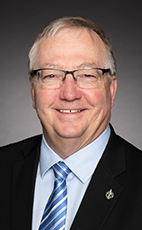
House of Commons photo

Crucial Fact

  • His favourite word was course.

Last in Parliament April 2025, as Conservative MP for Red Deer—Mountain View (Alberta)

Won his last election, in 2021, with 64% of the vote.

Statements in the House

Marlin Styner March 5th, 2014

Mr. Speaker, it is with a heavy heart that I rise to inform this House of the passing of a truly incredible individual and a personal friend, Marlin Styner.

In 1981, at the age of 18, Marlin became a quadriplegic when the vehicle he was riding in struck a cow. Marlin became a leader in our community with his message that success is not determined by physical strength or appearance but rather by our attitude and the boundaries we set for ourselves in our own minds. This attitude opened doors for Marlin and for other disabled people throughout our province.

The business administration diploma he received at RDC was the start of an incredible journey that proved his point about boundaries. He received the mayor's special recognition award for humanitarianism and held the position as chair of the Alberta Premier's Council on the Status of Persons with Disabilities.

On behalf of my family and colleagues in this House, particularly the member for Charleswood—St. James—Assiniboia, I extend our deepest sympathies to Marlin's wife Diane and those loved ones who have always surrounded them both.

The Budget February 13th, 2014

Mr. Speaker, Canada has one of the safest and healthiest food systems in the world, and our government has a strong record of action on this file. As we study budget 2014, we can readily recognize the absurdity of the Liberal leader's statement that the budget will balance itself, so with responsible budgeting in mind, could the Minister of Health please update the House on our government's latest investments in food safety?

Petitions February 7th, 2014

Mr. Speaker, I have a second petition. It calls for the creation of a legislated ombudsman mechanism for responsible mining.

Petitions February 7th, 2014

Mr. Speaker, it is my pleasure to rise today to present a petition on behalf of constituents and Canadians from Alberta regarding impaired driving causing death. These citizens want to see tougher laws and the implementation of new mandatory minimum sentences for those persons convicted of impaired driving causing death.

Agriculture and Agri-food February 7th, 2014

Mr. Speaker, Canadian grain farmers had a record harvest this past year. This bumper crop is testing our supply chain, as producers are depending on the railways to efficiently move the crops to market.

This week, grain farmers faced the threat of a CN Rail strike. I understand that there is now a tentative agreement with the Teamsters. What concerns me is that while Conservative members were standing in the House defending farmers, an NDP member attacked the government for doing so.

Could the Parliamentary Secretary please tell the House how our government is continuing to put hard-working Canadian farmers first?

Winter Olympic Games February 7th, 2014

Mr. Speaker, I am pleased to rise today to recognize some extraordinary individuals from my great riding of Red Deer.

On February 15, I will have the pleasure to celebrate the 100th birthday of Bill Wagstaff from Elnora. He has always been active and involved in our community and a great supporter of young people. Along with his family and friends, I look forward to celebrating his remarkable life.

Bill will be cheering alongside other central Albertans as we celebrate our local athletes at the XXII Olympic Winter Games. Zina Kocher will once again be competing in biathlon for Canada. We are also cheering for speed skater Danielle Wotherspoon-Gregg; Matthew Rowley, also from Red Deer; and Atsuko Tanaka, from Calgary. Both train in Red Deer as ski jumpers. We will once again be cheering for Lyndon Rush, who is back on the bobsled for Canada after winning a medal in Vancouver, along with Mellisa Hollingsworth, who is competing in her third Olympics in skeleton.

Central Albertans are proud of these athletes, and we wish all of them the best of luck in Sochi.

Grain Transport February 5th, 2014

Mr. Speaker, one of the most important aspects of this is recognizing that the rail system has to match the amount of grain that can work its way through the system. The purchasing of it at the grain elevators, the transfer of it to the ports with the trains, and then getting it on to the ships and moving it is something that has to happen. Our government, in discussions with all of the stakeholders, is looking for ways in which that can occur.

As I mentioned earlier today in my speech, we can be assured that when we speak about this to the stakeholders, and I am hopeful we will do that soon, we will be getting answers from people other than politicians, and we will be finding the situations that occur and the important things that are required.

To go back to one of the questions, I know that people were talking about car allocations. It is important to understand that the Canadian Wheat Board never allocated cars. It is the Canadian Grain Commission that allocates those cars, and it is the commercial deals that occur between the grain companies and the railway that are now actually allocating those cars.

Grain Transport February 5th, 2014

Mr. Speaker, the Canadian Wheat Board is still there, and it is still working. I talked to members in December who were putting into the pool and buying grain at that point. They were making that decision. We can take a look at the types of things that are going to happen. If they decide that they have the transportation opportunities, then they will build new pools and go from there.

To suggest that there is no Canadian Wheat Board is not true. Farmers were asking for a choice, and the Canadian wheat pool is one of those options.

This is the kind of thing that we have to look at. We have to realize that when people say there is no Canadian Wheat Board, it is all because of that, and that is not true.

Grain Transport February 5th, 2014

Mr. Speaker, people have to recognize that a couple of things have happened. We are 3% above the five-year average with respect to the amount of grain that has been delivered already. We are 5% below last year, and that is an issue.

When we are looking at situations like that, we then have to look at why we are having this problem. Cold temperatures do matter. As I mentioned earlier in my speech, there is a reason that we do not take our grain to the elevators when it is -40. We do not want to be taking our trucks through that. We do not want to have to worry about that. We do not want to be standing at the elevators in that kind of situation, and that is happening at this particular point in time.

I am not excusing the rail companies, but if they have to move from 130 cars to 107 cars because of the temperature and conditions, then we have to recognize that is where the problem is at this point. The rest of it is a case of trying to make sure we have the right rail allocation for the grains we have.

Grain Transport February 5th, 2014

Mr. Speaker, one of the things we can talk about is where the bases are. The amount that makes up those bases would come through elevation, inspection, cleaning, storage. These are the amounts that make up the particular chunk that is taken off. If there is no transportation, that gets larger because we are dealing with the storage aspect of it. In situations where people want the grain, that is where we would be looking at negative bases or trucking incentives that are also going to be included in that. We have to recognize that is what is taking place and that the prices are there if we are selling. That is why we have to take a look at some of the options that are available.

There is always the discussion that it happened because of the Canadian Wheat Board, which has nothing to do with it. It happens to have the same information as the canola commission, which is managing it now. All it needs is to have that information available, and it is there for them.

People have to recognize the other aspect of it, as well, which is that the government will be there. The concern, and I heard this earlier today, is that the farmer is going to owe all of this. It is part of the equity that the farmer has in that crop. That is what we have to look at and what people should be looking at when making these marketing decisions. If we sell at the bottom, we are going to be under the system and it is going to cause a problem. We have to look after—